Here is the early 20th century’s royal family of acting, the Barrymore’s, Lionel, Ethel and John.
Each a star in their own right, first on the stage and later in films. Yet the trio only appeared in one movie together, Rasputin and the Empress (1932).
The Clan Barrymore
When John, Ethel and Lionel Barrymore came together to play in M-G-M’s “Rasputin”, it made possible the first reunion of the entire family. Above photo shows the Barrymore reunion in Hollywood. Left to right- front row: Mrs. Lionel Barrymore (Irene Fenwick), holding John Blythe, son of John Barrymore; Lionel Barrymore, Ethel Barrymore, Mrs. John Barrymore (Dolores Costello) with Ethel Dolores Barrymore, her daughter; and Ethel Barrymore Colt, daughter of Ethel Barrymore. In rear are left to right: John Barrymore Colt (left) and his brother, Samuel Colt, with John Barrymore standing between the two. credit: Acme 9/20/32
This photograph was taken at John Barrymore’s home in early September 1932.
Interestingly before this film, the three actors had never even appeared together in the same play.
Rasputinand the Empress as the film was re-titled, marked Ethel Barrymore’s (1879-1959) first talking film. Her stage popularity was such that she wouldn’t appear in another film until 1944 (None But The Lonely Heart). After 1944 Ethel would appear regularly in motion pictures, making 20 more movies until her retirement in 1957.
After MGM signed Ethel Barrymore to appear in Rasputin, brother Lionel Barrymore (1878-1954) was asked to comment and said, “Great! And tell me what poor benighted and unlucky individual is to direct this opus in which all three of us are to act together?” Continue reading →
Maude Fealy “The Most Beautiful Woman In the World” In An Atypical Pose
One of the most read stories we have done was about Maude Fealy the stage star and film actress who had a career that spanned the first half of the 20th century.
Given the lack of fact based information available on the internet about Fealy we’ve provided another short page devoted to this forgotten star.
This unusual photograph entitled The Coiffure no. 3 captures Maude Fealy in a very flattering pose.
The Coiffure no. 3 was taken by Rudolf Eickemeyer. If there were other photographs from this sitting indicated by the fact that this is called number three, I have not come across any of them.
In 1903 the Figaro Illustre of Paris held a contest and offered a prize for the woman who represented the “perfect type of beautiful womanhood.” Photographer Burr McIntosh submitted a photograph he had taken of Maude Fealy. A committee of experts pored over 30,000 entries and decided Maude Fealy was the most beautiful woman in the world. Burr McIntosh won the prize for submitting the photo. Fealy wound up with the accolades.
Besides being a famous photographer, Burr McIntosh was the publisher of a popular magazine in the early part of the 20th century, mostly featuring theatrical stars. In February 1904 Maude Fealy graced the Valentine Number of The Burr McIntosh Monthly. The illustration above was drawn by Clark Hobart in 1903.
When we first wrote about Maude Fealy there was uncertainty as to her exact date and year of birth. That has yet to be resolved, though we can now narrow Maude’s birth year to prior to 1884. Maude’s papers housed in the Denver Public Library give a likely birth date of March 3, 1881.
Through diligent research we have established two previous unknown facts regarding Maude’s domineering actress-mother Margaret: the date of her marriage and divorce to Maude’s father. Continue reading →
If They Had, It Probably Wouldn’t Have Sounded As Good As Randy Jackson Of Zebra’s Acoustic Solo Version
Led Zeppelin never got to perform Carouselambra live. It’s a ten minute thirty four second synthesizer driven opus.
This version of Carouselambra performed by Zebra’s Randy Jackson is absolutely spectacular.
Carouselambra is one of the radio’s least played Led Zeppelin songs. Maybe it is because of the length of the song or maybe it is the mix which is not up to the usual Led Zeppelin standards. Whatever the reason, besides its enigmatic and haunting lyrics, Carouselambra has some very strong points.
Randy Jackson (lead singer and guitarist of Zebra) not only does the song justice, but turns in an amazing solo performance. Remember, this song was originally recorded with swirling keyboards, guitars, bass and drums. (At end of our story is the original Zeppelin recording.)
The Story of Carouselambra
After the sudden death of Robert Plant’s five-year-old son Karac from a virus in 1977, touring came to an immediate halt and the band went on hiatus. Robert Plant distanced himself from his band mates.
After a long period of self-introspection, Plant decided he was ready to make music again. In December 1978, Led Zeppelin convened to make their final studio album, In Through The Out Door. Three weeks of recording time in Stockholm’s Polar Studios, owned by members of ABBA, were mainly consumed by bassist John Paul Jones and singer Robert Plant. The pair, who had never been the closest of friends, spent a lot of time together and ended up writing almost all of the music and lyrics for the album.
John Paul Jones told Zeppelin biographer Barney Hoskyns, “The band was splitting between people who could turn up at recording sessions on time and people who couldn’t,” Continue reading →
Chico Marx Entertaining The Troops During World War II
U.S. Naval Air Station, Wold-Chamberlain Airport, Minneapolis, MN: Chico Marx was flying high back stage in the Orpheum Theater when three Aviation Cadets and one WAVE from the U.S. Naval Air Station called on him to make arrangements for his appearance at the Station Recreation Hall. Chico is bringing his entire show to the Air Station Tuesday to entertain the Naval Personnel. The Cadets are Lowell H. Conrow, Richard W. Hildebrand and Donald D. Bosold. The WAVE is Ensign Mary J. Withrow, USNR. Photo: U.S. Navy
When author Charlotte Chandler wrote her entertaining book about Groucho Marx, Hello I Must Be Going (Doubleday, 1978), it was mentioned by Groucho’s friends that someone should write or compile a book about Groucho’s eldest brother, Chico Marx.
Eventually a book was written about Chico by his daughter Maxine Marx. As interesting as that book is, it was not the sort of book that captured Chico’s flamboyant and incredible life.
Maxine had left out a good deal of the salacious parts of her father’s life by purposeful omission. Many other anecdotes were left out of her book simply because Maxine was unaware of them. There were hundreds of great stories known and shared only by show business veterans and insiders who Chico associated with, that went untold. Now those stories are lost forever, as all of Chico’s friends, contemporaries and acquaintances are long dead.
What is widely known is that Chico was a notorious womanizer and gambler who went through money as quickly as he made it or borrowed it.
Groucho famously said, “You know, somebody asked Chico how much money he lost gambling, and he said, ‘Find out how much money Harpo has. That’s how much money I lost.'”
The brothers had to bail Chico out countless times. There were even a couple of instances where had they not paid Chico’s debts, the gamblers he owed money to would have killed him.
Harpo wrote in Harpo Speaks! (Bernard Geis Associates, 1961) of his older brother when they were both teenagers, “Chico was a devout believer in the maxim, ‘Share and share alike.’ The way he shared my possessions was to hock them as fast as he got his hands on them, and then give the pawn tickets to me as my share.” Continue reading →
Aaron Boone Apparently Has A New Nickname for Every Yankee & It Ends With a “Y”
One of the worst innovations in baseball telecasts has been the managers interview in the dugout during the game.
Without fail the meaningless banter yields no insight and distracts viewers from the game itself.
Listening to new Yankee manager Aaron Boone during spring training, has been especially annoying. In about eight interviews I’ve heard with Skipper Boone, nearly every Yankee has been renamed by placing a “Y” sound at the end of their first or last name. Not being in the Yankees clubhouse I cannot be certain that the Yankees don”t rechristen themselves as Boone has done, but I somehow doubt it.
So during the MLB, YES or ESPN broadcast interviews this spring, Boone sounds more like a schoolboy, than a major league manager.
When Boone is referring to Aaron Judge, he is “Judgey.” Brett Gardner has become “Gardy.” Aroldis Chapman is “Chappy.” Greg Bird is “Birdy.” Aaron Hicks has become “Hicksy.” Chad Green is “Greeny.”
Jordan Montgomery is now the British expeditionary leader of WWII, “Monty.” Like our 40th president Ronald Torryes is “Ronnie.” Chasen Shreve is “Shrevey” which sounds like something akin to a short pervert. Jacoby Ellsbury who could have remained Jacoby or Ellsbury, is not a cow, but must represent Borden milk, as he has become “Elsie.”. Continue reading →
Clara Bow The “It” Girl Made Only One Film In Color, and This One Minute Fragment Is All That That Survives
(And What Exactly is “It”)
Most movie fans never saw Clara Bow’s beautiful red hair except when illustrated on magazine covers. All but one of her films was made in black and white. Her red hair and Brooklyn childhood earned her, her original nickname “The Brooklyn Bonfire.”
So seeing the primitive color film clip below is a pleasant treat for classic movie fans.
With the exception of one film, Red Hair” which is now considered lost, this one minute fragment is all that survives of Clara Bow filmed in color.
If the last minute of Red Hair could be found we would see Clara Bow in as little clothing as the censors would allow.
So what exactly is “It”? Writer Elinor Glin wrote a magazine article called “It.” and a movie soon followed in 1927 starring Clara Bow. The sobriquet The “It Girl” was immediately and permanently attached to Clara Bow.
“Either you have “It” or you don’t have” It.” “It” is sex appeal definitely, but much more than that.
In a 1927 interview, writer Glyn said you must have ALL of the following qualities: Continue reading →
Sweet – The 1970s Band That Should Have Been As Big As Anyone. They Released Their Final Hit In January 1978 – Love Is Like Oxygen
A Story of Sweet Success And Missed Opportunities
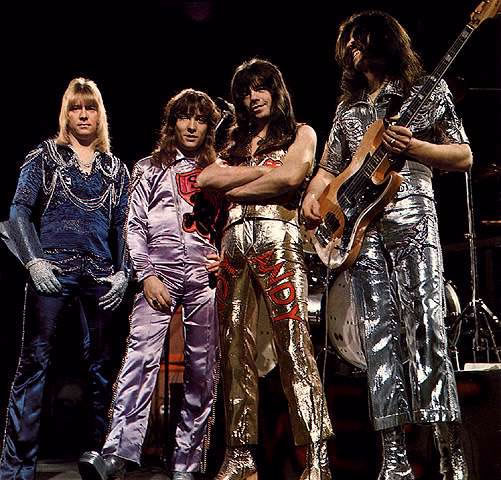
Sweet in their glam band outfits circa 1973. From l-r Brian Connolly, Steve Priest, Andy Scott and drummer Mick Tucker holding guitar.
If you were to name a rock band that should have had long-lasting, international success and made a major musical impact but didn’t, one of the top contenders would have to be Sweet.
In the pantheon of great rock bands, Sweet has been forgotten.
There are many reasons for this amnesiac neglect. Possibly the reasons add up like this: a series of bad breaks; not being taken seriously by a dismissive, indifferent critical press; an insufficient amount of American touring and radio exposure; and unsure musical direction. But certainly not because of a lack of producing great rock music.
This year marks the 40th anniversary of Sweet’s final hit Love Is Like Oxygen which was released in January 1978. We’ll discuss the song at the end of this article, but here is an abbreviated version from the TV program Top of The Pops.
A very similar band from the same time, Queen, became, a juggernaut, filling arenas and stadiums, having tens of millions of album sales and critical acclaim – all things Sweet seemed destined to achieve, but didn’t.
And if you don’t think Queen was heavily influenced by Sweet, then maybe you should have a listen.
Despite over 35 million album sales and moderate touring success around Europe, Sweet never lived up to their potential. With the exception of a handful of songs, Sweet was rarely played on American radio, hampering whatever breakthrough success they deserved.
Today, younger listeners unfamiliar with Sweet during their heyday, will rarely be able to name the band when they hear them. They recognize the songs, but often mistake the band’s music for that of E.L.O., the Bee Gees, Queen or some other band.
In the 1970s, Sweet, an English glam pop band, morphed into a serious hard rock band with a long list of hits in the United States and England. Originally they recorded songs written by others, primarily their managers and main songwriters Mike Chapman and Nicky Chinn.
But Sweet was more than just a Three Dog Night, Grass Roots or Monkees sort of band. Those bands could barely get by playing an instrument live and never or rarely wrote any of their own songs.
Sweet’s bass player Steve Priest, drummer Mick Tucker, guitarist Andy Scott and lead vocalist Brian Connolly were all accomplished musicians who could write and play their own music and do it damn well.
What made Sweet stand out was their vocal harmonies.
Frequently featured on the weekly British music show Top of the Pops, Sweet would, as the custom was at the time, go on stage and lip synch what they had done on record. Their disdain for lip synching was apparent and they would often make a mockery of their own performances.
Their early “hits,” all written by Chapman and Chinn, were simple but immensely catchy ditties, in the genre known as “bubblegum rock.” Innocent lyrics with just a bit of double entendre intended for a teen audience.
Blockbuster, Wig Wam Bam, Funny Funny, and the American crossover hit Little Willy were just a few of their early chart successes. These were followed by more hits Hell Raiser, No You Don’t, AC-DC, Turn It Down and Sweet’s most famous song The Ballroom Blitz. Continue reading →
Some Highlights Of The Late, Great, “Fast” Eddie Clarke, Guitarist Of Motörhead
The “classic” Motorhead line-up on stage circa 1980 (l-r) Phil Taylor, Eddie Clarke & Lemmy Kilmister photo: Simon Fowler
When “Fast” Eddie Clarke (October 5, 1950 – January 10, 2018), guitarist with Motörhead from 1976-1982 died from pneumonia last week at the age of 67, it closed the book on what many consider Motörhead’s greatest line-up.
In the space of a little over two years, Eddie Clarke, singer-bassist and founder Lemmy Kilmister and drummer Phil “Philthy Animal” Taylor, all died.
The trio put out albums that are considered the high points of Motörhead’s career: Motörhead (1977), Bomber (1979), Overkill (1979), Ace of Spades (1980), No Sleep ’til Hammersmith (Live 1981) and Iron Fist (1982).
After being forced out or leaving Motörhead in 1982 (stories conflict on the departure), “Fast” Eddie formed Fastway with bassist Pete Way of UFO. Continue reading →
William Holden & Veronica Lake in I Wanted Wings (1941) – photo: Paramount Pictures
William Holden – “The best actors I know have no style but that of genuine professionalism. They act each role according to the script. And if they do have a style, it is so much a part of their personality it can’t be noticed.” (Atlanta Constitution April 22, 1956)
If you hear people lament that today’s movie stars don’t stack up to the old stars, there are probably many reasons for the lack of charisma or star power today. Regardless of their approach to acting, the old-time Hollywood stars all had one thing in common: they came through the studio system, where they were trained and “groomed” to be and act like movie stars. How each actor accomplished that varied from actor to actor.
Whatever techniques they used to develop their acting style; “The Method,” “Chekhov,” or simply showing up and knowing your lines, movie stars usually could provide philosophy or insight into their craft when being interviewed by the press. Whether they had honed their skills on the legitimate stage or come straight from a farm, to be a star you had to learn and understand something about acting.
Here are twelve old time movie stars expressing their views, sometimes simply, other times with great insight about acting.
Veronica Lake – “I’m no great actress. I just had a movie job dumped into my lap, the public seemed to like me, and that’s all there was to it.” (Wide World Features May 3, 1942)
Rod Steiger – “Good acting is like good love-making. Leave yourself alone and explore. Do it. Don’t watch yourself do it. Don’t think about yourself doing it. You just go from moment to moment. But don’t take anything for granted either, especially not in acting. That’s when you get your ass kicked.” (Los Angeles Times September 15, 1994)
Yul Bryner – “I’m not of the can-kicking, shovel-carrying, ear-scratching, torn T-shirt school of acting. There are very few real men in the movies these days. Yet being a real man is the most important quality an actor can offer on the screen.” (Detroit Free Press April 27, 1958)
Paul Muni – “Acting is a scientific art. It’s a matter of trial and error. You try out your effects like a man who is experimenting on a new chemical formula. I enjoy the experimenting.” (Boston Globe Feb. 6, 1949)
Barbara Stanwyck on reluctantly accepting the role of the “no good” Phyllis Dietrichson in Double Indemnity – “Once I said yes I was awfully glad. During the making of it Fred (MacMurray) would go to the rushes. I remember once the next day he said, ‘You’re not acting, you’re enjoying it.’ And I remember saying ,’Fred, really, how was I?’ And very candidly he looked at me and said, ‘I don’t know about you- but I was wonderful!’ And that was such a true remark. Actors only look at themselves.” (Los Angeles Times April 5, 1987)
Spencer Tracy – “I’ve always played the same character. Larry Olivier says the way to act is learn your lines and get on with it. I’m Spencer Tracy with some deference to the character. When a person says he’s an actor – he’s a personality. The whole idea is to show your personality. There are people who are much better technically, but who cares? Nobody cares.” (Los Angeles Times November 18, 1962) Continue reading →


 Listening to new Yankee manager Aaron Boone during spring training, has been especially annoying. In about eight interviews I’ve heard with Skipper Boone, nearly every Yankee has been renamed by placing a “Y” sound at the end of their first or last name. Not being in the Yankees clubhouse I cannot be certain that the Yankees don”t rechristen themselves as Boone has done, but I somehow doubt it.