Tag Archives: Broadway

Old New York In Postcards #10 – Restaurants

A Look At Churchill’s and Four Other Restaurants From Old New York

Exterior Churchills Restaurant Broadway 49th St c 1915Churchill’s Restaurant southwest corner 49th Street and Broadway, circa 1915.

Police Sergeant Jim Churchill did not have the background of a typical restauranteur. He put in 20 years on the job policing the streets of New York and was named acting Captain of a precinct in the Bowery for a few months starting in November of 1901. He wound up being dismissed from the force in 1902 for neglect of duty.

It seems that Churchill was not aggressive enough in closing saloons operating illegally on Sunday and shutting down houses of ill-repute under his jurisdiction. From reading the newspaper accounts of his trial, Churchill may have been set up by others in the police department who wanted his ouster.

Churchill, with the help of friends and backers went into business for himself. In May 1903 Churchill ironically opened a saloon at 1420 Broadway between 39th and 40th Streets. The small bar and restaurant prospered and in 1906 he moved north to new digs on Broadway at 46th street to a space which could accommodate up to 350 patrons.

But even that was not enough room for the captain’s friends and clientele. In 1909 Churchill built for himself a spacious, luxurious entertainment and feasting palace at 49th Street that could seat 1,400 diners. Designed by architect Harold M. Baer, the three story terra cotta brick building with stucco ornamentation attracted huge crowds. Even with so much more space, guests frequently would have to wait in line for a table as capacity crowds filled the restaurant.

Employing over 300 people and with an annual advertising budget of $50,000 for a $250,000 business, Churchill’s became world famous and remained a favorite restaurant and cabaret spot for the Broadway crowd throughout the teens.

Churchill’s stayed in business until prohibition cut into profits and forced Jim Churchill to close his doors and lease the space to a Chinese restaurant. The building was demolished in 1937 and the location eventually housed heavyweight champ Jack Dempsey’s Broadway Bar and Grill from 1938 until its closing in 1974.

Churchill went abroad for a number of years after closing his restaurant and upon returning to the states, he commented about the changes that many New York City restaurants had undergone during the 1920’s. To the New York Times he remarked, “Hostesses? There were no such things in my days. No one ever thought of such a thing. It was not permitted that any woman come into a restaurant-cabaret unaccompanied. Instead of hostesses I employed 30 boys, one of them the late Rudolph Valentino, to dance with women who came unescorted for luncheon.”

When Churchill died in 1930 at the age of 67, he left most of his sizable estate, a half million dollars, to his wife.
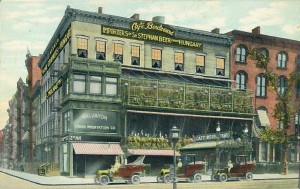
Exterior Cafe Boulevard Restarant 156 2nd ave at 10th st 1911The Cafe Boulevard 156 Second Ave southeast corner of 10th Street, circa 1909. Continue reading

Lois DeFee Bouncer At The Dizzy Club, New York City 1936

Don’t Mess With The Lady

woman bouncer Lois DeFee 1936 photo AcmeLois DeFee started her working life at the age of 18 in an unusual occupation – as a bouncer. A couple of years later she would achieve fame of another sort.

“Little Miss Bouncer”

Gentlemen guests at the Dizzy Club, New York night spot; are polite, especially to Miss Lois DeFee, (shown above), with a waiter of average size. Miss DeFee who stands six feet two inches, without high heels, is the official bouncer at the night club, and has acted in that capacity for seven weeks to the satisfaction of the management. Women drunks give her the most trouble, says Miss DeFee. She has been married twice; one of her husbands was a jockey who was only five feet tall. Yes– she enjoys her work, and Broadway night life in general. Credit Line: (ACME 5/15/36)

Lois DeFee was soon hired away from The Dizzy Club on 52nd street to go work across the street at the more famous Leon & Eddie’s performing the same duties at their nightclub.

Lois was later discovered by Harold Minsky of Minsky’s burlesque and she became a top burlesque star for many years, billed as a “glamazon.” Because of her great height, columnist Walter Winchell billed her as”The Eiffel Eyeful.” Lois died in Florida in 2012 at the age of 93.

Old New York In Photos #45 – Broadway After Snowstorm 1905

New York City 1905 After A Big Snowstorm – The Sights Along Broadway Between 29th and 30th Streets Described

New York After a Big Snowstorm 1905 ph Detroit Photo Library of CongressSo far New York City has not had a major snowstorm this season like upstate New York received earlier this month. But I dream of New York City days gone by like this one shown above.

In this high resolution photograph (click to greatly enlarge) taken in 1905, the effects of a recent snowstorm can be seen as the snow has been shoveled high onto the edge of the street and sidewalk.

We are looking up Broadway from the northwest corner of 29th Street towards 30th Street. On the extreme left at 1209 Broadway is one of the many United Cigar Stores outlets, a chain store which dominated New York’s tobacco retail industry at the turn of the century. Next door at 1211 Broadway is Marcus & Marcus supplying men’s furnishings.

Across the street at 1204 Broadway an advertisement in the window at ground level announces that the entire stock in their window was purchased by The Maurice Company, a clothing company run by Maurice Rogaliner. The “Broadway Dentists” also had offices in the same building along with Sol Young, Photographer.

Next door to the Maurice Company is Shanley’s Restaurant, owned by brothers Tom and Michael Shanley.

Shanley’s was one of the most famous eateries of the late 19th and early 20th century in Manhattan. With three restaurants, this one at 1210-1212 Broadway was their second location which opened in 1896. As the restaurant guide Where And How To Dine In New York (Lewis, Scribner & Co; 1903) describes it:

Everybody in New York knows Shanley’s and almost everybody has dined at one or another of the three establishments conducted under this name. The management acknowledges but one purpose in the conduct of its restaurants — to make its guests absolutely comfortable and to persuade them that Shanley^s holds the recipe for good cheer. It has taken twelve years to develop the atmosphere which one finds in Shanley’s and during this time the extent of its business operations has been greatly enlarged.   The service at Shanley’s is entirely a la carte. The cuisine is proverbial for its excellence. Chops, steaks, lobsters, game, shell fish and kidneys are among the special attractions of the house.

Next to Shanley’s the building with the initials HB and the crown on its sign is the Hof Brau Haus Restaurant. Continue reading

Old New York In Photos #44 – Western Union Building & The Day It Caught Fire

Western Union Telegraph Building – 1880

Broadway looking south Western Union Building 1880This view looking south on Broadway was taken from the Old Post Office in 1880 and shows a deserted stretch of the usually traffic clogged thoroughfare.

On the left in the foreground is the New York Herald Building. The building partially seen on the right side is the Astor House Hotel. Adjacent to the Astor with the columns is St. Paul’s Chapel. The tall structure further down Broadway is Trinity Church with its spire rising 281 feet. This was the highest point in New York until the World Building was built in 1890.

The main building dominating the photo at the corner of Broadway and Dey Street is the Western Union Telegraph Building designed by architect George B. Post. At 230 feet, it was one of the tallest commercial buildings in the city when it was built from 1872-1875. To put this tremendous height in perspective, this was four times the height of the average New York building. On top of the building’s flagstaff a time ball was perched which would drop precisely at noon, so everyone in the surrounding financial area could set their watch to the correct time.

The telegraph was still the predominant way to get a message to someone quickly. To send a telegram with the body message being ten words or less from New York to Baltimore or Boston cost 25¢; to Chicago 40¢ and to San Francisco $1.00.

Western Union Building Fire - New York Evening World

Western Union Building Fire – New York Evening World

A Fire Destroys The Building

As the night shift of telegraph operators and workers was letting out at 6:55 a.m. on Friday, July 18, 1890 the Western Union Building caught fire.

The fire broke out on the 6th floor and quickly spread to the upper floors. Firefighters arrived within six minutes of the first alarm being turned in.

The fire was far above the roof lines of the adjacent buildings and the water pressure from street level could not possibly come close to the fire. The firemen strung several hoses together and carried them up  into nearby buildings on to the roofs to fight the flames.

20,000 people watched from the surrounding streets as the firemen placed ladders from the adjacent building at 8 Dey Street to rescue people trapped in the Western Union Building and pour water on to the upper floors. Continue reading

Old New York In Photos #43 – Times Square Advertising Billboards

Giant Times Square Advertising Billboards Of The Past

New York's Times Square at night 60 Years ago, 1954 photo: Charles Shaw

New York’s Times Square at night 60 Years ago, 1954 photo: Charles Shaw

The New York Times article about the new eight story high, block long, LED illuminated billboard that will be put into use on Tuesday night, November 18, 2014, made me think about some of the classic advertising signs that were in place during the 1940’s and 1950’s at the crossroads of the world.

Bond Clothiers sign, 1948, Times Square looking north

Bond Clothiers sign, 1948, Times Square looking north

Chief among these ads was the dramatic Bond Clothiers sign taking up the entire Broadway block between 44th and 45th Streets. The 200 foot wide, 50 foot high billboard was brightly lit up at night and had a waterfall cascading between the two large scantily clad statues flanking it. The figures appeared nude during by day and had electric lights draped around them which produced a quasi-covering effect on the statues when the lights went on.

With two miles of neon, it was a colorful spectacle to behold in person, especially at nigTimes Square 1948 Bond Clothiers at night billboardht. The sign was only up from 1948-1954.

We previously showed what the area looked like at night in our story about the giant New York snowstorm of 1948.

The Bond sign replaced an earlier sign for Wrigley’s Spearmint Gum that also was breathtaking with its neon aquatic design. Designed by Dorothy Shepard, it occupied the site from about 1936 to 1948.

Times Square Wrigleys Billboard sign Ad postcardThe other billboard Continue reading

In 1918 New York’s Hotel Commonwealth Was Going To Be The Largest In The World

 The Unbuilt 2,500 Room Hotel Commonwealth – New York’s Largest Hotel

Hotel Commonwealth New York City postcard view 3New York has always been a city of ambitious plans, dreams and schemes. But there are few rivals to the grandiose project for a hotel which was to be the largest in the world with 2,500 rooms and set up on a cooperative system to be owned by common investors.

The promotional brochure proclaimed:

TO BE BUILT BY THE COMMON WEALTH
TO BE MANAGED FOR THE COMMON GOOD
TO BE OPERATED FOR THE COMMON BENEFIT

The Hotel Commonwealth was to be situated on Broadway between 55th and 56th Streets. The description on the back of this 1918 postcard pictured above contains early 20th century ballyhoo of the highest order:

Hotel Commonwealth – “Greatest thing of its kind on earth.” The Commonwealth will be the first important building to be erected in conformance with the new building law to conserve light and sunshine for the general public. Through its 28 stories which will contain 2,500 rooms, it will rise 400 feet in the air in graceful terraces, or “set-backs” as the zoning law calls them, the flowering plants and shrubs upon each terrace giving the monster hostelry an unusual beauty of architecture, rivaled only by the ancient Hanging Gardens of Babylon.

The planned 2,500 rooms would be 500 more rooms than the largest hotel ever built. Continue reading

Old New York In Photos #40 – View From The Woolworth Building Observatory

A 1920’s View Of Lower Manhattan Looking Northeast From The Now Closed Woolworth Building Observation Deck

Lower Manhattan from Wooloworth building Observatory 1920s

A tourist in the early 1920’s took this panoramic view of lower Manhattan from a place that is currently off-limits to the general public, the observation deck of the Woolworth Building. The visitors observation deck was shut down in 1941 right before the United States entry into World War II, when the Navy ordered it closed because it offered too good a view of ships in the harbor. Recently even the Woolworth Building lobby was declared off-limits to anyone wanting a view inside of the ornamental entrance.

Woolworth Building 1913

Woolworth Building 1913

From this vantage point we can see from right to left the Brooklyn Bridge, the East River, the Manhattan Bridge. In the hazy distance is the Williamsburg Bridge. Spread across the lower east side are an array of many small buildings. There are a couple of exceptions, most notably the tower of the New York City Municipal Building, partially seen on the extreme left in the foreground.

When completed in 1913, the 792 foot tall Woolworth Building at 233 Broadway was the tallest building in the world. The Woolworth Building retained that title until the Chrysler Building usurped it in 1930. Depending upon your source and how you are counting stories, the Woolworth Building contains anywhere between 55 – 60 floors.

For the admission fee of 50¢, visitors could get an incredible view of the surrounding metropolitan area from its observation deck. The tour book the building Continue reading

The Macy’s Thanksgiving Day Parade In 1936

How The Macy’s Thanksgiving Day Parade Balloons Looked in 1936 – Snapshots Taken From Broadway & 92nd Street

Macy's Parade 1936 120 foot long Dragon balloon

Macy’s Parade 1936 120 foot long Dragon balloon

The first Macy’s Thanksgiving Day Parade was held in 1924. In 1928 helium filled balloons made their first appearance. By the early 1930’s over one million people were attending the parade.

The Thanksgiving Day Parade held on November 26, 1936 was quite a different affair than it is today.

At 1 pm on 110th Street near the south wall of The Church of St. John the Divine just off of Amsterdam Avenue, the paraders and balloons lined up and made their way west to Broadway. The parade route then remained on Broadway for its entire length until it reached Herald Square. There were 2,311 policemen assigned special parade duty along the route, with mounted men to lead the march and bring up the rear. As incredible as this may seem, on the main crosstown arteries of 34th, 42nd and 59th streets, traffic was let through, even if it meant temporarily halting the parade.

Macy's Parade 1936 Indian Balloon

Macy’s Parade 1936 Indian Balloon

Macy's Parade 1936 Turkey Balloon

Macy’s Parade 1936 Turkey Balloon

Macy's Parade 1936 Two Headed Giant

Macy’s Parade 1936 Two Headed Giant


Continue reading

7 Old Ads Of New York Businesses From 1874

How Macy’s, Tiffany & Co. And Other New York Firms Advertised Their Businesses In 1874

Macy's Ad 1874 The 1874 book New York Past and Present by Charles Edwin Prescott (Mercantile Publishing) contains interesting advertising which provides a look at how various companies sold their wares.

Some companies or the buildings they occupied in 1874 are still here today, other companies vanished long ago without a trace and are completely forgotten.

Click on any advertisement to enlarge.

R. H. Macy was down on 14th Street at the corner of Sixth Avenue. They had a collection of buildings joined together on 14th Street as the company kept growing throughout the late 1800’s. They moved to their Herald Square location in 1902. I remember up until the 1980’s looking up at some of the buildings on 14th Street and still being able to see the Macy’s red star emblazoned on the facades of a few buildings.

In 1874 Macy’s top line for advertising was that they were “importers and dealers of embroideries and lace goods.” The rest of the ad goes on to describe carrying goods:”various ladies’, gents’ and childrens’ furnishing goods,” “white goods,” “fancy goods” and “kid gloves”

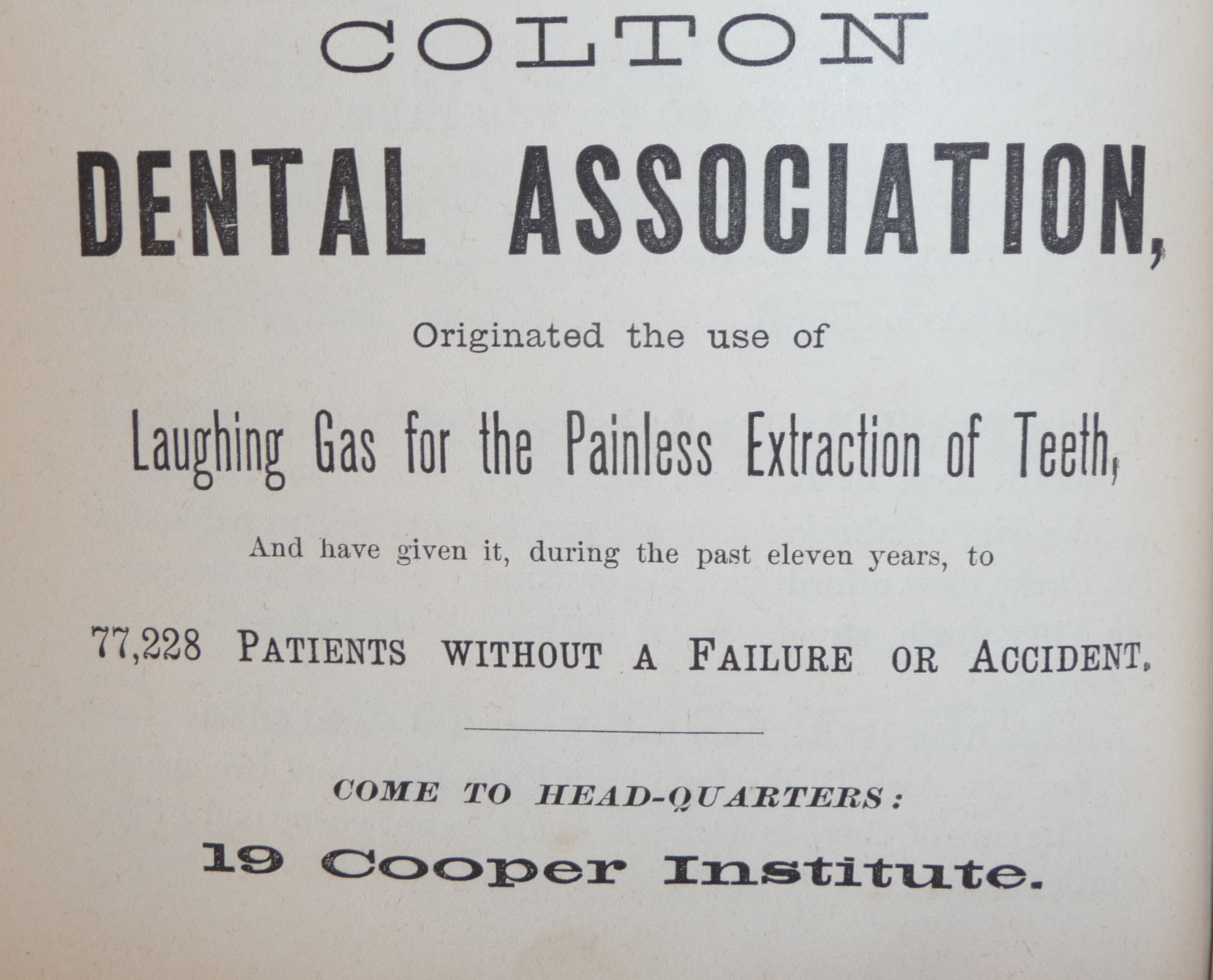
Colton Dental Ad 1874The advertisement for the Colton Dental Association located at 19 Cooper Institute says they originated the use of “laughing gas for the painless extraction of teeth.” Who knew?

In the 19th century, people were really scared of the dentist because it was generally a painful experience. The interesting part of the ad: “77,228 patients without a failure or an accident.”

Zero Refrigerator Ad 1874Seeing the word “refrigerator” in an 1874 ad may cause you to do a double take. But this is not a modern refrigeration system advertised by Alex M. Lesley, the manufacturer of the Zero Refrigerator with offices located at 224 -226 West 23rd Street. The Zero Refrigerator was merely an icebox with “water, wine and milk cooler.” Mr. Lesley simply says the Zero “is the best food and ice keeper in the world.” The world’s first refrigerator was built in 1834. Refrigerators for home use didn’t come into existence until 1913.    Continue reading

Old New York In Photos #29 – Times Square In Vintage Color Photographs

Advertisements & Scenes of Times Square In Vintage Color Photographs 1954

Times Sq 7 1954

It’s been almost 60 years since these photographs were taken by an anonymous amateur photographer who was interested in the signage, ads and the streets surrounding a vibrant, now vanished Times Square.

The city began sterilizing all the flavor from the crossroads of the world in the late 1980’s. It was a few years later that most New Yorker’s began noticing the mall-ification of Times Square. True, Times Square had denigrated into a rather sleazy place from the mid-1960’s until the “revitalization” took place. But what has it become?

For anyone who lived through Times Square’s final heyday in the 1950’s, today the place must seem extremely distasteful with its countless tourist barkers, ill-planned pedestrian plazas and glass monolith buildings sheathed in gaudy LED light ads. It’s overcrowded with people moving slowly, chain stores, costumed kitsch characters and modern day hucksters hawking their products to tourists for a “real New York experience.” Give me the days of three card monte games and prostitutes over eight people wandering around in Mickey Mouse costumes any day.

As Nik Cohn said in 1997, ‘Times Square has always changed every 20 years. But this time it’s changed to a corporate, generic American city that doesn’t particularly express the uniqueness of New York.”

Times Sq  looking southeast 1954But let’s go back in time to 1954 when it was a better time for Times Square. Legitimate theatre was still great, movies offered up Cinemascope entertainment and real Broadway characters (not criminals and freaks) roamed the streets.

Enjoy these Kodachrome views of what you would have seen looking around Times Square on a sunny, warm July day in 1954.

Minimal commentary has been added for identification purposes. Click any photo to enlarge.

Times Sq 6 1954Times Square looking south from 46th Street. Shown are: Times Tower Building, Bishop’s Crook Light, Hotel Astor with The Astor Roof Garden, Victoria Theater showing About Mrs. Leslie starring Shirley Booth and Robert Ryan, on the extreme left a portion of the statue for the giant block long Bond Clothes advertisement.

Times Sq 1954 1Looking west from Broadway and Seventh Avenue along 45th Street. Shown are: the Astor Theater with a large billboard for Indiscretion of an American Wife starring Jennifer Jones and Montgomery Clift, and Rodgers and Hammerstein’s musicals Me and Juliet  and The King and I, and the 26 story Hotel Piccadilly at 227 West 45th Street. Continue reading