Tag Archives: 1950s

30 Vintage Advertisements From The New Yorker Part 2

Ads From the November 3, 1951 New Yorker, continued

We continue our look at some of the advertisements from this issue of The New Yorker.  To put the prices of goods and services in perspective: in 1951, a first class postage stamp cost three cents; a loaf of bread cost sixteen cents; the minimum wage was seventy five cents per hour and the average salary was $4,200 per year.

For The Men

Of course The New Yorker appealed to the well heeled man as well as the elegantly outfitted woman. (click on any ad to enlarge)

Freeman Shoes –  Men’s shoes have not changed much in sixty years. If the Freeman Shoe is the footwear of the successful man, what is the footwear of the man who fails? Continue reading

30 Vintage Advertisements From The New Yorker Part 1

Ads From The November 3, 1951 New Yorker Magazine

I really enjoy looking at old magazines. Those old issues of Life, Look, Collier’s, The Saturday Evening Post and especially The New Yorker uniquely capture the 1920’s-1960’s.

I like the articles, the cartoons and especially the ads.  You read the copy, look at the typography and study the images.  The salesmanship is very direct. Some ads are wordy and try and convince you of the merits of the product. Others let the product stand on its own with few or no words.

I picked a random issue of The New Yorker Magazine from over 60 years ago to look over and picked 30 ads that were indicative of the time.  There are over 100 advertisements in this issue: some are very small, some are full page, some black and white others are in color.

Then, probably more than now, The New Yorker was read by and appealed to the upper crust of society and the ads definitely reflect that.

Here are the first fifteen ads. Click on any image to enlarge.

They Liked To Drink

Those post-war years meant if you were going out, coming home or even at the office you should have an alcoholic drink.

Booth’s House Of Lords Finest Distilled Dry Gin – Probably better than Booth’s House of Commons Gin Continue reading

Jackie Robinson Packs Up And Retires

A Classy Man Calls It A Career – January 7, 1957

55 Years Later- Remembering The December 13, 1956 Trade That Shocked New York

In this January 7, 1957 photograph Jackie Robinson packs up the contents of his locker from Ebbets Field, his home for his entire ten year major league career.

After the 1956 season Jackie Robinson’s legs were gone. He was no longer the player he once was and he knew it. He batted a respectable .275 with ten homers.  But rather than continue playing with eroding skills, Robinson would retire at the age of 37.

One problem: except for his family and future non-baseball employer, Robinson didn’t tell anyone of his decision.

The Trade

The Dodgers shocked everyone including Robinson, with a December 13, 1956 trade to the New York Giants for Dick Littlefield and $35,000 for the Dodger legend.  After the trade announcement, fans of the Dodgers were outraged. Brooklynites believed that Robinson would retire rather than play for the hated crosstown rival Giants. But they did not know Robinson had already decided before the trade that he was retiring.

All Robinson would publicly say was he would “inform the Giants by January 14, if he would play in 1957.”

The reason Robinson couldn’t announce his retirement was because he had signed a contract to write an exclusive article for Look magazine, about his retirement in December which would not hit the newsstands until January 8.

Announcing his retirement on January 7, many Dodger fans were happy Robinson would not be playing for the Giants.  Robinson said he had decided to take a position with Chock full O’Nuts as Vice President of personnel rather than play baseball.

Whether Robinson would have played for the Giants had he not retired is open to speculation.

click to read Robinson’s letter

Robinson’s January 14, 1957 letter to Giants owner Horace Stoneham takes the high road. Robinson says he appreciates being offered the chance to play for the Giants, but he has “decided to devote his full time to business opportunities.”

The Agony of Defeat

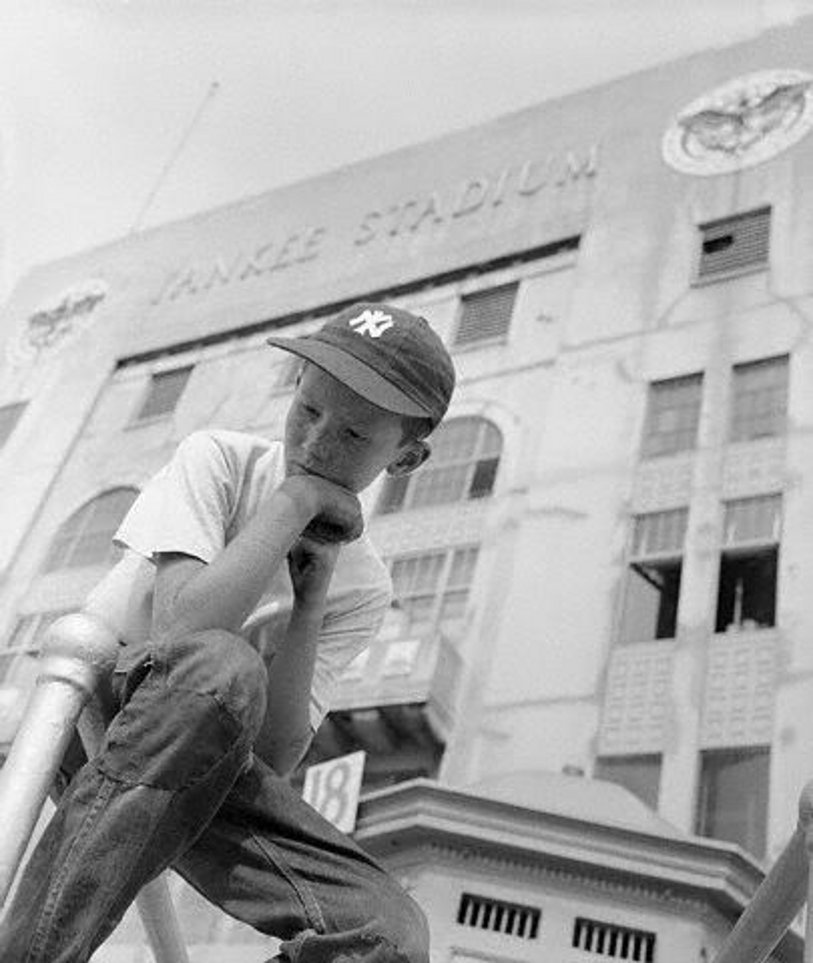
The Day After The Yankees Were Swept in a Late Season Doubleheader – 1954

The day of September 13, 1954 was not a happy one for Yankees fans as can be seen above. Reality sank in for eleven-year-old Walter Golle as he sat in front of Yankee Stadium. The dejection shown in Walter’s face reflected the fact that the Yankees would not be in the World Series for the first time since 1948 when Walter was five-years-old. The Yankees had won five consecutive World Series from 1949-1953.

The day before, on September 12, the Cleveland Indians had swept the Yankees in a doubleheader in Cleveland. The games were witnessed by 86,563 fans, the largest crowd to ever see a baseball game in the cavernous Municipal Stadium.

September 12, 1954 Municipal Stadium Filled

Bob Lemon won the first game 4-1 for his twenty-second win of the year and Early Wynn triumphed 3-2 in the second game for his twenty-first victory. The Yankees ended the day being 8 and a half games behind the Indians, reducing Cleveland’s magic number for clinching the pennant to three games.

The Indians would go on to win an American League record 111 games. They finished the season eight games ahead of the Yankees.  Miraculously the New York Giants defeated the heavily favored Indians four games to none in the World Series.

Walter eventually got over the Yankees 1954 failure. Maybe that is an assumption.

Here is what Walter looked like 46 years later in 2000 featured in The Norwood News Inquiring Photographer section.

And Here’s The Batter’s Box…

Gil McDougald Needs to Be Reminded Where He Can Stand

Photo © Bill Nehez

New York Yankee third baseman Gil McDougald had one of the most unorthodox batting stances of all time.  He would face the pitcher with both feet pointing towards the mound in an open stance.

At Municipal Stadium on June 12, 1953 the Cleveland Indians were upset with where McDougald was standing, claiming his right foot was over the line of the batter’s box. Continue reading

Classic Hollywood #8 – Marilyn Monroe & Edward R. Murrow

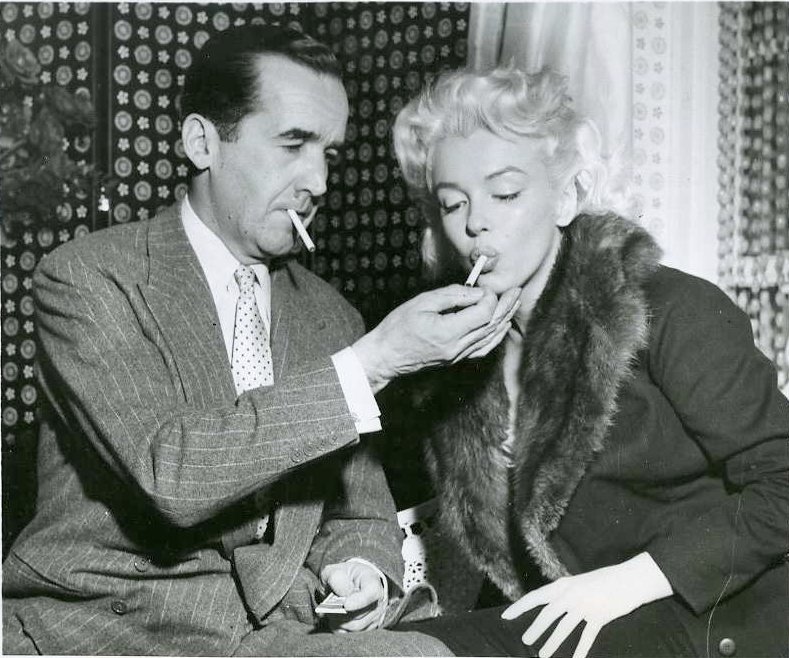
Marilyn Monroe and Edward R. Murrow Share a Smoke, April 1, 1955

The caption for this press photo is:

News Commentator Edward R. Murrow holds a match to the cigarette Marilyn Monroe extends to her puckered lips, during discussions at the Ambassador Hotel in New York regarding the luscious actress’  forthcoming appearance on Murrow’s “Person To Person” television show.  Scheduled for April 8th, the TV show will be the second one Miss Monroe has ever done.

Here is interview that aired live April 8, 1955

http://youtu.be/NBGIL7-ah1U

Classic Hollywood #6 – Harpo Marx & At Home With His Children

Harpo With His Children, 1954

Harpo Marx of the Marx Brothers married the beautiful actress Susan Fleming in 1936. She promptly retired from acting and from all accounts they had a terrific marriage until Harpo’s death in 1964.

Unable to have children, Harpo and Susan adopted four children, three of whom are seen here. From left to right Alex, Jimmy & Minnie.

Upon reflection, years later in interviews, the children concurred Continue reading

I Recognize That Scream

The Story Of “The Wilhelm Scream”

Coming across weird, useless things like this, is what makes life fun.

When films need vocal sound effects, professional voice actors are frequently called in to a recording studio to create them.

For the Warner Bros. 1951 film “Distant Drums” the sound needed was “a man being bit by an alligator. ” Instead of the actor being “bit” by the alligator recording the scream of pain, someone else at the studio, did the screaming. Continue reading