Tag Archives: 1940s

Horror Movie or Hockey Player?

Who’s Behind This Mask?
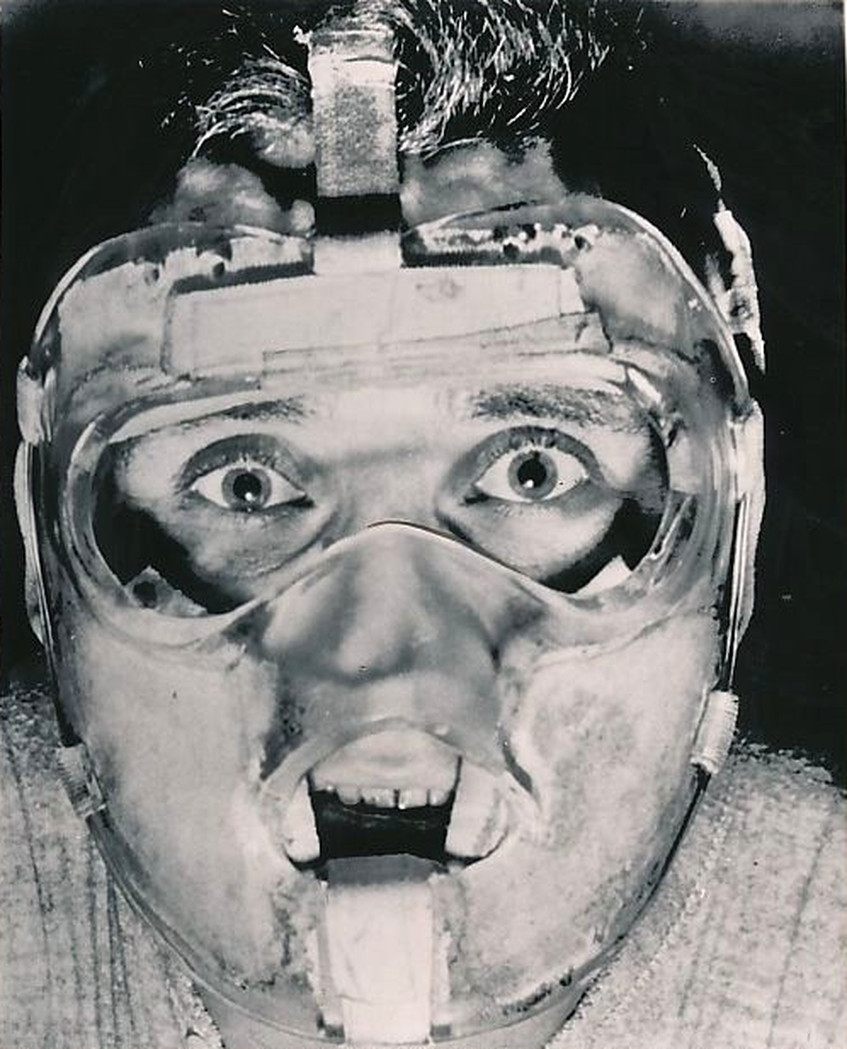
Jacques Plante 1st mask 1946 1 23Though your first guess of who might be behind this frightening mask may be Hannibal Lecter,  Jason or Leatherface, it is actually hockey player Jacques Plante.

The legendary Montreal Candiens goalie was not the first to use a mask for protection, but Jacques Plante was the player to introduce the goalie mask as everyday equipment. Before Plante, the only goalie previously to wear a mask was the Montreal Maroons’ Clint Benedict who wore one briefly in 1930 to protect a broken nose.

This Associated Press photo was taken January 23, 1948 when Plante was just 19-years-old. He was playing organized hockey for the Quebec Citadelles and was still five years away from his NHL debut with the Canadiens.

This leather and fiber mask Plante wore in 1948, was used only in practices because there were so many pucks coming at him at once.

photo via sb nation habs eyes on the prize Plante hurtPlante first donned a mask in a game on November 1, 1959 against the New York Rangers at Madison Square Garden. Plante was struck on the left side of his  nose and upper lip in the first period on a shot from Andy Bathgate. The game was delayed 20 minutes as Plante left the ice, received seven stitches and returned wearing a plexiglass mask (not the one seen in the photo above).
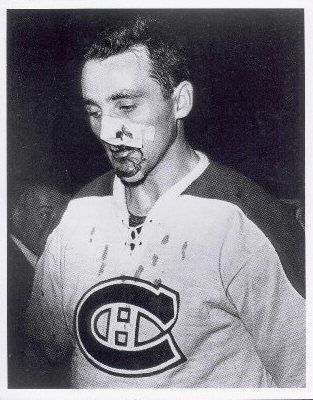
photo via sb nation habs eyes on the prize Plante bloodiedMontreal coach Toe Blake, a traditionalist, had been an ardent opponent of Plante wearing a mask. Continue reading →

Old New York In Photos #52-A – Penn Station At Night 1941

Penn Station And The City At Night – January 1941

Pennsylvania Station seen at night from The New Yorker Hotel January 1941 - photo Underwood & Underwood

Pennsylvania Station seen at night seen from The New Yorker Hotel January 1941 – photo Underwood & Underwood

Every time you see photographs of New York’s old Pennsylvania Railroad Station you have to ask yourself how could this architectural masterpiece be knocked down and carted off piece by majestic piece to the landfill? The answer resided with the owners of the Pennsylvania Railroad and real estate developers who saw the station as a white elephant: filthy; declining train ridership; losing tons of money and impractical as a revenue generator. The land Penn Station sat upon was too valuable to let this monument to interstate travel remain in place. It would be redeveloped as office buildings and the fourth Madison Square Garden put in its place with the railroad station relegated to an unsightly subterranean labyrinth.

Soon after its destruction lasting from 1963 -1966, the city and New Yorkers began yearning for the old Penn Station. All New Yorkers today await a suitable replacement for the modern underground lair we now possess ignominiously called Penn Station.

Look at this panoramic view of Manhattan looking lit up to capacity in January 1941. Here is the original photo caption:

Pennsylvania Station

The electric glamor of New York by night shines out in this shot looking southeast from the roof of the Hotel New Yorker at 34th Street and 8th Avenue.  Directly below is Pennsylvania Terminal, its glass roof aglow. Surrounding it are gleaming office buildings and hotels. No more thrilling metropolitan scene could be recommended to the thousands who arrive at this station daily. The beacon-like light in the background surmounts the Metropolitan Life Building (23rd Street Madison Avenue). credit: Underwood & Underwood,  January 26, 1941

11 months later this photographic view would not be possible because America had entered World War II. The mandatory brownouts (dimming of all lights at night) in American cities blotted out the spectacle of light and cast a protective veil over New York City that would not be lifted until the conclusion of the war in 1945.

editor’s note; We have changed the title of this story to Old New York in Photos 52-A because someone forgot how to count – there were two number 52’s!

This Is The Last Known Photograph Of Babe Ruth

A Dying Babe Ruth In Memorial Hospital July 29, 1948

Last Photo of Babe Ruth in hospital  July 29 1948New York – Babe’s Most Recent Picture – This picture, taken at Memorial Hospital here July 29, is believed to be the last picture of the baseball idol. It was made just before the Babe’s most recent relapse. With him is Steve Broidy of Allied Artists movie studio, who is presenting Ruth with a check for the Ruth Foundation for underprivileged children. The homerun king’s condition today was critical.  photo – AP, August 11, 1948

Babe Ruth June 13, 1948 in Yankee locker room

Babe Ruth June 13, 1948 in Yankee locker room

On June 13, 1948 just six weeks prior to the above photograph being taken, Ruth made his final appearance at Yankee Stadium and put on his old uniform for the last time as his number three was retired by the Yankees. After the ceremony the uniform would be shipped off to Cooperstown to the Baseball Hall of Fame. The day was hailed as Silver Anniversary Day at Yankee Stadium officially marking the 25th anniversary of “The House That Ruth Built.” Sixteen members of the 1923 Yankees came to the ceremony and even participated in a two inning old-timers game against a team of Yankee all-stars from other years.   But everyone was there to see the man himself, Babe Ruth.

Friends and old teammates lined up and approached Babe before the ceremony and he obligingly signed autographs for everyone. After others had spoken, Ruth emerged from the dugout to a huge ovation and made a short speech in a raspy voice telling the crowd how happy he was to be present, how proud he was to be the first man to have hit a home run at Yankee Stadium and how glad he was to be with his old friends again.

Babe Ruth, William Bendix and a studio executive on the set of The Babe Ruth Story

Babe Ruth, William Bendix and a studio executive on the set of The Babe Ruth Story

Returning to the story of our original photograph, the last one of Babe Ruth, the emaciated Babe was probably happy to receive a check for the film The Babe Ruth Story, based on his life . But he could not have been pleased with the film which starred William Bendix. Continue reading →

Classic Hollywood #44 – Brian Donlevy & Marjorie Lane

Brian Donlevy and Wife Marjorie Lane At A Party 1946

Brian Donlevy and wife Marjorie Lane

Brian Donlevy is one of those stars who you see in a lot of films from the 1930’s – 60’s who has been mostly forgotten by today’s generation. That is a shame because he was a good actor who starred in some excellent films including Beau Geste (1939), The Great McGinty (1940), The Glass Key (1942), Kiss Of Death (1947) and The Big Combo (1955).

Donlevy took his role as the sadistic Sergeant Markoff in Beau Geste a little too seriously alienating many of the other cast members to the point that they all supposedly detested him. In one of the final scenes in the film, John Geste played by actor Ray Milland, kills Donlevy with a bayonet. According to director William Wellman and corroborated by Ray Milland in each of their autobiographies, Milland actually stabbed Donlevy near his left armpit. The rest of the cast was elated, Milland was apologetic.

This photo above was taken by Nat Dallinger, the great photographer of Hollywood’s stars during its off hours at home and at play. King Features Syndicate would distribute Dallinger’s photos called “Inside Hollywood with Nat Dallinger” with many of captions written by Dallinger himself.

Here is the original caption: Continue reading →

W.C. Fields Will Gave The Bulk Of His Estate To Establish A College For White Orphans

W.C. Fields Died On A Day He Pretended To Despise, Christmas Day 1946

When His Will Was Read, It Had A Peculiar Racial Provision In It

WC Fields full face and portraitsMovie star comedian W.C. Fields is not well remembered by today’s generation, his cerebral brilliance generally going unappreciated or unrecognized. But those who know comedy such as Monty Python’s John Cleese said of Fields, “At a time when political correctness often stifles honesty and impulse to laugh and genuine wit is in such short supply, I think nothing could be healthier than the re-discovery of this most original, perceptive and unrepentant of comedians.”

When Fields died 68 years ago today on December 25, 1946, his will provided small amounts for family members and friends with the $800,000 remainder of his estate being left to establish “The W. C. Fields College for White Orphan Boys and Girls Where No Religion of Any Kind is Ever to be Taught.”

This strange racial provision seemed completely out of character for a man who treated blacks as equals and stood up for racial equality long before it was popular.  It was at W.C. Fields insistence that his Zigfield Follies friend, the great black vaudeville star Bert Williams, be allowed to join Actor’s Equity. Williams was finally admitted to the association. Fields said Williams was, “The funniest man I ever saw and the saddest man I ever knew.”

So why would Fields put this exclusionary provision in his will? Continue reading →

Old New York In Photos #43 – Times Square Advertising Billboards

Giant Times Square Advertising Billboards Of The Past

New York's Times Square at night 60 Years ago, 1954 photo: Charles Shaw

New York’s Times Square at night 60 Years ago, 1954 photo: Charles Shaw

The New York Times article about the new eight story high, block long, LED illuminated billboard that will be put into use on Tuesday night, November 18, 2014, made me think about some of the classic advertising signs that were in place during the 1940’s and 1950’s at the crossroads of the world.

Bond Clothiers sign, 1948, Times Square looking north

Bond Clothiers sign, 1948, Times Square looking north

Chief among these ads was the dramatic Bond Clothiers sign taking up the entire Broadway block between 44th and 45th Streets. The 200 foot wide, 50 foot high billboard was brightly lit up at night and had a waterfall cascading between the two large scantily clad statues flanking it. The figures appeared nude during by day and had electric lights draped around them which produced a quasi-covering effect on the statues when the lights went on.

With two miles of neon, it was a colorful spectacle to behold in person, especially at nigTimes Square 1948 Bond Clothiers at night billboardht. The sign was only up from 1948-1954.

We previously showed what the area looked like at night in our story about the giant New York snowstorm of 1948.

The Bond sign replaced an earlier sign for Wrigley’s Spearmint Gum that also was breathtaking with its neon aquatic design. Designed by Dorothy Shepard, it occupied the site from about 1936 to 1948.

Times Square Wrigleys Billboard sign Ad postcardThe other billboard Continue reading →

Smoking Cigarettes For A Living

Here Is A Real Chain Smoker

Man tests cigarettes for a living photo Acme 1945This is not part of some government secret test program to see how many cigarettes you need to smoke before you develop cancer. Testing cigarettes was part of Sol C. Korn’s job as the director of various cigarette and cigar company’s from the 1920’s until the 1960’s. In 1945 when this picture was taken he was president of the Fleming-Hall Tobacco Company.

The caption reads: Continue reading →

World Series Photos Delivered Instantly

Before The Internet, The Quickest Way To Get Photos Back To The Newspaper- Via Pigeon

Walker Cooper Phil Rizzuto pigeon delivers negatives 1942 world series

Walker Cooper, Phil Rizzuto and Private Harry Myers and carrier pigeons, October 4, 1942 photo: New York Journal-American

You would have thought by 1942 there was a quicker way for a newspaper to get photos from one place to another than using a carrier pigeon. Apparently not.

Before game four of the World Series at Yankee Stadium, Private Harry Myers, the Journal-American’s pigeon specialist, shows the Cardinal’s Walker Cooper and the Yankee’s Phil Rizzuto how photographic negatives of the World Series game are sent by pigeon from the ballpark to the newspaper’s offices for same-day publication of the photos.

Amazing.

Maybe it was just the New York Journal-American’s method, as I cannot imagine all the newspapers releasing pigeons during a baseball game.

The 11-Year-Old New York Pancake Flipping Champ For 1947

Henry McChesney Wins An Unusual Contest

Pancake flipping champ 1947

Bet you didn’t know there was once a pancake flipping champ in New York? Well there was in 1947.

Note the concentration in young Henry McChesney’s face. The rules and how many other entrants there were in this contest is anyone’s guess. The caption for this Acme news photo reads as follows:

Fancy Flapjack Flipper

New York: When Henry McChesney end-over-ended a flapjack five times, he became champion flapjack flipper of the Madison Square Garden Club. Judging the contest, held August 28th, is Legionnaire John M. Lewis, who awarded the wise old owl emblem to the club, one of the Boys’ Clubs in which the National Americanism Commission of the American Legion is interested. credit: (Acme) 8-28-47

1949 Yankees All-Stars – DiMaggio, Berra, Henrich, Reynolds & Raschi

New York Yankees All-Stars Of Yesteryear

Vic Raschi Tommy Henrich Joe DiMaggio Allie Reynolds Yogi Berra Yanks All Stars July 6 1949 photo © Acme

In 2014, the struggling New York Yankees have three players that were named to the All-Star team: Derek Jeter, Dellin Betances and Masahiro Tanaka, who will not play because of an elbow injury.

In 1949 the Yankees had five players play on the All-Star team. Seen in this photo from left to right are Vic Raschi, Tommy Henrich, Joe DiMaggio, Allie Reynolds and Yogi Berra.

There were 32,577 fans in attendance in what turned out to be a slugfest at Brooklyn’s Ebbets Field, as the American League topped the National League 11-7. Joe DiMaggio drove in three runs and Vic Raschi pitched three scoreless innings to get the save.