Tag Archives: 1910s

Kings Bridge (1693) and The Farmers Bridge (1759) – Two Of New York City’s Oldest Bridges Still Exist

The Story of Two Forgotten And Buried New York City Bridges

This is Kings Bridge connecting upper Manhattan to the Bronx and Westchester. The Kings Bridge was originally constructed in 1693 under a grant from the Crown and maintained by the Philipse family as a toll bridge until the revolution.

The toll was collected on every person, animal and vehicle crossing to the mainland excepting the King’s soldiers. At night the rates doubled. The bridge was reconstructed in 1713 and altered slightly a few times in the intervening 200 years. Continue reading

Baseball Approves Of Legalized Gambling In 2019 – Isn’t It Time To Re-Examine Joe Jackson?

MLB Approves Gambling On Baseball, Maybe Its Time To Reconsider “Shoeless” Joe Jackson’s Lifetime Ban

Joe Jackson 1915

“Shoeless” Joe Jackson before game vs. Yankees at Comiskey Park August 23, 1915

“Shoeless” Joe Jackson, believed by many to have been the greatest natural hitter of all-time, was banned from baseball for life after the 1920 season by Commissioner Kennesaw Mountain Landis.

Jackson had a .356 batting average in his abbreviated 13 year career. Controversially, Jackson remains on baseball’s permanent ineligible list, meaning he can never be inducted into the Baseball Hall of Fame. His alleged crime, as many people know, was participating in the 1919 “Black Sox” scandal.  Eight members of the Chicago White Sox including  Jackson were influenced by gamblers with promised payoffs to throw the World Series.

As the old car commercial goes “Baseball, Hot Dogs Apple Pie and Chevrolet, they go together in the good ole’ USA.” Where does gambling fit in? Apparently right beside baseball. Continue reading

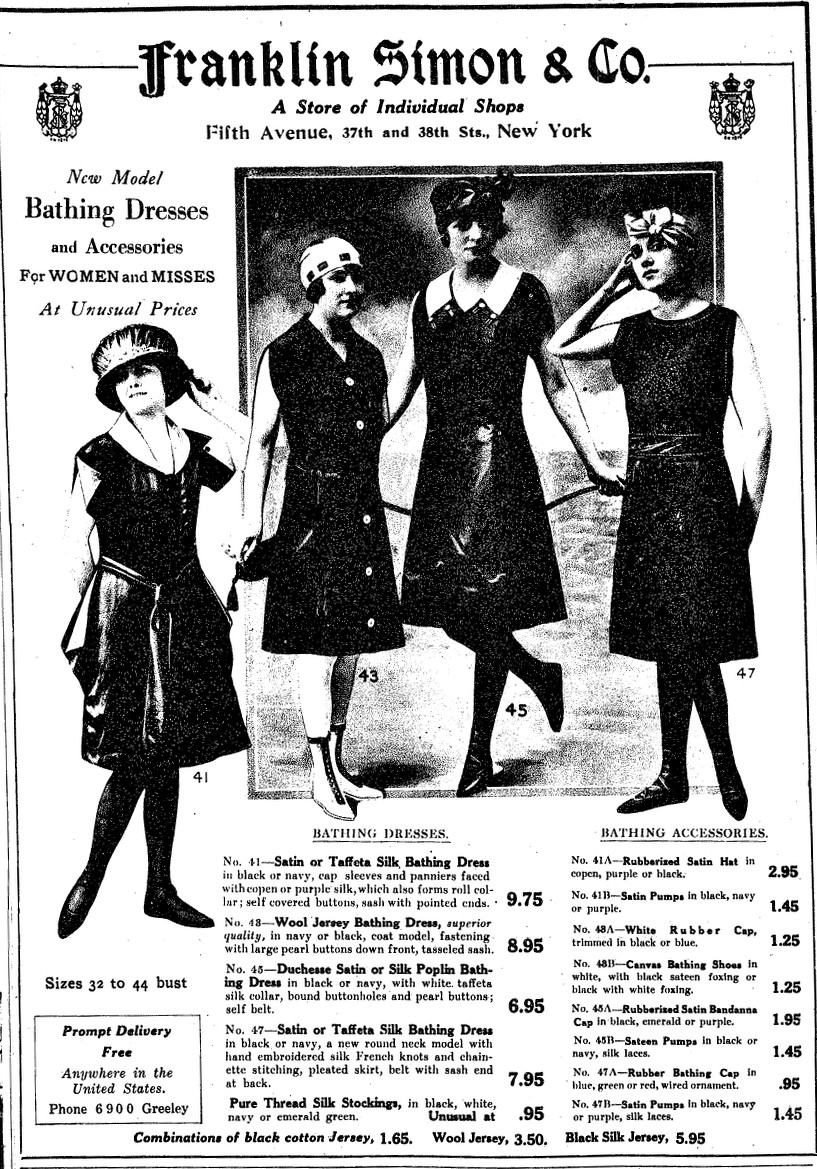
New Women’s Bathing Suits & Accessories In 1918 From Franklin Simon

What Swimsuit Fashions Looked Like 100 Years Ago – Arms Were Visible –  How Shocking!

New York Tribune bathing suits ad from Franklin Simon department store

From The New York Tribune newspaper of June 16, 1918 comes this advertisement from Franklin Simon & Co..

They were not called bathing or swimsuits, but bathing dresses and for good reason. Women still covered their bodies in dresses from neck to toe. Things were getting a bit risque for the time- these dresses had exposed arms. Of course legs were still fully covered by material, but not completely hidden by the bathing dress. Continue reading

The Woolworth Building & Singer Building At Night In Color – 1914

The Woolworth Building and Singer Building At Night In Color  – 1914

In this photograph looking south along Broadway are three buildings that each at one time  held the record as tallest building in the world.

This hand colored magic lantern slide was taken soon after the Woolworth Building was completed in 1913. After its completion and for 16 years until 1929, the Woolworth was the tallest building in the world. Continue reading

What Was In A New York Newspaper 100 Years Ago – June 16, 1918

A Look Back At What Was In The New York Tribune Newspaper 100 Years Ago, June 16, 1918

Immigrant Aliens, Child Labor and Of Course Entertainment

What was occurring 100 Years Ago? The Fairbanks Twins and Lillian Lorraine were about to appear in The Ziegfeld Follies of 1918 at The New Amsterdam Theatre.

It’s interesting to see what newspapers of the past contained. 100 years ago, June 16, 1918 the Great War (World War I) was still raging and battle news dominated the news. What else would you see in the newspaper as far as local matters?

Here are seven of the things I thought were worth highlighting from The New York Tribune. Click on any image to read the entire story.

The hostility towards immigrants who are not citizens has always existed. During World War I anti-German sentiment ran high. The government required that all alien (non-citizen) German women 14 and older register at their local police stations, take a loyalty oath and provide five photographs of themselves! Women who failed to register would be arrested and severely punished.

German women register with police

It seems like paranoia, but German espionage and sabotage were a real threat during the war. But usually the reason an entire group gets demonized is because they are an easy target when the populace gets inflamed. One man took matters into his own hands printing 3,000 signs to be distributed at shops along Fifth Avenue declaring, “Speaking of German Prohibited On These Premises.” The unnamed man ran out of signs within walking three blocks. Volunteers grabbed as many as they could to help pass them out. The thinking was this will “Americanize” those Germans.

There would be a big uproar if someone tried to do something similar today pointing the finger at any ethnic group, even when we are at war, which by the way, we still are. The never-ending “war on terrorism.” The language those barbarians who commit terrorist acts doesn’t matter, does it?

German language prohibited

You could say lawyer Albert W. Gray was henpecked, but the things Mrs. Gray did are a little more extreme than henpecking. Mrs. Gray made poor Albert account for every penny he spent and explain every moment and movement he made. Mr Gray had 11 years of being told when to wake, eat and sleep, before deserting his overbearing spouse. Mrs. Gray in her separation decree said if she only knew her husband was unhappy she would have changed her system of housekeeping!

Wife controlled every aspect of husband’s existence

The Tribune reprinted a whole page from the San Antonio, TX based Kelly Field military newspaper. Continue reading

These Are The Relics From The Lincoln Assassination

The Gun, The Knife and The Bullet From the Lincoln Assassination

Two tragic historic events occurred on the evening of April 14, forty-seven years apart.

On April 14, 1865, John Wilkes Booth shot Abraham Lincoln at Ford’s Theater. Lincoln died at 7:22 am on April 15

At 11:40 in the evening of April 14, 1912 the unsinkable Titanic on its maiden voyage hit an iceberg in the North Atlantic. The great ship went down at 2:20 am April 15 taking over 1,500 lives.

Our AP news photograph above is from 1965 when the 100th anniversary of the Lincoln assassination was observed.

RELICS OF ASSASSINATION

These are some of the relics associated with the assassination of President Lincoln. The small pistol in the center is the pistol used by John Wilkes Booth. The dot just below it is the bullet dug from Lincoln’s head. The knife to the right of the pistol was used to stab Major Rathbone, the President’s bodyguard. The pistol at extreme right is the one Booth was carrying when caught. The boot was worn by Booth at the time of the assassination . Other weapons were taken from members of a gang which associated with Booth. (AP News features Photo For use Sunday, April 11, 1965)

Continue reading

Mendicants In New York City – 1910

Mendicants 1910

This photograph taken at Sixth Avenue and 14th Street by Lewis Hine in 1910 is simply labeled “Mendicants.”

It’s a word you don’t often hear today. Mendicant – a beggar; panhandler.

While you may think the main subject here is the blind man sitting by the pole of the el, that would not be the case The focus of the photograph is the little girl who is begging. She appears aged and streetwise beyond her years. But both of them are mendicants.

Hine’s photographs of children at work in major cities usually focuses on newspaper sellers, shoe shiners, telegraph boys, delivery boys and other street trades. In 1910 mendicant was considered a street trade.

Who are these two people? Father and daughter? Grandfather and granddaughter? Or just two people in need who have teamed up to ply their trade?

Where did they live?

Unfortunately Hine did not get the names, ages and addresses of this girl and blind man, as he did with many of his other subjects. Continue reading

It’s True, A Group Wants To Entirely Rebuild The Original Penn Station

A Serious Proposal To Rebuild The Original Penn Station

New Main Waiting Room Penn Station Credit: Jeff Stikeman for Rebuild Penn Station.

The National Civic Art Society has developed a plan to entirely rebuild the original Penn Station.

The biggest and most obvious hurdle to accomplishing the Society’s plan would be demolishing the many buildings that currently stand on the site including Madison Square Garden and a 34 story office building. Then the next question arises: who would fund such an enterprise?

As crazy as all this sounds, the actual rebuilding plan sounds feasible. You would just need all the corrupt politicians and greedy real estate entities to cooperate. That will almost certainly not occur.

But that doesn’t stop one from hoping. The organizers have an executable plan and want to drum up support among the public. Here is the opening statement from their website rebuildpennstation.org

New York City’s original Penn Station was one of the finest buildings ever constructed. With its vast main hall and soaring concourse, it provided a triumphant gateway into the city. Its demolition in 1963 was one of the greatest architectural and civic crimes in American history.

That wrong is all the worse given the current station, which is cramped, dismal, and hard to navigate. As the historian Vincent Scully said about the original station, “One entered the city like a god; one scuttles in now like a rat.”

We aim to reconstruct the original station to return it to its former glory. Click here to join our cause.

The video the Society produced explains more.

As the rebuild Penn Station group pointed out, New York’s greatest architectural loss occurred 54 years ago.

On October 28, 1963 the demolition of Penn Station began and three years later the majestic station was gone, its marble and debris trucked out in pieces to the New Jersey Meadowlands and used as landfill.

Trains still go in and out of Penn Station. But the Penn Station that replaced the original has nothing in common with the original but the name.

Main Post Office completed 1912 photo: Underhill

Directly across from the original Penn Station between 31st to 33rd Streets and Continue reading

How Baseball Fans “Watched” The 1911 World Series

Before Radio Or Television If You Didn’t Have A Ticket To The World Series – You Could Still Watch It On The Play-O-Graph

Advertisement for the “wonderful Automatic Play-O-Graph” – Philadelphia Inquirer Oct. 13, 1911

In August, 1911 with $10,000 capital, John W. Baker, Henry H. Abbott and Sumner Ford incorporated the Baseball Play-O-Graph Company in Stamford, Connecticut. The men devised a way of transmitting the actions of sporting events “live” through telephone and telegraph.

The depiction of baseball games through mechanical means had been accomplished previously, but not showing the track of the ball, which was what made the Play-O-Graph unique. The Play-O-Graph would show the action without the aid of electric lights.

Baseball fans congregate outside the New York Herald Building during the 1911 World Series

In October of 1911 the American League champion Philadelphia Athletics lead by manager Connie Mack would play John McGraw’s New York Giants for the World Championship.

Giants manager John McGraw (l) and catcher Chief Myers (r) at Polo Grounds before 1911 World Series.

Giants manager John McGraw (l) and catcher Chief Myers (r) at Polo Grounds before 1911 World Series.

There were a couple of oddities in the 1911 World Series. Each game alternated cities with games one, three and five being played in New York and games two, four and six played in Philadelphia. The other strange occurrence was that there was a one week delay between games three and four as a deluge of rain hit Philadelphia for six straight days.

After inspecting the field for playability causing the fifth straight postponement of game four, umpire Bill Klem joked, “There was a pool around second base big enough for a diving exhibition by (swimming champ) Annette Kellerman. I was unable to locate the home plate for the lack of a diving apparatus. The outer gardens would make excellent pasturage for a herd of hippopotami.”

Both teams were considered evenly matched and felt confident they could win the series. Since 1904 each team had won three pennants.

Line outside the Polo Grounds at 7:00 am to buy tickets for game 3 of the 1911 World Series. photo: Bain

When tickets for the opening game of the World Series went on sale on Friday, October 13 at the Giants home field, the Polo Grounds all the tickets were gone within two hours. After the sell-out, the regular ticket price of three dollars shot up to five, six, seven and eventually eight dollars from speculators (scalpers) who had scooped up as many tickets as possible.

With over 38,000 fans cramming the ballpark it would be difficult to see the game without a ticket.

That would be where the Play-O-Graph would come into use. Setting up their machines at four locations in the United States, fans could see the game as it transpired.

“When the pitcher pitches the ball and when the batter hits it and when he is thrown out, is all shown upon the Play-O-Graph. Every move of the game is made clear to the spectator who watches the ball as it moves from place to place upon the board,” the company proclaimed.

The company installed two boards in New York, one in Chicago, one in Detroit and one in Philadelphia. Continue reading

Old New York In Postcards #17 – Riverside Drive

Postcard Views of Riverside Drive 1900-1920

Riverside Drive may not be the most famous street in Manhattan, but it is among the prettiest.

The natural beauty of the surrounding area made this parcel of Manhattan real estate an ideal setting for a park and residential development.

Up until the late 19th century there was not a whole lot of home building along this western portion of the city with the exception of a few mansions perched high along the river.

As transportation options continued to improve, Riverside Avenue began attracting wealthy New Yorkers and real estate developers to the west side. The extension of the Ninth Avenue Elevated in 1879 and opening of the subway in 1904 made it possible to commute from the upper west side to New York’s business center downtown. In 1908 Riverside Avenue’s name was officially changed to Riverside Drive.

If Riverside Drive had been built as originally proposed by Park Commissioner William Martin in 1865, it would have been a 100 foot wide straight boulevard.

Fortunately that turned out to be impractical due to the natural topography of the area.

Riverside Drive looking north towards Grant’s Tomb 1912

In 1873 Frederick Law Olmsted the designer of Central and Prospect Park received the job of laying out Riverside Park and Drive. Olmsted realized that incorporating the existing landscape surrounding Riverside Avenue into a park was a better plan than grading and straightening the hills along the drive.

By the time work started on the park in 1875 Olmsted had left New York City. Over the next 25 years  a succession of designers, engineers and architects executed Olmsted’s proposal but not exactly sticking to his plan. Calvert Vaux, Samuel Parsons and Julius Munckwitz all had their turn in building up Riverside Drive and its park.

By the turn of the 20th century Riverside Drive was lined with expensive single family townhouses and row houses overlooking the Hudson River. Land speculation led to a spate of luxury apartment buildings in the upper parts of the boulevard.

A touring bus along Riverside Drive

The first portion of  Riverside Drive from 72nd to 85th Street was opened in 1879. Riverside Park terminated at 129th Street. The Riverside Viaduct completed in 1900, bridged the schism between 125th and 135th Streets. Riverside Drive then continued north to 181st Street.

Here are some of the views from 100 years ago.

postcard view Riverside Drive north from 72nd Street 1918

Riverside Drive north from 72nd Street 1918

This World War I era view shows Riverside Drive at 72nd Street looking north. The entire block between 73rd and 74th Streets and Riverside Drive and West End Avenue belonged to one man and his extravagant home. The french style chateau with the large front lawn is the 75-room Charles M. Schwab mansion.  Designed by Maurice Ebert and completed at a cost of $6 million in 1905, the home contained a gym, a bowling alley, a pool, and three elevators. Schwab had made his millions working with Andrew Carnegie. Schwab went on to head United States Steel. Continue reading