Censored – What The Movies Couldn’t Show In 1921

An Incredible List of Things That Movies Were Not Allowed To Portray In 1921

Annette Kellerman the first "star" to do a nude scene 1916 "A Daughter of the Gods"

Famous swimmer, Annette Kellerman was the first “star” to do a nude scene 1916 “A Daughter of the Gods”

Looking at what was prohibited in the state of Maryland from being shown on movie screens in 1921 is overwhelming in its restrictiveness. It includes, but is not limited to: indecorous dancing; over passionate love scenes; exhibition of feminine underwear; gruesome murders; birth control; disrespect for the law; use of opium or other habit forming drugs; executions; profanity; excessive drunkeness especially in women; and maternity scenes.

The complete Maryland censorship rules is a laundry list of vice and of how people really behaved. Basically real life was prohibited in the movies.

Because there was no film industry set of standards, individual states set up their own board of censors to either insist on cuts to movies or block films from being exhibited entirely within that state.

In 1921 there were only six state censorship boards, and that number would greatly expand throughout the 1920’s. What was okay in one state, may not be playable in another. This set off a quagmire of problems for producers of films who needed to be able to show their films to the widest possible audience without having to make special edits to satisfy each state’s censorship board.

Rather than risk the creation of a national censorship board, the film industry eventually self monitored and created its own censorship code and a board to enforce the rules.

One of the last pre-code films. 1933 Roman Scandals with a young Lucille Ball in the chorus as a slave girl

One of the last pre-code films. 1933’s Roman Scandals with a young Lucille Ball in the chorus as a slave girl

The Hays Code (1930) and Joseph Breen, head of the Production Code Administration  standardized censorship rules and staved off an official national censorship board.

But even after the Production Code went into full effect (1934), local authorities or the Legion of Decency could still condemn a film and keep it from being exhibited. The city of Boston was a prime example of banning films with objectionable content.

Below is the complete list of Maryland’s censorship restrictions. Continue reading

Marching In New York For Their Socialist Agenda May 1, 1934

May Day Parade 1934

May day parade Madison Ave May 1 1934 photo APWhile this may look like a group of Nazi women dressed like stormtroopers marching up Madison Avenue it is actually just a bunch of American socialists resembling the sieg heiling Nazi’s.

The original caption for this news photo reads as follows:

The Red Flag of Socialism

A general view of the parade of the Socialists up Madison Avenue in New York May 1.  A group of women Socialists carried red flags and sang and shouted as they marched. Parades were held throughout the city by various groups but there was no disorder of any kind. (Associated Press Photo 5-1-34)

In the first half of the 20th century, every May Day in New York would bring thousands of activists out into the streets to march and promulgate their ideas . Many were just plain old Socialists, however there would be smaller parades of Communists, anarchists, Industrial Workers of the World, or other labor groups who had a concern or cause.

In 1932, the Socialist party presidential candidate Norman Thomas received 884,895 votes, a little more than 2% of all ballots cast.

Mostly the May Day marches in New York Continue reading

Lifebuoy Soap Body Odor Ad 1933

My Dear, You Smell of B.O.

Lifebuoy Soap Ad - Schenectady Gazette March 13, 1933

Lifebuoy Soap Ad – Schenectady Gazette March 13, 1933 (click to enlarge)

“What a kill-joy B.O. is!” says this 1933 Lifebuoy comic strip ad.

“Perhaps its your fault,” says Auntie to Mrs. B.O.

Nothing like being direct.

The Lifebuoy ad warns that B.O. make life miserable for its victims. I like that  it is whispered in parenthesis in case you don’t know that B.O. stands for body odor.

And to add a dramatic flair, B.O. “threatens their jobs, social positions – even their homes!”

Fortunately of course there is a Continue reading

Old New York In Photos #49 – Broadway & 80th Street

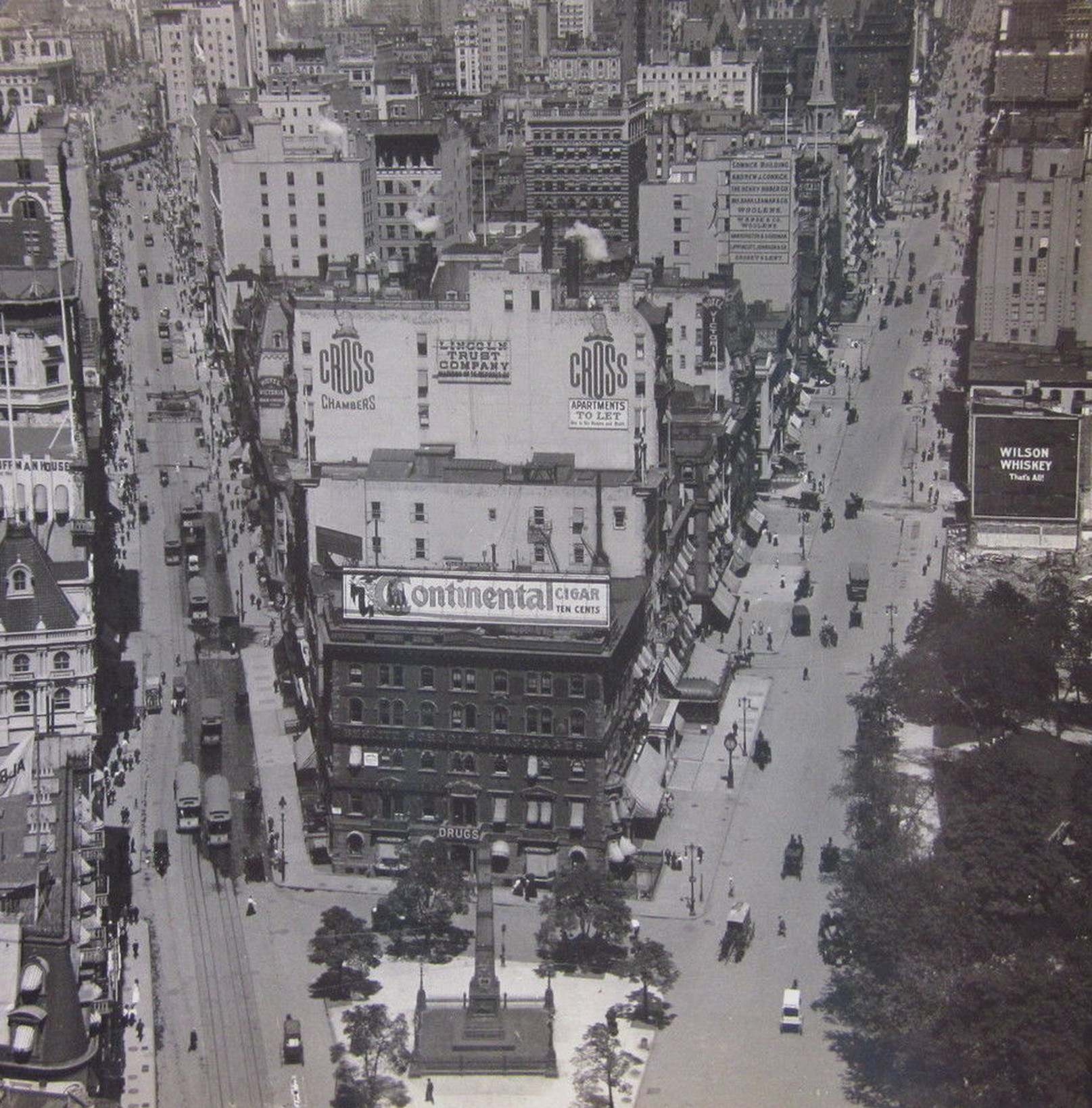
Broadway & 80th Street 1898 and 1928

What A Difference 30 Years Makes

Broadway 80th 81st Street 1898 photo H. N. Tiemann

Broadway looking north and west between 80th & 81st Streets. 1898 photo: H.N. Tiemann

Up until the late 1800’s Broadway above 59th Street still retained much of its sleepy Dutch ways and was still called the Boulevard which followed the course of the Old Bloomingdale Road. The upper west side neighborhoods had their own unique character which were based upon the villages of Harsenville, Striker’s Bay, Bloomingdale and Manhattanville.

In the photo above from 1898 we see the Boulevard looking north and west from 80th Street with horses lined up along the curb. Building is sparse with low profile two and three story buildings. Commercial structures might contain blacksmith’s, grocery shops and tailors. Open land and farms were still nearby. In thirty years the change would be striking.

Land speculation and the coming of the subway would end the ruralness of the area.

Broadway 80th 81st Street 1928 photo H. N. Tiemann

Broadway looking north and west between 80th & 81st Streets. 1928 photo: H.N. Tiemann

This photograph taken in 1928 from the median of Broadway and 80th Street and looking in the same direction as the previous photo shows that almost everything from 1898 has vanished.

We see automobiles, but no horses. The trees that lined the street are gone and there is quite a bit of pedestrian activity along the street. Commercial stores line Broadway and 80th Street to the west and the north. The white building in the foreground is still standing today and now contains Zabar’s.

Continue reading

Batman As 007 – Twelve Actors Who Turned Down The Role Of James Bond

Batman’s Adam West Is One Of Many Actors Who Were Offered The Role Of  Agent 007 James Bond, But Turned Down The Part

Adam West Batman

“The name’s West, Adam West”

There is a little of James Bond in every actor. That does not mean that every actor wants to play James Bond.

Bond is an expert in a wide range of subjects, an outstanding athlete and fighter, can drive any vehicle, land, air or sea and seems to have a way with the ladies. There are some critics who have complained that James Bond is a misogynist. If so, he has rarely used his “license to kill” on women. Out of 370 people Bond has killed on screen, only three have been women.

Recently while watching Diamonds Are Forever (1971), the extra features on the DVD mentioned that before Sean Connery agreed to return to the role of James Bond, several actors were considered to play 007 and some turned it down. The reasons varied, but I doubt that any of the actors regretted their decision.

The most surprising decline to me was Adam West who had brilliantly played the campy title role on Batman, ABC’s hit series which ran from 1966-1968. I can see how the producers considered him for the role, but I cannot imagine Adam West being James Bond. But then again neither could West and he was smart enough to pass on the part. On the other hand, some of the actors who turned down James Bond, I could see playing 007.

So here is a slideshow of just some of the actors who turned down the role of the world’s most famous secret agent.

A little more about Patrick McGoohan who had he accepted the role may have been the best actor to ever play the part. But it was not only the womanizing McGoohan objected to; he truly despised the character, calling Bond “contemptible and simplistic.”

McGoohan, a man of very strong ethics said in a 1960’s interview Continue reading

The Beatles, Abbey Road Unused Alternate Cover Photos

The Photos The Beatles Didn’t Use For The Cover Of Abbey Road

Abbey Road 01 photo Iain Macmillan 1938-2006

Abbey Road album cover outtake photo – Iain Macmillan

If you are a Beatles fan, and visit London there is a strong chance that if you venture just outside the Abbey Road studios you will find groups of Beatles fans recreating their own version of The Beatles famous walk across the street while someone photographs the scene. The Abbey Road cover is considered to be one of the best and most imitated album covers in rock history.

The photo session took place on August 8, 1969 and photographer Iain Macmillan was given ten minutes to photograph The Beatles. Macmillan perched himself on a ladder in the middle of the street and took only six photographs of the group, one of which became the final album cover.

Here are the other four photos that did not end up being used for the cover. Click on any photo to enlarge.

For The Beatles fan who owns everything you could purchase your own set of the photos, but you would have to spend some big bucks. A set of the five unused photos with one signed by Macmillan was auctioned Continue reading

70 Years Ago Today – President Franklin Delano Roosevelt Dies

The Nation Mourns After Learning of the Death Of  F.D.R.

This is how the New York newspapers announced the death of F.D.R. on April 12, 1945.

70 years ago today when the 32nd President of the Unites States, Franklin Delano Roosevelt died suddenly of a massive stroke at the age of 63 in Warm Springs, GA  there was an overwhelming outpouring of grief across the globe.

With the exception of Adolf Hitler and a few die hard anti-FDR Republicans most of the world was saddened to learn of Roosevelt’s death. Roosevelt was held in high esteem by most Americans, even those that did not agree with many of his policies. There were also those who could not stand the man, but were in awe of Roosevelt as a shrewd politician and the job he had done in seeing the United States through the Great Depression and World War II.

It was especially sad that Roosevelt never got to witness the end of the war which brought final victory to the Allies. Less than four weeks after Roosevelt’s death, Hitler and Mussolini were dead and Victory in Europe Day was celebrated May 8, 1945. Japan unconditionally surrendered on August 15, 1945.

What I cannot imagine happening now in today’s world of partisan politics is having a universal outpouring of sorrow if a President were to die suddenly while in office. There is so much outright hatred and disrespect in modern politics that we will never see anything like this again.

FDR's funeral procession in Washington D.C.

FDR’s funeral procession in Washington D.C.

The Brooklyn Eagle Continue reading

A Visit To The New York City Book and Ephemera Fair

Three Antiquarian Book Shows In New York City This Weekend – A Quick Look At The Newest One

A view of the floor of the New York City Book and Ephemera Fair  - Wallace Hall St. Ignatius Loyola Church April 11, 2015

A view of the floor of the New York City Book and Ephemera Fair – Wallace Hall St. Ignatius Loyola Church April 11, 2015

With book lovers from all over the world descending upon New York York City for the ABAA’s New York Antiquarian Book Fair from April 9 -12 2015, two satellite shows containing about 50 dealers each displayed their wares at nearby locations.

Display of fine books at the New York City Book and Ephemera Fair

Display of fine books at the New York City Book and Ephemera Fair

So this morning I had a chance to check out one of the shows The New York City Book and Ephemera Fair, at a location that to my knowledge has never held a book show; Wallace Hall at St. Ignatius Loyola Church on Park Ave and 84th Street.

The show produced by Marvin Getman, was well lit, spacious and chock full of top book dealers from all over the country and Canada.

Many dealers seemed happy with the turnout and for a $15 admission fee the public was able to see some high quality books at mostly affordable prices.

The display case of Wiggins Fine Books, Shelburne Falls, MA

The display case of Wiggins Fine Books, Shelburne Falls, MA

The selection was wide, ranging from signed and first editions to ephemeral early punk rock magazines to science fiction classics to incunabula.

Several dealers featured art, photography and architecture books which seemed to moving briskly.

Children’s books were carried by many dealers and selling for fair prices. A first edition A Pocket for Corduroy a classic by Don Freeman with the dustjacket was offered at $600. Continue reading

Old New York In Photos #48 – Brooklyn’s Fulton Ferry House

Brooklyn’s Fulton Ferry House and Brooklyn Bridge circa 1885

Brooklyn Fulton Ferry House and Brooklyn BridgeThis view captures the newly built Brooklyn Bridge and Brooklyn’s Fulton Ferry House, a beautiful Queen Ann style Victorian building with its ornate mansard roof.

This picturesque scene showing street railways, horse carts, telegraph poles and light fixtures are all vestiges of the 19th century that vanished long ago. The photo was taken around 1885 from the corner of Everett Street (that is the original spelling) and Fulton Street (now called Old Fulton Street) looking north toward Water Street and the Brooklyn Bridge. Besides the Brooklyn Bridge, the small hotel on the corner of Water and Fulton Street on the extreme right with the striped awning, is the only structure in this photo that is still standing.

The service that became the Fulton Ferry began in 1642. The ferry service moved location several times and Robert Fulton inventor of the steamboat, in the 1810’s secured the lease on the land at the foot of Fulton Street for East River ferry service. William Cutting established a ferry line there starting in 1819.

The Brooklyn Fulton Ferry House building was constructed in 1871 by the Union Ferry Company. Called “The Great Gateway to Brooklyn,” the Ferry House was designed by architect William Belden Olmsted a distant relative of Central Park and Prospect Park landscape designer Frederick Law Olmsted.

At a time when fire laws generally prevented construction of any wooden structures, the Ferry House was built of wood rather than iron because the company believed that vapors from the sewage deposited directly into the river and the salt water would cause iron to rust! It was probably more of an economic ploy to save on building costs as iron or brick was much more expensive than wood. The three story building measured 173 feet wide and 35 feet high, with the tower reaching a height of 86 feet and the main floor containing large waiting rooms featuring every modern convenience. Even opting for the cheaper wood construction, the final cost was a lofty $138,000.

As the new Fulton Ferry House building was opening its demise was literally right behind it. The construction of the Brooklyn Bridge which began in 1869 led to an inevitable and slow decline of the viability of Fulton Ferry service.

With the 1883 completion of the Brooklyn Bridge Continue reading

1,001 Ways To Die In New York City In 1855

 A Detailed Look At New York City Mortality For One Week In 1855

the new york city morgue Frank Leslies Illustrated Newspaper 1866

The New York City morgue

Maybe there weren’t 1001 ways to die, but in a typical week in New York’s death log 160 years ago there were at least 73 ways to enter into eternity. New York City was only the borough of Manhattan and the population was around 629,000.

355 people died during the week of September 22 – 29, 1855.

First looking at how people died we see things that are not predominant causes of death in the United States today.

The most common causes of death that week were: Consumption (38 dead); Infantile Marasmus (35 dead); Infantile Convulsions (31); Stillborn (25); Cholera (25) and Dysentery (20).

Consumption was the 19th century name for tuberculosis. What exactly is marasmus? It is severe malnutrition. Only 5 people died of cancer. Old age was listed only once as the cause of death.

Some other causes of death that week that are now relatively uncommon or in some cases all too common (i.e. shooting, suicide): Bleeding Bowels (1); Colic (1); Diarrhea (21); Dropsy of Head (9); Gravel (passing broken Kidney Stones) (1);  Hydrophobia (Rabies) (9); Scurvy (1); Suicide by arsenic (1); Killed or Murder by shooting (1); Casualty being run over (1); Drowned (1) and Teething (2). Teething?

Death came to both Continue reading