Not Just Another Pretty Face

Putting a large black mask over a woman’s face is supposed to block out the rest of her features so that only her legs can be judged? I don’t think so. Continue reading

Putting a large black mask over a woman’s face is supposed to block out the rest of her features so that only her legs can be judged? I don’t think so. Continue reading
Fifth Avenue Looking North From 51st Street – 1913

In this one hundred year old view of Fifth Avenue, we see some of the many methods of transportation that New Yorker’s took to get around the city.
A double-decker Fifth Avenue bus ambles to its terminus at 22nd Street and is packed with riders on the top deck taking in the sights. There are horse drawn carriages and many types of automobiles traveling both north and south as Fifth Avenue was a two way street until 1966.
And of course pedestrians crowd the sidewalks on this brisk sunny day.
A couple of things to take note of: Continue reading

Jack Harshman first came up to the major leagues with the New York Giants for five games in 1948 at the age of 20, with a reputation as a slugging first baseman. In 1949 he spent the entire season at the Giants top AAA farm club in Minneapolis where he clouted 40 home runs and knocked in 111 RBI’s while batting a respectable .270. The Giants had expectations that Harshman was going to be able to translate his minor league success into the majors. This March 16, 1950 photograph’s caption says:
Simply “Bats” About The Game
Phoenix, Ariz: New York Giants’ first baseman Jack Harshman, who has been slamming the ball with great style during exhibition games, might well wind up being “Rookie of the Year.” Here, Harshman selects a bat prior to displaying his “diamond” skill in a game. Credit (Acme) 3/16/50
Harshman ended up playing only nine games with the Giants in 1950. He played all season in the minors in 1951 hitting 47 home runs. He was called up again by the Giants in 1952 for three games and was sent down again to the minors for the entire 1953 season. Harshman had been in the Giants organization for six years and played a grand total of 17 games in the big leagues. His low minor league batting averages (.218, .230 etc.) was a major contributor to preventing his progress with the Giants. On September 19, 1953 Harshman was sold to the Chicago White Sox.
 The White Sox converted Harshman to a pitcher. In his first season with Chicago in 1954, Harshman struck out 16 Red Sox in one game and pitched a 16 inning complete game 1-0 shut-out against the Tigers. In that game, it is estimated that Harshman threw 245 pitches. Thank goodness there were no modern day pitch counts! From 1954 to 1957 with the White Sox, Harshman won 48 games while losing only 34 with a 3.33 ERA.
I never saw Jack Harshman play, but I have a few of his baseball cards, and he always looks happy in them. Maybe it was because he had found success as a pitcher rather than a hitter.
Harahman went on to play for Baltimore, Boston and Cleveland before being released by the Indians in October of 1960 at the young age of 32. His career won and lost record was 69-65. His hitting, which was so hyped when he was breaking into the game, was not a factor in his career. In 521 career at bats, Harshman hit 21 home runs (not bad for a pitcher) drove in 65 runs and batted .179.
As far as the news publicity photo, maybe one bat would have been sufficient instead of nine.
UPDATE: Jack Harshman passed away August 17, 2013 at age 86.
French Models Get Minds And Bodies In Shape

This must have been taken for one of those slow news days when a photo editor thought a cheesecake photograph might be better than a boring news story. Even though it is slightly bizarre, I imagine this did not run in too many newspapers. It shows two French models in bikinis and is dated May 22, 1949. The caption says: “Paris – To shock the body and nervous system into shape they pick up great buckets of ice water and dash each other with the frigid contents. Acme News Photo.”
It looks as if the models are actually in a sauna, so what might seem to be a cruel way to “shock the body and nervous system” is quite apropos.
Snow Doesn’t Stop A Tiger Victory
In the old days of baseball when there were fewer games and no playoff rounds, the baseball season started in mid-April. In part, the later start date was to try and prevent what happened to the Tigers on Saturday, April 15, 1911. The Tigers were playing their third game of the year at their home field, Bennett Park, against the Chicago White Sox on what started out as a cold and raw day.
One sportswriter said the game was played in “conditions that were unprecedented.”

Patsy Dougherty triples for the White Sox.
The snow started to fall in the top of the sixth. The White Sox had an opportunity to break a scoreless tie when Patsy Dougherty led off the sixth inning with a solid triple. Continue reading
The “Georgia Peach” Ty Cobb, Plays In The Windy City
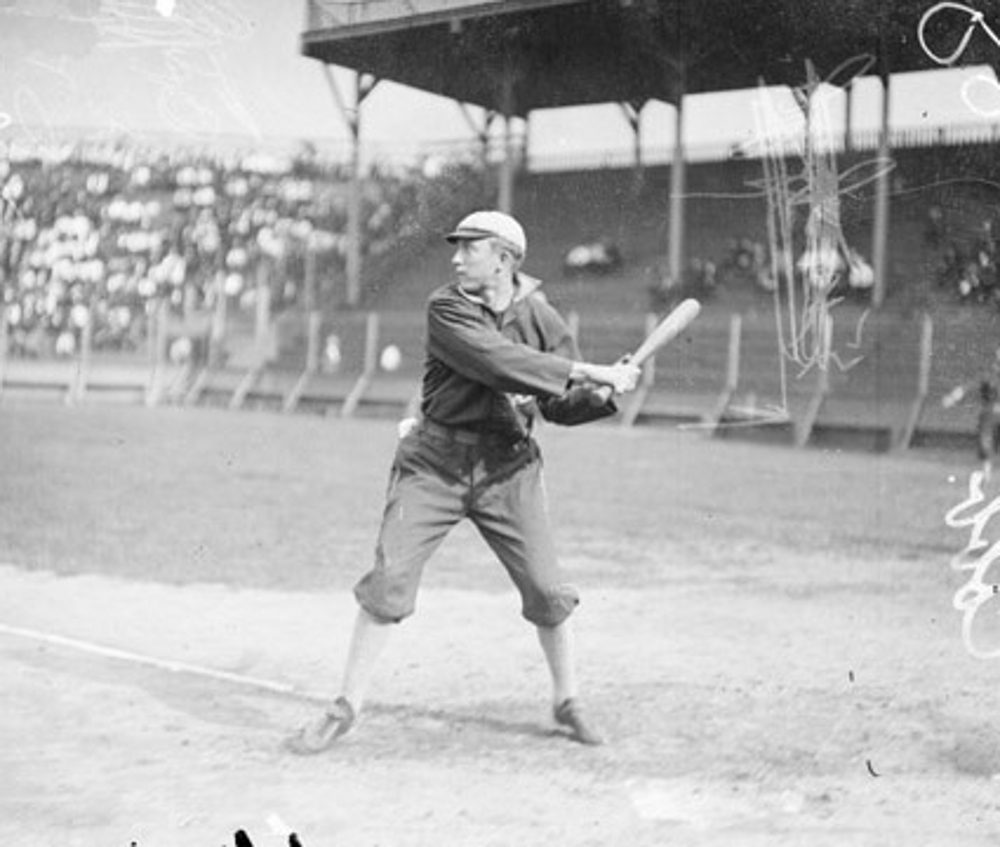
I wonder if baseball fans recognize greatness early on in a player’s career? Ty Cobb started his major league career with the Detroit Tigers in 1905 and had his first breakout season in 1907 at the age of 20 when he led the American League in hits, stolen bases, RBI’s and a .350 batting average. The photograph above is from 1907, taken at Southside Park in Chicago, home to the White Sox from 1900-1910. So did the fans in Chicago realize they were watching a player who would electrify baseball for the next twenty years?
One thing you notice by looking at Ty Cobb is that he had a unique batting stance. His legs and feet would many times be planted way ahead of home plate and his hands spread apart on the bat. It enabled him to spray balls all over the field and get to the pitch before it could do what the pitcher wanted it to. He hit .366, the highest career batting average ever by a major leaguer.

Here Cobb plays against the White Sox in 1908 at Southside Park in front of a packed house. Once again notice how far ahead Cobb is standing in front of the plate. One criticism of Cobb besides his nasty disposition, was that he didn’t hit a lot of home runs like Babe Ruth. Cobb bristled at that comparison, saying anyone could hit home runs, it took talent to be a spray hitter like he was.
On May 5, 1925 visiting St. Louis against the Browns, Cobb told a reporter in the dugout that “today for the first time my career I’m going to go for home runs.” The comment is apocryphal, but that day Cobb went six for six. Home runs? He hit three.

A new feature of our web site: photos and short biographies of glamor girls of the past.
These are women that were more than just beautiful, they were talented and were able to cut out successful careers for themselves during an era when men dominated the entertainment industry. Of course with the passage of time, many of these stars have dimmed and are now distant memories. We hope to bring them to light again to a wider audience.


Maude at age 8 with mother Margaret Fealy.
Maude Fealy (born Maude Hawk) in Memphis, Tennessee, started her career at the age of 3 in the legitimate theater with her mother, actress Margaret Fealy. Margaret divorced Maude’s father, James Hawk and then went by her maiden name of Fealy and Maude also adopted her mother’s maiden name.
Fealy’s exact birth date was never clearly established and contemporary reports range from March 4, 1881 to 1886. The Social Security Death Index lists her birthday as March 3, 1882


Fealy hit the big time just before the turn of the century when theatre impresario Augustin Daly discovered her playing Juliet and signed her to a five year contract. Daly died in 1899, effectively canceling the contract and Fealy was then courted by all the major playwrights to appear in their productions. Fealy quickly became a star in many Broadway and London productions. Among the many plays she appeared in were: Quo Vadis, Sherlock Holmes, The Professor’s Love Story, Heart’s Courageous, The Truth Tellers and On the Quiet. She cemented her reputation as a fine actress by playing the female lead in several of the first British actor ever knighted, Sir Henry Irving’s plays including, Becket, The Lyons Mail, Waterloo and Louis XI. Continue reading
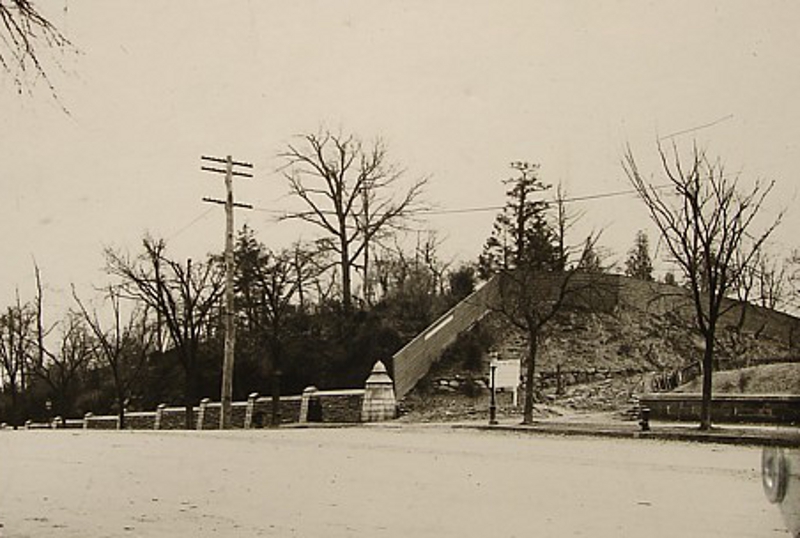

These rural looking scenes are of The Boulevard, now known as Broadway taken around 1895. On the left is Broadway and 153rd Street and on the right, Broadway and 158th Street.
At Broadway between 153rd and 154th Street was the approximate site of Washington’s second fortification of entrenchments in the Battle of Manhattan during the Revolutionary War in 1776.
On the western corner of Broadway and 158th Streets stood the second building of the Church of the Intercession. The congregation moved into their larger, current building at Broadway and 155th Street in 1915.
Billy Klaus Takes Down Yogi Berra, Ted Williams Picks Up 2,000th Hit – 1955


In this series of photographs from August 11, 1955 at Yankee Stadium, Red Sox shortstop Billy Klaus smashes into Yankees catcher Yogi Berra.
The play unfolded in the fifth inning after Klaus singled and Ted Williams hit a ground-rule double advancing Klaus to third. Norm Zauchin then hit a fly ball to right and Hank Bauer made a great throw to Berra. Klaus barreled into Berra knocking the ball loose.
What I like about the photograph besides the action, is that umpire Jim Honochick looks on rather passively not moving very far from where he calls balls and strikes, to make what should have been a very close call at the plate!
The Red Sox would lose this game 5-3. After the game with an ice bag pressed to his face Berra was sore and said, “I don’t know what he hit me with, but I hurt all over.”
One very important event happened in the game, Ted Williams became the 96th player in major league history to record 2,000 hits. He picked it up on a bloop single in the first inning that fell in left center between Phil Rizzuto, Mickey Mantle and Elston Howard. When Williams reached first he jokingly commented to Yankee first basemen Moose Skowron, “What a smash.”
With the hit, Williams became one of only four active players to be in the 2,000 hit club, the others being Stan Musial, Enos Slaughter and Mickey Vernon.

We have previously featured an overview of the Times Tower Building and Times Square. Now we present a street level view looking west from Broadway. The date is October 3, 1915 and there are a handful of people milling about on the street. Continue reading