Frank Chance, Subject of Baseball’s Most Famous Poem
These are the saddest of possible words:
“Tinker to Evers to Chance.”
Trio of bear cubs, and fleeter than birds,
Tinker and Evers and Chance.
Ruthlessly pricking our gonfalon bubble
Making a Giant hit into a double –
Words that are heavy with nothing but trouble:
“Tinker to Evers to Chance.”
Just what is a “gonfalon” anyway? It is a pennant or a flag.
When columnist Franklin P. Adams wrote the poem “That Double Play Again” (later retitled “Baseball’s Sad Lexicon”) in 1910, Frank Chance was the manager and first baseman of the Chicago Cubs. With double play partners Johnny Evers and Joe Tinker, the three would be immortalized first in the popular poem and later in the Baseball Hall of Fame.
Chance played for the Cubs from 1898 -1912 and was claimed off waivers by the Reds after the 1912 season. A month later he was claimed off waivers again from the Reds by the Yankees. In 1913, Chance became the manager of the New York Yankees and played a few games at first base.
He managed the Yankees for two seasons, leading the team to 7th place in 1913 and 6th place in 1914.
Frank Chance died at the age of 48 on September 15, 1924. He was elected to the Hall of Fame in 1946, 22 years after his death by the Old Timers Committee.
Chicago, June 10, 1951 – Scooter Makes Them Laugh — Phil “Scooter” Rizzuto (right), diminutive New York Yankees shortstop, draws a laugh from Chicago White Sox infielders Nelson Fox (left) and Ed Robinson before game in Comiskey Park yesterday. Fox is batting at a healthy .360 clip while Robinson leads the American League in the runs batted in department with 48 and is tied with Ted Williams in homers with 11. Rizzuto drew the laugh when he told Fox not to stand on his toes in an attempt to look taller than he. (AP Wirephoto)
Annabelle Whitford Moore Buchan And The Original “Gibson Girl”
The epitome of feminine beauty at the turn of the century was captured in artist Charles Dana Gibson’s skillful drawings of women, that came to be known as “Gibson Girls.”
Annabelle Whitford was 15 years old when she achieved notoriety dancing at the Columbian World Exposition in Chicago in 1893. Annabelle appeared in movies performing her dances under the name Annabelle Moore from 1896 -1902. She went onto a successful stage career hitting the top as a star in the Ziegfeld Follies of 1908 playing one of the “Nell Brinkley Girls.” Brinkley (September 5, 1886 – October 21, 1944) was a female newspaper artist whose creations were very similar to the Gibson Girls. In 1910 Annabelle married Dr. Edward James Buchan and retired from performing.
In her obituary in the New York Times it was said Annabelle “was the symbol of beauty in her day. She was billed as ‘the original Gibson Girl’ because of her striking resemblance to the Charles Dana Gibson portrait.” The illustrations below are from Gibson’s 1902 book The Social Ladder.
Fascinating Museum Of Memories Collection Displayed At Grand Central Terminal’s Transit Museum Annex
This year marks the 100th anniversary of the current Grand Central Terminal. Jane Greengold is one of a dozen contemporary artists taking part in an exhibition, On Time /Grand Central at 100. Her work is an installation of objects that have been lost and then found over the past 100 years by one family of conductors who worked on various train lines at Grand Central.
Greengold describes how the project came together:
“When I started working on a piece for the Centennial of Grand Central Terminal, I walked around the Terminal for days, looking for inspiration. I was lucky to meet a conductor, Joe Wenham, willing to chat. He told me his father, grandmother, and great-grandfather had all been conductors, starting before 1913. I said his family itself could illustrate the history of the Terminal and he told me that his great-grandfather had begun a family tradition of retrieving items he had brought to the Lost and Found and that had not been reclaimed, even buying items valuable enough to be sold. He began on a whim, but then decided to create a personal museum of memories of his passengers. The family has kept this up for 100 years.
They did not usually keep the kinds of objects most often lost — umbrellas, gloves, hats, glasses – but kept things that happened to strike their fancy. Neither Joe nor his father has been as enthusiastic about collecting as the first two generations, but they didn’t stop. So instead of creating a work for the Centennial, I persuaded Joe to share some of the family collection, and together we chose the objects presented here.”
This is the sort of thing that will bring a smile to your face if you go see it in person. I love the fact that the Wenham family contemporarily tagged each item with where and when the object was found, along with their astute and sometimes witty observations. Below is a sample of objects from the collection.
The photograph caption recaps what is on the tag: the date and train the object was found on and a remark from the Wenham who found it. You can click on any picture to enlarge.
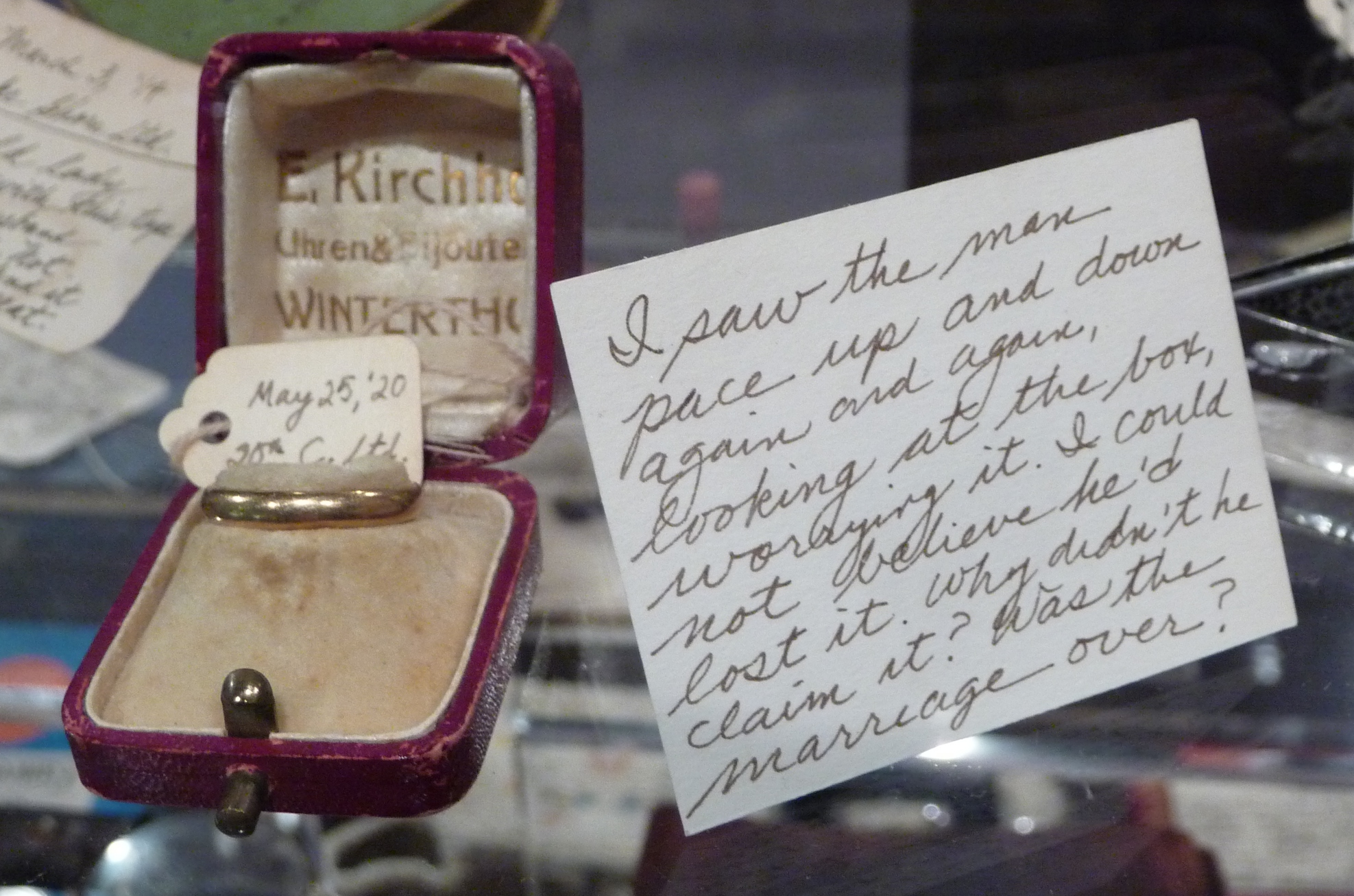
May 20, 1920 – Twentieth Century Limited “I saw the man pace up and down again and again, looking at the box worrying it (sic). I could not believe he lost it. Why didn’t he claim it? Was the marriage over?”
June 25, 1924 – Special “These were the happiest bettors I ever saw”
February 13, 1931 – 20th Century Limited “I never saw anyone wearing this. I don’t even know if it was a man or a woman.”
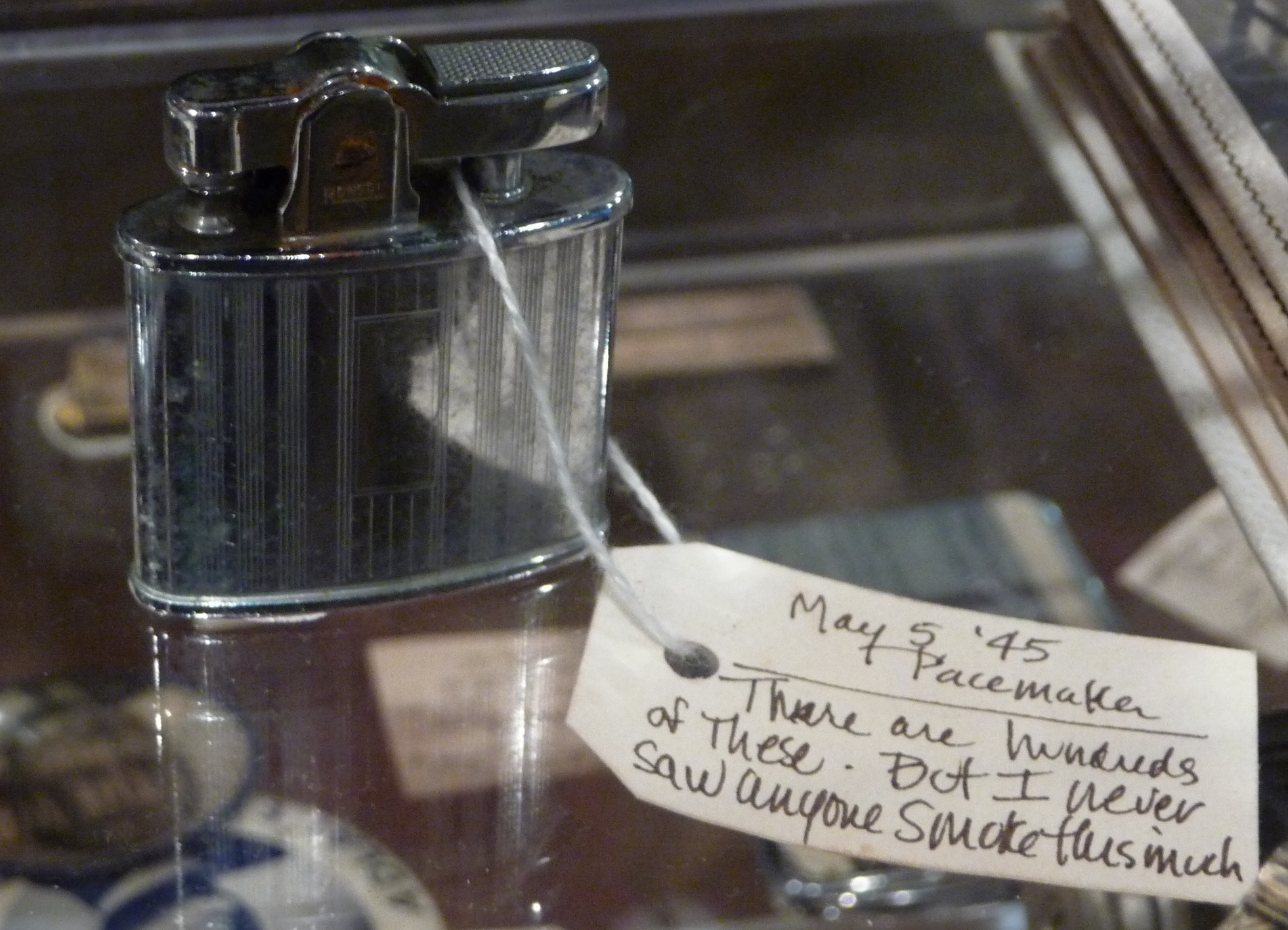
May 5, 1945 – Pacemaker “There are hundreds of these. But I never saw anyone smoke this much”
February 27, 1946 – Pacemaker “I’d be so sad if I lost my babies photos.”
October 3, 1946 – Pacemaker “Girls! were playing with cars! Maybe they’ll be race car drivers! It’s a German car!”
March 3, 1947 – Empire State “The woman was as round as the bottle”
September 17, 1958 – 20th Century Limited “Boring travel diary of a spoiled 13 year old. Went to Europe on Queen Mary, lost diary on a fancy train. Must be a brat.”
November 28, 1963 – Empire State “I talked to the boy who had this. He’d planned to go to the game but then went home for comfort after the assassination. Wasn’t sure he’d go to the game now. I guess he didn’t.”
On Time /Grand Central at 100 is on view at the New York Transit Museum Gallery Annex & Store at Grand Central until July 7, 2013.
Brigitte Bardot co- starred in Viva Maria! (1965) with Jeanne Moreau. The Louis Malle film was partially responsible for the development of the MPAA ratings system for films. Continue reading →
New York City used to have an annual May Day Parade where Socialists, Communists, unions and other pro-labor forces would march down a route and finally assemble around Union Square. Most of the time the assemblies have been peaceful. There were some exceptions during the Depression when work was in short supply and occasional violence would break out on May Day.
In recent years, May 1 in New York City has turned into the flavor of the moment, general protest or demonstration for a wide array of left-wing causes.
In 1935 there were two May Day Parades both held without incident. One was held by the Socialists whose route took them along Eighth Avenue from 15th Street to Columbus Circle and then up Central Park West to 72nd Street. The Communists held their own parade starting at Madison Square on Fifth Avenue up to 32nd Street, across to 7th Avenue and then down to 17th Street and back across to Union Square.
There is no description on this May 1, 1935 photograph which parade this was taken at, but the buildings in the background tell us this is Union Square looking east along 17th Street, so it is surely the Communist parade.
Everyone seems to be paying a lot of attention to the parade…except the one man in the white fedora reading a newspaper.
If this picture was taken in 2013 instead of 78 years ago, I’m sure conspiracy theorists would say there is something very suspicious underfoot here.
Andy Johns, Led Zeppelin and Rolling Stones Right Hand Man; Storm Thorgerson, Album Cover Creator Extraordinaire; Christina Amphlett, Lead Singer Divinyls; All Die in April
April has been a bad month for the world of rock ‘n roll, as death has taken away three unique talents.
Andy Johns who worked on some of the greatest rock albums of all-time as a producer and engineer died in Los Angeles on April 7, at the age of 62 due to complications of a stomach ulcer.
Johns was a name not known to casual rock fans because he worked behind the scenes, but his contributions to dozens of classic albums is immeasurable. From the Rolling Stones Exile on Main Street to Led Zeppelin’s greatest period of production in the early 1970’s, Johns was setting up and overseeing the recording of albums that will be played for as long as people listen to rock n’ roll. Some of the many bands and artists Andy Johns worked with included Free, Eric Clapton, Blind Faith, Cinderella, Van Halen, Joe Satriani and Mott The Hoople.
After Andy Johns died I scanned The New York Times on a daily basis in disbelief that they did not cover his death. Nearly two weeks after his passing, an obituary finally appeared.
Here, Andy Johns talks about his experiences working with Led Zeppelin guitarist Jimmy Page and the recording of Led Zeppelin’s classic Led Zeppelin IV (a.k.a. 4 Symbols or Untitled) and the song Stairway To Heaven.
David Gilmour and Roger Waters of Pink Floyd between Storm Thorgerson photo possibly by Jill Furmanovsky
Storm Thorgerson was a name even less known by the general public than Andy Johns, but literally millions of people have seen his work. Thorgerson, as half of the design firm Hipgnosis with Aubrey Powell, created dozens of the most iconic record album covers, sleeve and insert artwork of all time. After the dissolution of Hipgnosis in 1983, Thorgerson ran his own firm and continued working until he died on April 13 at the age of 69 from cancer.
Thorgerson’s work was surreal and many times bizarre. But it caught your attention like any great artwork that was meant to be contemplated. Millions of people who bought albums would study the large canvas that an LP album offered for insights and clues about the music and the band they were listening to. With the supremacy of CD’s in the 1990’s, cover artwork was given a much smaller space and a less important role in point of purchase sales of music. Despite this, Thorgerson maintained a steady stream of clients who wanted original and outstanding works of art to go with their musical output.
Best known for his long association with Pink Floyd, Thorgerson also created album covers for a wide variety of bands including Led Zeppelin, Yes, Scorpions, UFO, Phish, AC/DC, 10cc, Black Sabbath, The Alan Parsons Project, Anthrax and many others.
In the original clip we had up, Thorgerson talks about the beginnings of Hipgnosis, but that clip was taken down. Instead here is the trailer of a documentary about Storm.
The Divinyls lead singer Christina Amphlett was known in the United States as more of a one-hit wonder for the 1991 top ten song I Touch Myself than for anything else. But in her native Australia, Chrissy Amphlett was a rock legend. The Australian Prime Minister Julia Gillard even spoke of the impact of Amphlett’s death and what she meant to the Australian music scene.
Amphlett died in New York City at the age of 53 on April 20 after battling multiple sclerosis and breast cancer for many years.
The Divinyls were not just a pop band, they could rock as hard as anybody as evidenced here in a 1982 live performance of Boys in Town. With her schoolgirl outfit Amphlett displays some head-banging moves reminiscent of AC/DC’s Angus Young.
Rare Postcards Of The Upper West Side And Harlem 1900 – 1915
Broadway and 141st Street Looking North circa 1903
Most old postcards depicting turn of the century New York City usually show the typical tourist attractions, landmarks and notable buildings of the city.
It was uncommon for the big postcard manufacturers to produce postcards of average streets, buildings or scenes in New York City for people to send to their friends back home. After all who wanted to see an apartment building on 117th Street and Seventh Avenue?
That is what makes these scenes of New York City and upper Manhattan rather unique. They feature the areas not frequented by tourists. They are photographs, rather than illustrations, and were typically produced in small quantities by smaller or unnamed card manufacturers. The absence of vehicles and people on the streets belies the rapid housing development that occurred in upper Manhattan during the time. Click on any postcard to enlarge.
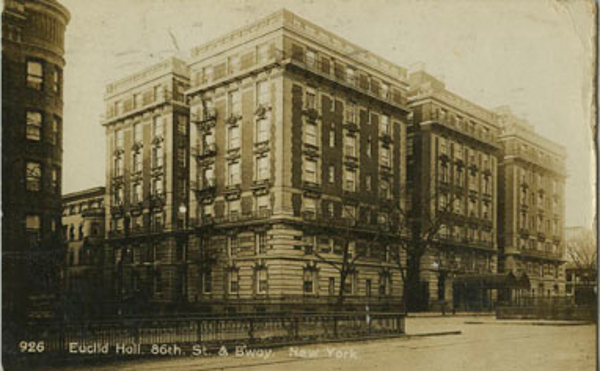
Euclid Hall Apartments 2349 Broadway, northwest corner of Broadway and 86th Street. This view shows the Euclid Hall Apartments which was built in 1903 by Hill and Turner is a heavily ornamented seven story red brick building. It is still standing and the ground floor has been modernized and now houses commercial businesses.
The William Apartments looking west at 243 West 98th Street, northwest corner of Broadway and 98th Street. The William, a seven story building was completed in 1899 and is currently a condominium. To the right of The William behind the trees is the Arragon at 2611 Broadway. Continue reading →
Hedy Lamarr and Cecil B. DeMille On The Set Of “Samson and Delilah”
The 1949 biblical epic, Samson and Delilah starred the beefy Victor Mature and the beautiful Hedy Lamarr in the title roles. According to legend, when Groucho Marx was asked what he thought of the movie he replied with one of the greatest bon mots ever. Groucho said he “couldn’t enjoy a film where the leading man’s tits were bigger than the leading lady’s.”
The caption on the back of this October 28, 1949 publicity photograph reads:
THERE CAN BE QUIET — This is one of the few serene moments in “Samson and Delilah.’ Hedy Lamarr (left) with Producer- Director Cecil B. DeMille maintain an interested silence while technicians set up the equipment for the next scene. It is Ms. Lamarr’s first Technicolor picture and also her first under the DeMille banner. In it she enacts one of history’s most exotic and celebrated personalities, the Delilah of the Book of Judges, from which Mr. DeMille has extracted the framework of his big-budget production. (PLEASE CREDIT SAMSON AND DELILAH)
On this date, Wednesday, April 11, 1973, the New York Yankees were at home against the Cleveland Indians and playing their fifth game of the year. They had lost their first four.
Bobby Murcer batting clean-up went 3 for 4 with a double and two singles and scored two runs in a Yankee 4-0 victory.
It is sometimes hard to believe that decades have passed on events that seem like they occurred only a few years ago.
Growing up in the Bronx, my two favorite Yankees were Ron Blomberg and Bobby Murcer. It was a little easier to root for Murcer because he was in the line-up a lot more than the oft-injured Blomberg.
Murcer was probably the best position player on those late 1960’s, early 1970’s Yankee teams which were generally not very good. Until Thurman Munson, Lou Pinella, Chris Chambliss, Graig Nettles and others joined the Yankees, the team had few bright spots.
Because of their shared Oklahoma heritage and other vague similarities, some fans were expecting (unfairly) for Murcer to be the next incarnation of Mickey Mantle and carry the team to the playoffs.
No player should have that burden placed upon him. Murcer had solid season after solid season, but he knew that he was never going to be the next Mickey Mantle.
Bobby Murcer was traded in a shocking blockbuster deal after the 1974 season and missed out on being a member of the Yankee world championship teams of 1977 and 1978. He returned to the Yankees in 1979 and did get into a World Series in a losing effort against the Dodgers in 1981. Bobby Murcer retired after 1983 and became a Yankee TV and radio announcer. Beloved by many fans and players in baseball, Murcer contracted a brain tumor and died of cancer at the age of 62 in 2008.
Some interesting notes concerning this April 11 game –
It was a day game. Why play night games in New York in early April? So the temperature can drop an additional 25 degrees and fans and players can freeze? MLB and the teams didn’t try and maximize attendance figures by playing in conditions not conducive to baseball (see current November World Series as an example).
The attendance was 5,059. (Which is the rationale that now most weekday games are scheduled as night games.)
The game was completed in two hours and 29 minutes.
Mel Stottlemyre pitched a complete game two hit shutout, striking out six but walking eight.
Indians starter Gaylord Perry also went the distance. Perry ended up with 19 wins and 19 losses in 1973 and pitched 29 complete games. That is four more complete games than the top five (Verlander, Dickey, Hernandez, Peavy and Harrison) complete game leaders combined for in 2012.
All three of Bobby Murcer’s hits were to left field. Murcer generally could not stand hitting against Gaylord Perry and constantly complained publicly that Perry was cheating by loading-up the ball. For his career Murcer batted .232 against Perry.

 These are the saddest of possible words: