Category Archives: History

Part 3 Even More Vintage New York City Books With Great Art Deco Dust Jackets

The Art of The Book #3 – New York City Deco Dust Jackets From The 20′s & 30′s

We continue with our look at vintage books about New York City with great dust jackets. (click here to read part 1 and here to read part 2)

Starting with a look at an all-time classic of deco design, New York Nights. (click on any photo to enlarge)

Art Deco dj New York NightsNew York Nights by Stephen Graham, New York: George H. Doran, 1927, dj illustrator, Kurt Wiese

A native of Scotland, author Stephen Graham (1884-1975) goes on a tour of  jazz age nightclubs, speakeasies and cabarets. Graham provides the grittier side of life in an up to the minute description of prohibition New York neighborhoods, establishments and people.

Kurt Wiese (1887-1974) illustrated over 300 books and later became an award-winning children’s book author. Besides the knockout jacket cover, Wiese drew all the illustrations contained in the book. This was the first American book he worked on. Continue reading →

Part 2 More Vintage New York City Books With Great Art Deco Dust Jackets

The Art of The Book #2 – New York City Deco Dust Jackets From The 20′s & 30’s

We continue our look at some great New York City books from the 1920’s and 1930’s with exceptional artwork on their dust jackets. (click here to read part 1)

We begin with graphics on a dust jacket worthy of a large size poster from the quintessential art deco New York book. (click on any photo to enlarge)

Art Deco dj New York Paul MorandNew York by Paul Morand and Joaquin Vaquero Palacios. New York: Henry Holt, 1930, dj illustrator, Joaquin Vaquero Palacios.

A witty description of New York, via French writer Paul Morand, (1888-1976) from four visits he made to New York, none longer than a month, from between 1925-1929. Morand later became a supporter of the French Vichy regime.

Joaquin Vaquero (1900-1998) as he is credited in the book without the Palacios surname, was a Spanish architect and painter. His paintings are held in museums across the globe. Continue reading →

Part 1 Vintage New York City Books With Great Art Deco Dust Jackets

The Art of The Book #1 – New York City Deco Dust Jackets From The 20’s & 30’s

From the 1920’s until the 1940’s, book publishers put out some phenomenal books about New York. They also hired talented artists to design the book’s dust jackets.

The eye-catching art deco graphics were meant to attract potential buyers. Unfortunately, most people who purchased books 80 years ago would discard the dust jacket once they brought the book home with them.

Because of that, many of these books from that time are very scarce in their original dust jacket.

This is the first part of a five part series looking at the dust jackets of books about New York City, the artists that created the work and the authors.

Below are some fine examples of New York City books from the golden era of publishing.

(click on any photo to enlarge)

Art Deco dj New York By QuexNew York by Quex.  New York: David McKay, 1928, dj illustrator, Dixon (possibly Arthur A. Dixon)

Quex was the pseudonym of reporter George H.F. Nichols (1881-1933) of The Evening News of London. Nichols was at the time of his death one of the highest paid reporters in the world. Nichols was the originator of articles written in the form of “the diary of the man about town.” Quex’s observations about about New York are well worth reading.

The dust jacket is classic New York, but I am unsure about the attribution to Arthur Dixon, so we will leave biographical information out until someone can provide a conclusive identification on the artist.

Continue reading →

Times Square New Year’s Eve: Celebrations Of The Past

4 Photographs Of Times Square On New Year’s Eve 1952-1965

Another New Year’s celebration tonight. What did it look like half a century ago?

Pretty much the same.

Here are four photographs of Times Square as it appeared during New Year’s Eve celebrations during the 1950’s and 1960’s.  The amount of light emanating from the vicinity leads to an overexposure, making this a difficult scene to capture.

Times Square New Year’s Eve 1952

Times Square New Years Eve December 31 1952

Continue reading →

Helen Keller And Al Smith 1929

New York State Commission For The Blind Christmas Fundraiser 1929

Helen Keller Al Smith 1929

This news photograph reads:

Helen Keller “Sees” And “Hears” Al Smith — World Famous Blind Deaf-Mute Meets Ex-Governor For First Time At Sale Benefiting The Blind

New York City – Photo Shows: Helen Keller, remarkable and world-famous blind deaf-mute “seeing” and “hearing”former Gov. Alfred E. Smith, who is greeting her with his famous smile and a word of cheer at the annual Christmas sale for the benefit of the New York State Commission for the Blind. Witnesses at the meeting of the famous people said that Miss Keller’s words could be understood. – December 19, 1929

Helen Keller was deaf and blind from infancy. She was born in Alabama on June 27, 1880.  Early in her childhood Miss Anne Sullivan was employed to instruct her, and so well succeeded that by means of touch she was able to communicate knowledge of the world that was closed to her understanding through the usual senses.

Helen Keller’s sense of touch was so acute that she was capable of understanding the speech of another merely by the placing of her fingertips upon their throat. Through the aid of Miss Sullivan, Keller became a highly educated young woman, earning a degree at Radcliffe College. She would go on to write 12 books and many magazine articles. She devoted her life advocating for people with disabilities.

Keller’s childhood story and that of her teacher Anne Sullivan, was told quite dramatically in the Broadway smash The Miracle Worker which ran for 719 performances from 1959-1961. The show won five Tony awards in 1960 including Best Actress in a Leading Performance for Anne Bancroft.  The1962 movie version featured the Broadway stars reprising their roles; Patty Duke as Helen Keller and Anne Bancroft as Anne Sullivan. Each won an Academy Award for their performances; Bancroft for Best Actress and Duke for Best Supporting Actress.

Alfred E. Smith was born December 30, 1873 on the lower east side of New York. He was elected Governor of New York, 1919-1920 and again from 1923-1928. In 1928 he became the first Roman Catholic to run for President and was defeated soundly by Herbert Hoover.  After the election Smith became president of Empire State, Inc. the firm that built the Empire State Building.

Al Smith died on October 4, 1944. Helen Keller passed away June 1, 1968.

Old New York In Photos #24 – Fort Tryon

Fort Tryon Hill As Seen From Fort George Hill

Fort Tryon Hill

The northern area of Manhattan: Washington Heights, Inwood and Fort Tryon were among the last areas of the island to be developed. Much of the area remained somewhat rural until the early 20th century as evidenced in this undated photograph.

The area of Fort George Hill was at the time of the Revolution called Laurel Hill. Upon it the British constructed an extensive fortification called Fort George. The Fort was located at what would today be 192nd Street and Audubon Avenue. The neighborhood that sprung up around this area was given the name of Fort George Hill.

Fort Tryon Hill was one of the last portions of Manhattan to pass from Indian ownership to the possession of the Dutch. The aboriginal owners were the Wickquaskeek corrupted to Wickers Creek Indians.

Fort Tryon Map Showing Land Ownership and Parcels

Fort Tryon Map Showing Land Ownership and Parcels

Fort Tryon was named by the British for Major General William Tryon (1729–1788), the last British governor of colonial New York. Fort Tryon was part of a series of posts running along the Hudson River during the revolutionary war.

Between 1901 and 1904 Cornelius Kingsley Garrison Billings acquired several property lots from many different owners around Fort Tryon Hill. Billings had begun assembling an estate that culminated in a stately mansion being built which was completed in 1907. The mansion can be seen on the right hand side of the photograph. Billings sold the mansion in 1916 to John D. Rockefeller. In 1917 Rockefeller donated the Billings estate and surrounding properties which he had acquired to New York City and the area was turned into Fort Tryon Park. The mansion was destroyed by fire in 1926.

First Pneumatic Mail Delivery In New York 1897

The Pneumatic Mail Tubes And The “Age of Speed”

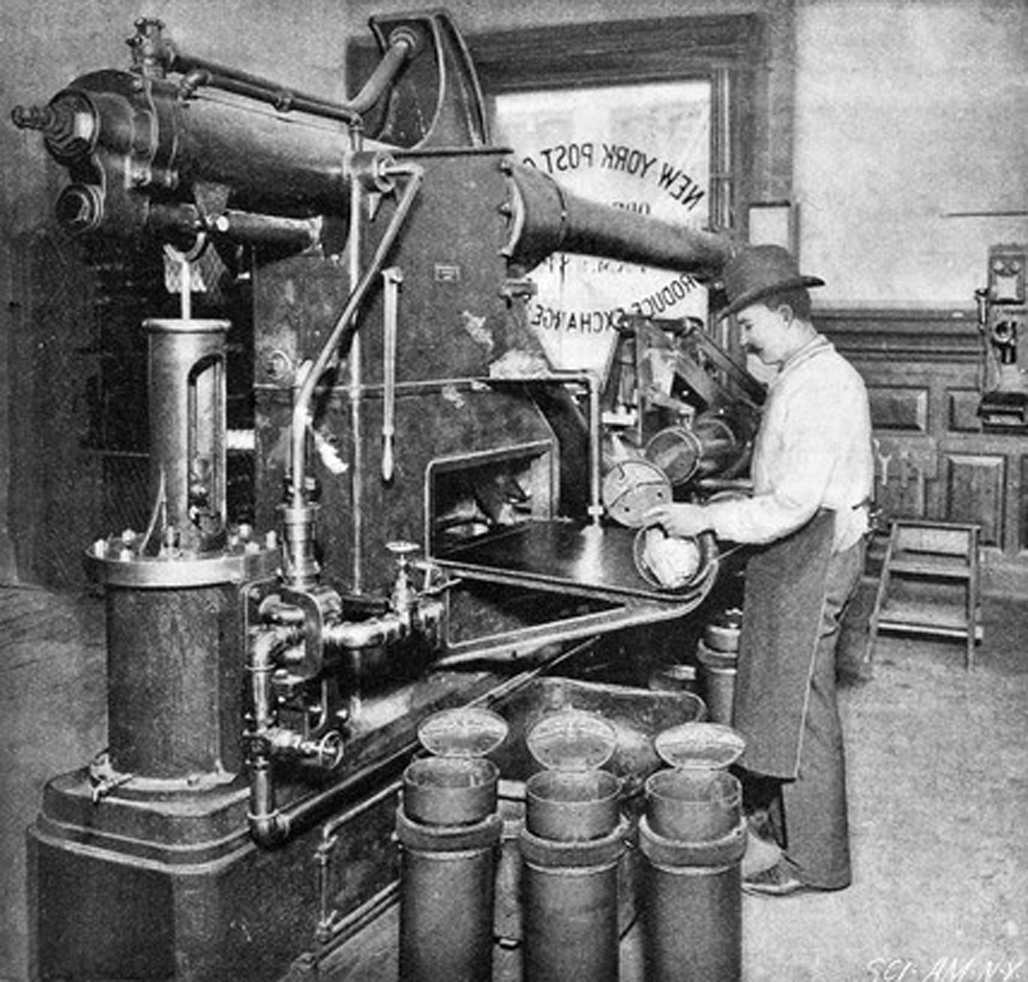
Pneumatic Tubes Produce Exchange Post Office 1897

Reading Howard Wallace Connelly’s highly entertaining 1931 autobiography Fifty-Six Years In The New York Post Office–  A Human Interest Story of Real Happenings in the Postal Service (self-published) the following anecdote begins Chapter VI:

When the pneumatic tubes were installed at the General Post Office, October 7, 1897, we Supervisors were given a fine treat after the ceremonies were over. A rough hastily constructed row of steps (circus show style) had been erected facing the tubes. Senator Chauncey M. Depew was Master of Ceremonies. Probably over a hundred friends and Post Office officials were spectators. The first tube contained only a large artificial peach. The roar of laughter that greeted it was heartily joined by the Senator. A Bowery audience that had attended a political meeting at which he was the principal speaker, instead of trying to break up the show, took quite a liking to the speaker and a loud voiced man yelled, “Chauncey, you’re a peach.” Hence the laugh when the first tube arrived. From the second tube, a cat was taken. How it could live after being shot at terrific speed from Station P in the Produce Exchange Building, making several turns before reaching Broadway and Park Row, I cannot conceive, but it did. It seemed to be dazed for a minute or two but started to run and was quickly secured and placed in a basket that had been provided for that purpose.  A suit of clothes was the third arrival and then came letters, papers, and other ordinary mail matter.

Hah-ha very funny. The postal officials must have had a ball putting a cat into the tubes. Can you imagine the public outcry if something like that was done now?

Connelly omits that the first parcel actually sent through the tubes was sent by Depew to the Produce Exchange Post Office which included Continue reading →

New Yorker’s Starved For News -1953 The End Of The Strike

Newspaper Strike Ends December 8, 1953

Photo UPI

Beginning November 28, 1953, six of New York’s seven daily newspapers went on strike. 400 photo engravers demanded better pay and working conditions and the other newspaper employees honored their picket lines. For eleven days New York City had only one newspaper available to them, The New York Herald Tribune. Because the Herald Tribune had an outside commercial firm doing their photo engraving, they were the beneficiaries of added readership. Continue reading →

How The Super Wealthy Woman Of 1903 Lived

“Free To Indulge Her Whims and Fads In Whatever Way The Gay World Of Society, And Her Own Inclination, May Lead Or Tempt Her”

Let’s say you are the wife of a turn of the century financier. How do you run your household and spend your time and money? Is there no one to teach you except your family or contemporary one percenters?

Fortunately there was a book written just for the rare woman who needed such advice.

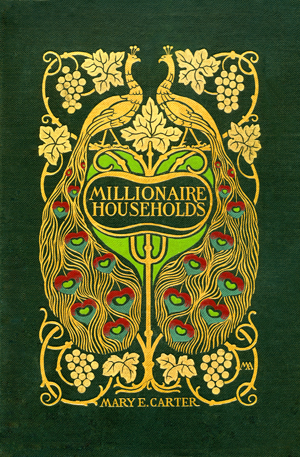
The book which could now be slightly updated and reprinted for today’s super wealthy billionaires is called, Millionaire Households and Their Domestic Economy With Hints Upon Fine Living by Mary Elizabeth Carter published by D. Appleton & Company 1903.

Miss Carter was not a society lady, but had managed a house for the wealthy Vanderbilt family.

With chapters such as Fine Living or Housekeeping; The Hostess’s Wardrobe; The Lady’s-Maid; The House-Maid; The Parlor-Maid; The Servant’s Dining Hall-Maid; The Butler and His Staff; The Valet; Monsieur Le Chef and His Aids; Side-Lights and Shifting Scenes When The “Smart Set” Dine; the book has everything you would need to know as the grande dame running an American version of Downton Abbey.

We learn from Miss Carter that a butler is more than just a servant. She writes, “When the ubiquitous newspaper reporter appears the butler knows how to get rid of him with as little information imparted as will spare the family from false statements or ridicule. During these interviews he requires his entire stock of aplomb. He must withhold all information possible, while appearing to give it out freely.”

This book was not for the 1% that we hear so much about today. In 1903, Millionaire Households and Their Domestic Economy would apply to only o.oo5% of Americans, since there were about 4,000 millionaires out of 80 million people living in the United States at the turn of the century. Approximately half of those millionaires resided in New York State. It is safe to say this book probably did not sell very many copies. It is also important to remember how much a million dollars was back in 1903. One would need to have about twenty million dollars today to have the purchasing power of a millionaire in 1900.

Comparatively today, globally there are about 10 million people (exclusive of their home) with a net worth  of one million dollars or more and approximately 3.1 million of them reside in North America.

The book gives a complete view into the way the millionairess should conduct her household. While the advice the book offers might seem frivolous and somewhat outrageous to read today, Continue reading →

The Gates That Have Been Closed For Over 360 Years And Will Never Be Opened Again

The Bear Gates, Traquair Castle, Scotland

Photo Traquair Castle Bear Gates courtesy www.stravaiging.com

The Scottish lament of “Will ye no come back again,” refers to the 1746 exile of Charles Edward Stuart (1720-1788) otherwise known as Bonnie Prince Charlie, the second Jacobite pretender to the thrones of England, Scotland and Ireland.

Traquair Castle is located 30 miles south of Edinburgh in the town of Innerleithen, Scotland. In 1745 Bonnie Prince Charlie and the Jacobite army passed through the Bear Gates during his visit to the 5th Earl of Traquair. Afterwards the Earl, a fervent supporter of the Stuart cause, ordered the Bear Gates be closed and not re-opened until a Stuart again sits on the Scottish Throne.

The Battle of Culloden took place on April 16 , 1746 and Bonnie Prince Charlie was soundly defeated by the son of King George II, the Duke of Cumberland. Bonnie Prince Charlie took flight, ending the cause of the Stuarts to regain the throne. He lived the rest of his life in exile and died without having children.The Royal House of Stuart became extinct in 1807 with the death of Charles’ brother Henry Benedict Stuart.

The Bear Gates will never be opened again.