Category Archives: Baseball

1949 Yankees All-Stars – DiMaggio, Berra, Henrich, Reynolds & Raschi

New York Yankees All-Stars Of Yesteryear

Vic Raschi Tommy Henrich Joe DiMaggio Allie Reynolds Yogi Berra Yanks All Stars July 6 1949 photo © Acme

In 2014, the struggling New York Yankees have three players that were named to the All-Star team: Derek Jeter, Dellin Betances and Masahiro Tanaka, who will not play because of an elbow injury.

In 1949 the Yankees had five players play on the All-Star team. Seen in this photo from left to right are Vic Raschi, Tommy Henrich, Joe DiMaggio, Allie Reynolds and Yogi Berra.

There were 32,577 fans in attendance in what turned out to be a slugfest at Brooklyn’s Ebbets Field, as the American League topped the National League 11-7. Joe DiMaggio drove in three runs and Vic Raschi pitched three scoreless innings to get the save.

Crazy Baseball All-Star Game Ticket Prices

$2.40 For An All-Star Game Box Seat?

Fenway Park ticket booth before the 1946 All Star Game

$2.40 for a box seat is not the crazy price we are talking about. Those days are long gone.

The scene above is Fenway Park where the 1946 All-Star Game was played. As fans lined up for tickets the night before the game at the box office (what a novel idea), they had the choice of purchasing box seats for $2.40 or reserved seats for $1.80.

Please direct your attention to the kids, wearing suits no less, neatly lined up waiting for tickets. Yes, even kids could save up $1.80 by delivering newspapers, mowing lawns or doing chores in 1946.

The crazy prices we are talking about are for the current baseball All-Star game.

According to a May 9 Forbes Magazine story, the 2014 baseball All Star Game in Minneapolis is the second most expensive ticket in All-Star game history. The article points out that according to a ticket broker who owns hundreds of MLB All-Star tickets the average ticket price for the 2014 All-Star Game is significantly higher than the previous four All-Star games, with a current average ticket price of $1,096. Continue reading

Willie Mays, Roberto Clemente Before The 1961 All-Star Games

Before The Mid-Summer Classics Of 1961

NL All Stars 1961 Mays Cepeda Murtaugh Burgess Clemente

Pittsburgh (July 1) – All Stars – Danny Murtaugh, manager of the world champion Pittsburgh Pirates (center), looks over some mighty potent bats in the hands of four National League stars named for the All-Star baseball games July 11 at San Francisco and July 31 at Boston. They are (l to r) Willie Mays and Orlando Cepeda of San Francisco and Smoky Burgess and Roberto Clemente of Pittsburgh (AP wire photo) 1961

For 1959 – 1962 two baseball All-Star games were played during the summer.

The National League won the first game on July 11, 1961 by a score of 5-4. Both Mays and Clemente played the whole game. Mays went 2 for 5 scoring twice and driving in a run when Mays doubled home Hank Aaron and scored on a single by Clemente in the tenth inning. Clemente went 2 for 4, scored one run and drove in two including the game winner.

This was also the legendary game where pitcher Stu Miller was allegedly blown off the mound in San Francisco’s windy Candlestick Park. To this day Miller denies it even though he was quoted after the game saying, “The wind blew me off the mound.”

In the second All-Star game at Boston’s Fenway Park July 31, 1961, the game was called after the ninth inning, a 1-1 tie. Again Mays and Clemente played the entire game with Mays going 1 for 3 and Clemente going 1 for 2.

The Pirates starting catcher Smoky Burgess always looked old in every photo I’ve ever seen of him. In 1961 he was only 34. If you met Smoky on the street you would probably think he was anything but a ballplayer – possibly a postal clerk or a truck driver. But Burgess, was indeed a six time all-star with a .295 career batting average, even if he didn’t look the part.

Great Baseball Nicknames – Willie “Puddin’ Head” Jones

Willie “Puddin Head” Jones Safe At The Plate 1949

Willie Puddin Head Jones Joe Garagiola 1949

Did anyone ever call “Puddin’ Head” Jones, Willie? Jones even signed his baseball card with his nickname.

1959 Topps Puddin' Head Jones baseball card

1959 Topps Puddin’ Head Jones baseball card

“Puddin’ Head” Jones, had a lifetime .258  batting average with 190 career home runs and 812 RBI’s. Known for his defensive prowess around the hot corner, “Puddin’ Head” played most of his fifteen seasons in the majors as the starting third baseman for the Philadelphia Phillies from 1947-1959.

“Puddin’ Head” was traded by the Phillies to Cleveland for a short eleven game stint and was then sold to the Cincinnati Reds for the remainder of the 1959 season. He remained there until he was released in 1961 at the age of 35.

“Puddin’ Head’s” best offensive output was during the Phillies 1950 pennant winning season in which he batted .267 with 25 home runs and 88 RBI’s with 100 runs scored.

So just how did “Puddin’ Head” get his unique nickname? He received it as a child after a song that was popular in the 1930’s called Wooden Head, Puddin’ Head Jones.

In the action photograph shown above, “Puddin’ Head” Jones is safe at home plate as Cardinals catcher Joe Garagiola awaits the throw.

Here is the original caption:

July 16, 1949 – Philadelphia Phillies – St. Louis baseball. Willie Jones of Phils safe at home in third inning. Del Ennis hit to third baseman Kazak  of Cards who threw him out at first. First sackman Nelson of the Cards then threw home to Garagiola (catcher) but it was too late. Jones was safe (credit  ACME Telephoto)

“Puddin’ Head” Jones died from cancer of the lymph glands at the age of 58 in Cincinnati, OH on October 18, 1983.

Scorecard. Who Needs A Scorecard?

The Death Of The Scorecard At The Ballgame

Scorecard vendor at the Polo Grounds 1949 - photo William C. Greene

Scorecard vendor at the Polo Grounds 1949 – photo William C. Greene

Recently I went to a baseball game at that imitation ballpark in the Bronx they call Yankee Stadium. After being gently frisked at the admission gates and going through the turnstiles, the thing that did not greet me was what you see above: a vendor selling scorecards.

You could buy a scorecard, but not for 10 cents as it was at the Polo Grounds in 1949. The archaic idea of a scorecard costs $10 at Yankee Stadium and is available at the souvenir shops spread throughout Yankee Mall Stadium. The scorecard is buried in some glossy souvenir publication which I did not purchase, nor did anyone else.

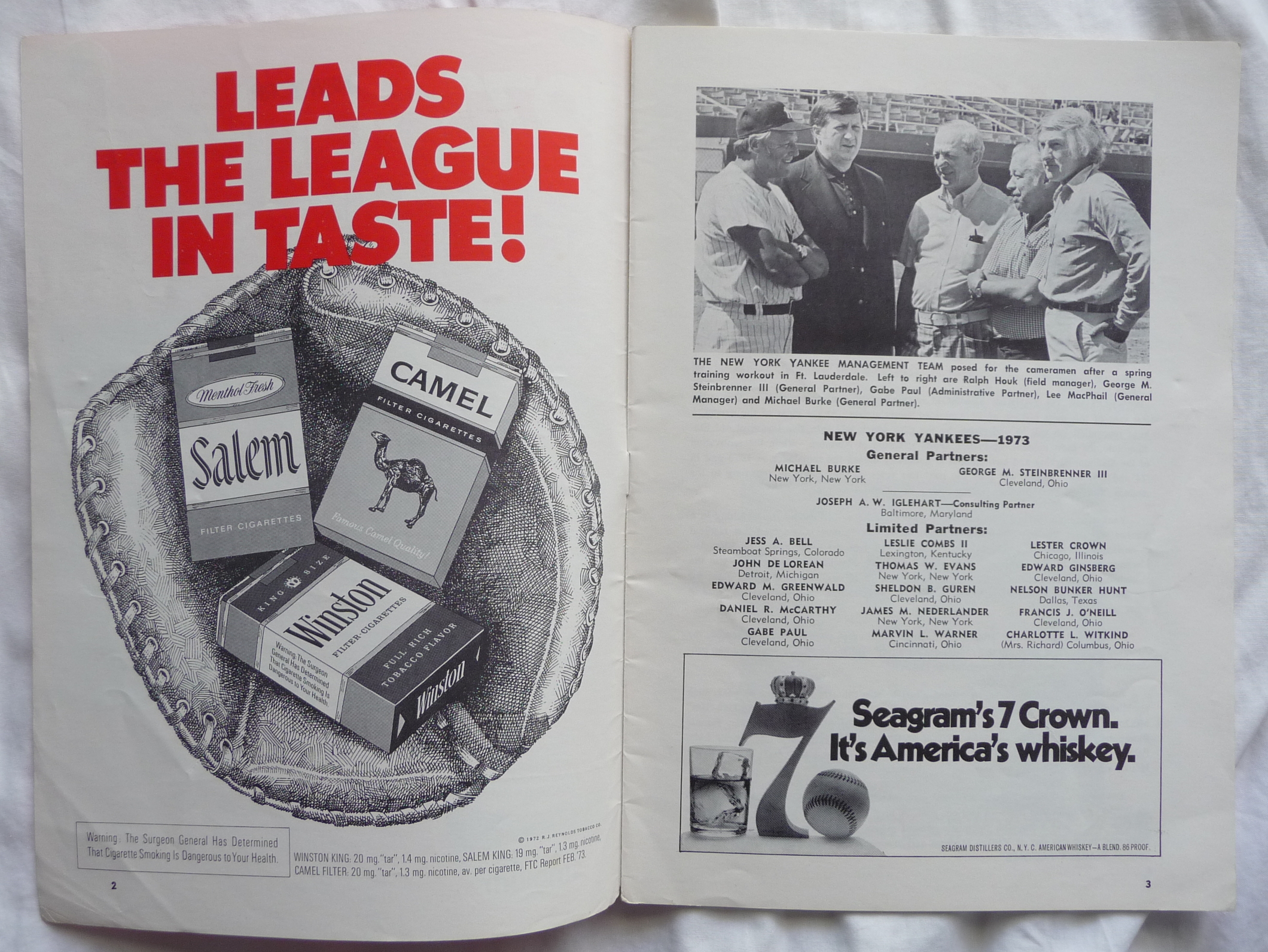
When I used to attend a lot of games in the 1970’s and 80’s buying a scorecard was a no-brainer. From anywhere from a reasonable 25 cents in the early 1970’s to two dollars in the late 80’s, filling out that scorecard and having a program was a nice memento of a game I went to. There is a certain enjoyment derived from scorekeeping and having a permanent record of a game you are attending.

I just dug this program of my closet from a game I went to on Thursday evening September 6, 1973. The Yankees came back in the bottom of the eighth inning after trailing 6-5 on a three run home run from Mike Hegan to beat the Milwaukee Brewers 8-6. Bobby Murcer and Roy White also homered for the Yanks. The time of the game was 2:22.

In my childish way I merely recorded outs as fly outs, ground outs or line outs without denoting the fielders who made the play. As you can see my scorekeeping leaves a lot to be desired, but for a little kid I think I did a pretty good job. Eventually I learned to score correctly.

For 30 cents they packed a lot into 28 pages. Continue reading

The Moment Lou Gehrig Stepped Down “For The Good Of The Team”

The Story Of The End Of Lou Gehrig’s Consecutive Game Streak – May 2, 1939

Yankee captain Lou Gehrig stuns Tigers manager Del Baker, home plate umpire Steve Basil and umpires Red Ornsby and Bill Summers as Gehrig informs them he has benched himself.

Yankee captain Lou Gehrig stuns Tigers manager Del Baker, home plate umpire Steve Basil and umpires Red Ornsby and Bill Summers as Gehrig informs them he has benched himself. (photo AP)

Almost everyone knows something about Lou Gehrig, the Iron Horse, and his consecutive game playing streak. But you’ve probably never seen the dreaded moment when Gehrig took himself out of the lineup ending his streak, except by seeing actor Gary Cooper do it in the famous 1942 movie The Pride of the Yankees.

This photograph above shows that actual moment that occurred 75 years ago today.

Since June 1, 1925 Lou Gehrig had appeared in 2,130 straight games over the past fourteen seasons with the Yankees. Gehrig played with sprains, concussions, back spasms, broken bones and illnesses that would have had a lesser man take at least a day off, go on the disabled list or convalesce in a hospital. But Gehrig didn’t just play. He played exceptionally, putting up outstanding numbers offensively and defensively while always conducting himself with grace and humility on and off the field.

So on Tuesday, May 2, 1939 at Briggs Stadium in Detroit, nothing seemed out of the ordinary when Yankee captain Lou Gehrig came to home plate to deliver the starting lineup card.

But earlier in the locker room in a private talk, Gehrig informed Yankees manager Joe McCarthy that he was removing himself from the lineup because he “wasn’t doing the team any good.” McCarthy asked him if he was serious and Gehrig replied that he was. McCarthy then told Gehrig it would be as he wished.

Gehrig approached the plate and handed the lineup card without his name on it to home plate umpire Steve Basil and Tigers manager Del Baker. On the photo, you can see the shock and disbelief on the faces of the men gathered around Gehrig whose expression is one of complete dismay.

The thunderbolt news raced through both teams, then around the stadium and finally throughout the baseball world through the newswires that Lou Gehrig had taken himself out of the lineup and was ending his famous streak.

When the announcement was made over the public address system to the 11,379 fans in attendance of Gehrig’s voluntary withdrawal, it was suggested that he get a “a big hand.”

The New York Times reported a deafening cheer resounded as Lou walked to the dugout, doffed his cap and disappeared in a corner of the bench.

Lou Gehrig consoles  Babe Dahlgren about replacing Gehrig in the Yankees line-up, May 2 1939

Lou Gehrig consoles Babe Dahlgren about replacing Gehrig in the Yankees line-up, May 2 1939

Ellsworth “Babe” Dahlgren who had waited since 1937 to start at first base for the Yankees, finally, but reluctantly got his chance. “I hated to break his streak,” said Dahlgren.

”I remember Lou taking the lineup card up to the plate that day. When he came back to the dugout he went over to the water fountain and took a drink. He started to cry. Lou stood there with a towel on his head, taking the longest drink I’ve ever seen anybody take.” Continue reading

The Stress of Hank Aaron Breaking Babe Ruth’s All-Time Home Run Record

Before Breaking Ruth’s Record, Hank Aaron Had So Many Death Threats, He Had A Security Team Appointed To Protect Him

Willie Mays (l) and Hank Aaron at Shea Stadium June 3, 1972 – the two true #1 and #3 career home run leaders

Forty years ago today, on April 8, 1974, Hank Aaron, under incredible duress, hit his 715th career home run, breaking Babe Ruth’s record.

Aaron finished his career in 1976 with 755 home runs and is now second all-time on the career home run list to Barry Bonds. In my mind and many others, Aaron is still the legitimate home run champion due to Bonds strange physical transformation in which his body became gargantuan and slugged more and more home runs as he aged.

What Aaron had to endure with the constant death threats and pressure is poignantly told in an excellent article by USA Today‘s Bob Nightengale which is reproduced below.

Hank Aaron has the letters tucked away in his attic, preserved these last 40 years. He’s not ready to let them go.

He almost has them memorized by now, but still he carefully opens them up and reads every word, as if he wants to feel the pain.

“You are (not) going to break this record established by the great Babe Ruth if I can help it,” one of them reads. “Whites are far more superior than jungle bunnies. My gun is watching your every black move.” Continue reading

Orioles In Spring Training – 1972

Mark “Dutch” Weems, Ralph “Mickey” Scott and Wayne Garland

Mark Weems Ralph Scott Wayne Garland March 1972

They were supposed to be the Baltimore Orioles pitchers of the future. Of the three Orioles pitchers seen here at spring training in March 1972, only one would have success in the major leagues.

Mark “Dutch” Weems (left) never made it to the majors and was out of organized ball in 1973 at the age of 22 after posting a 24-19 record in five minor league seasons. Ralph “Mickey” Scott (center – throwing) bounced round the majors from 1972 -1977 appearing in 133 games and compiling a 8-7 record. He passed away at the age of 64 in 2011.

The star of this group was Wayne Garland (right), the Orioles the fifth overall pick in the first round of the 1969 (June secondary) amateur baseball draft.

The Orioles took a chance by drafting Garland who had declined previous chances to play. The Pittsburgh Pirates chose Garland in the fifth round of the 1968 amateur draft but he did not sign with them. The St. Louis Cardinals then made him the first overall pick in the (January secondary) 1969 draft, but once again Garland did not sign.

Wayne Garland had six nondescript seasons in the minors and majors until 1976 when he went 20-7 with a 2.67 ERA for the Orioles. He was paid $23,000 that season and became a free agent in the off season.

It was the beginning of the free agency era in baseball and Garland became one of the highest paid players in the majors when he signed with the Cleveland Indians for $2.3 million for 10 years.

At the time I thought it was bizarre to give any player a ten year contract. As Ira Berkow of New York Times pointed out, “Many baseball people wondered how the Indians could pay so much for a player with only one good major league season. They are still wondering.” Continue reading

Dodgers In Spring Training – 1963

Podres, Koufax And Perranoski Get Ready For A Great Season – March 1963

Podres Koufax Perranoski 1963 March

Three of the anchors of the Dodger pitching staff, Johnny Podres, Sandy Koufax, and Ron Perranoski reach for the same ball at spring training in March 1963.

This trio of Los Angeles Dodgers hurlers would play a big part in helping propel the Dodgers to a World Championship in 1963. The 99-63 Dodgers would humble the 104-57 Yankees in a four game World Series sweep holding the Yankees to a measly four runs.

Johnny Podres hero of the Brooklyn Dodgers 1955 World Series Championship would go 14-12 in 1963 and win game two of the World Series against the Yankees pitching eight and a third innings and allowing just one run in a 4-1 Dodger victory at Yankee Stadium.

Sandy Koufax had his breakout year in 1963 going a magnificent 25-5 with a 1.88 ERA and chalked up 301 strikeouts in 311 innings pitched. He won the Cy Young Award and National League Most Valuable Player Award. In the World Series he won game one and game four allowing just three runs while striking out 23 batters!

Dodgers relief ace Ron Perranoski had his best season ever in the majors with a 16-3 record and 21 saves to go along with a miniscule 1.67 ERA. He received the save in Podres’ victory.

Don Drysdale pitched the third game in the World Series and shut out the Yankees 1-0.

Mets In Spring Training – 1970

Tom Seaver Instructs Duffy Dyer, Ken Boswell And Cleon Jones – March 1970

Dyer Boswell Seaver Jones March 1970

The World Champion Miracle Mets of 1969 were looking forward to 1970. During spring training in March 1970, Tom Seaver has some instructions for Duffy Dyer, Ken Boswell and Cleon Jones.

The Mets would have a disappointing season going just 83-79 and finishing in third place in the National League Eastern division.