Author Archives: B.P.

Yes, He Really Plays Baseball

Dave Ricketts, St. Louis Cardinals, Topps Baseball Cards 1968 & 1969

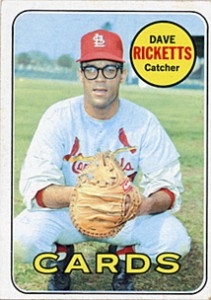
It is an unfair characterization to say Dave Ricketts could have easily been mistaken for a high school biology teacher rather than a major league catcher. Players who wore eyeglasses in the 1960’s were still very much a rare breed. When I was a kid, every time I looked at these two baseball cards, I thought that Dave Ricketts never really got to play, but just posed for the card.

Ricketts did play sporadically, appearing in 130 total games for the St. Louis Cardinals from 1963-1969 and the Pittsburgh Pirates in 1970 and ended up with a .249 career batting average and one home run.

After his playing career ended, Ricketts became a fixture in the Cardinals organization mostly as the bullpen coach and minor league manager. Ricketts by all accounts was an excellent coach and had a large influence upon other players.  Derrick Goold of The St. Louis Post-Dispatch wrote about Ricketts after he passed away:

“I’m here because of him,” Yadier Molina said. “He made me into a catcher. I wasn’t a catcher when I got here. I learned a lot from him. He was like my dad, there for me since I was 17. He meant so much to me.”

“I’ve never seen a coach who has worked harder for whatever team he’s involved with than Dave Ricketts. Ever,” former Pittsburgh Pirates pitcher Steve Blass said. “Totally dedicated. … He had a zest for life that was part of his personal life, and, thank goodness, we are better because it spilled over into his professional life.”

“Sometimes the word ‘great’ gets overused, and it’s a shame,” manager Tony La Russa said. “There have been some truly great Cardinals who have come through the organization, but I don’t know anyone greater or more beloved than Dave Ricketts.”

Dave Ricketts died in St. Louis at the age of 73 on July 13, 2008 of renal cancer.

Classic Hollywood #17 – Director W.S. Van Dyke & Family

“One Take Woody” Gets A Son – 1937

Film director Woodbridge Strong Van Dyke is mostly forgotten today to many movie fans. He was a good director, and known in the film industry for working quickly, shooting many scenes in one take. This earned him the nickname “One Take Woody” and “One Take Van Dyke.” Continue reading

Old New York In Photos #23 – Subway Excavation Along Broadway & 49th St. 1901

Subway Excavation, Broadway and 49th Street – 1901

While the MTA is currently striving to build the new Second Avenue subway without disturbing businesses along the route, the Interborough Rapid Transit Company (IRT) had no such compunction about hampering businesses as demonstrated by this photograph taken on November 26, 1901.

We are looking north along Broadway towards 49th Street. The J.B. Brewster Carriage Continue reading

“Mongo” – Alex Karras NFL Star Dies At 77

Karras, Famous For Stellar NFL Career, Will Always Have A Place in Movie Comedy History

Alex Karras died in Los Angeles at the age of 77 on October 10, 2012 due to kidney failure and other health complications.

The Detroit Lions All-Pro defensive tackle will be remembered by many as a great football player who played from 1958-1970. But I, along with many other people, will remember his acting career which stretched from 1968 -1998. Mel Brooks comedy fans especially loved Karras’ portrayal as the monosyllabic ruffian cowboy, Mongo, in Brooks brilliant 1974 western satire Blazing Saddles.

Karras did not have many scenes in the movie, but they were all very funny.

This scene below is the one that shocked audiences: Karras’ one punch knockout of a horse.  As an fyi -Karras did not actually hurt the horse and people would later come up to him and ask how he could do such a horrible thing.  “I thought it was hilarious, but I didn’t want to hurt that horse at all, believe me,” Karras said in a 2011 interview with the “Sports and Torts” Internet radio show. “I’m not the type of person to do that.”


Bobby Orr’s First Time At The Boston Garden 1966

Bobby Orr’s Debut At The Boston Garden October 10, 1966

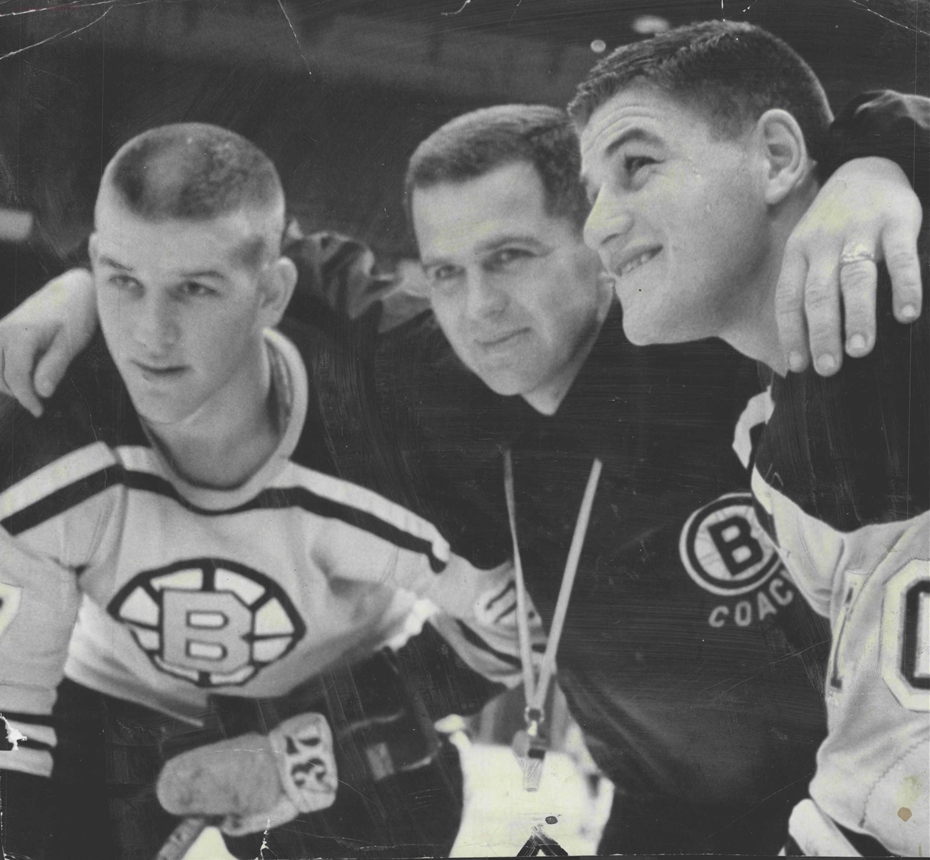
This photograph shows Bobby Orr wearing number 27, (left) at his first practice at the Boston Garden on Monday, October 10, 1966. Next to Orr is the youngest coach in the NHL, 34-year-old Harry Sinden and defenseman Gilles Marotte.

The Bruins had practiced for a month at their training facility in London, Ontario and came to Boston on October 9, 1966 to prepare for the coming season with some exhibition games. Since the 1959-60 season the Bruins had posted seven consecutive losing seasons. Continue reading

I Hear You Knocking But You Can’t Come In

Smiley Lewis And Early Rock n’ Roll

Smiley Lewis

There are controversies over what song marks the birth of rock’ roll. Rather than engage in a protracted debate or discussion, I thought it would be good to just take a look at one under-appreciated classic R&B song that seems to qualify as one of the first rock songs.  I Hear You Knocking was written by Dave Bartholomew and Pearl King in 1955 and performed the same year by New Orleans musician Smiley Lewis.

It is definitely a lesser known progenitor of what sort of music would become  popular during the magical year of 1955 with artists such as Chuck Berry, Fats Domino, Little Richard and Elvis Presley all emerging onto a national stage performing early rock n’ roll.

Click here to listen to Smiley Lewis’ version of I Hear You Knockin’.

Few people are familiar with Smiley Lewis’ version of the song, as it was popular during a time when radio was segregated and R&B artists did not get their songs played on many stations. However the song did make it to number two on the Billboard R&B charts.

There are at least thirty other versions of the song by other popular artists, but I Hear You Knocking was really rescued from oblivion by the great Dave Edmunds when he covered the song in 1970 and it became a number one hit in the United States and England. Edmunds version is still played regularly on many classic rock stations, perpetuating the popularity of this catchy, R&B/early rock classic. Below is a video of an uncharacteristically wasted-looking Edmunds, lip-synching his hit in 1971 in front of a freaky looking audience that one youtube commenter noted, “I didn’t know the Manson Family had a variety show.”

UPDATE 2022 Unfortunately in the intervening years since this story was first written, Warner Music has pulled the video. Below is Edmunds live version, unfortunately without the 1971 stoned audience.

.

The Day Brooklyn Will Never Forget – October 4, 1955 The Brooklyn Dodgers Become World Champions

Johnny Podres Shuts Out The Yankees to Win Game 7 of The 1955 World Series

Cover Daily News Oct 5 1955

The Brooklyn Dodgers had appeared in seven World Series previous to 1955. They had lost all of them. But on Tuesday, October 4, 1955, a magical afternoon (yes the World Series was always played in the daytime until 1971) occurred at Yankee Stadium in front of 62,485 fans. Amazingly the game was not sold out.

Johnny Podres, after winning game three of the World Series, was matched up in game seven against Yankee veteran Tommy Byrne. An interesting side note: Byrne rode the IND subway from 59th Street to Yankee Stadium unrecognized by anyone. Podres ended up pitching the game of his life – an eight hit, 2-0 shutout. The Dodgers had finally vanquished the Yankees who had beaten them in five previous World Series.

The Dodgers played without Jackie Robinson who was nursing a strained Achilles tendon. And the Yankees were equally handicapped without Mickey Mantle, who, even though he pinch hit in this game, missed most of the Series with a torn leg muscle. Other Yankees and Dodgers stars like Duke Snider and Hank Bauer played despite being injured.

First pitch of Game 7, 1955 World Series Yankee Stadium. Tommy Byrne throws a strike past Jim Gilliam

The Dodgers scored one run in the fourth when Roy Campanella doubled and a single by Gil Hodges drove him home. The Dodgers added a run in the sixth with Hodges hitting a sacrifice fly to drive in Pee Wee Reese.

Sandy Amoros Catch 10 4 55

The acknowledged defensive play of the game was made by Dodgers left fielder Sandy Amoros.

Continue reading

1955 World Series The Brooklyn Dodgers Win Game 3 Behind Johnny Podres

Johnny Podres, The Birthday Boy, Wins A Critical Game 3

This news photograph’s caption reads as follows:

NEW YORK; SEPT. 30 — VICTORY ON HIS BIRTHDAY

Johnny Podres kicks, fires and follows through — with eyes on ground — during third World Series game against New York Yankees at Ebbets Field in Brooklyn today. Johnny celebrated his 23rd birthday with an 8-3 victory over the American League champs. Slender lefty thus put Dodgers back into contention for Series. (AP wirephoto)

The New York Yankees looked like they were on their way to beating their crosstown rivals the Brooklyn Dodgers once again in another World Series. The Yankees had taken the first two games of the 1955 World Series by scores of 6-5 and 4-2. Continue reading

Billy Martin, Mickey Mantle Prepare For The 1952 World Series

Martin, Mantle Prepare Series Strategy

60 years ago, the World Series started on the first day of October. This year the World Series will begin October 24!

Here is another one of these great baseball news photographs. This one is from UPI dated September 30 1952. The caption reads: Continue reading

The Doors And A Parody Of The Doors

Light My Fire” And “Reading Rainbow” On The Ed Sullivan Show

Elektra publicity The DoorsForty-five years ago, on September 17, 1967, The Doors performed for the first and last time on The Ed Sullivan Show. The variety program which had introduced America to The Beatles three years previously, was consistently one of the most watched shows in America and could help establish a successful career for a comedian, singer, band or any entertainer.

Before singing their hit Light My Fire, live on national television, the band was warned by a Sullivan show staff producer not to sing the word “higher” when the phrase “girl we couldn’t get much higher,” came up. It was suggested Morrison the poet, come up with another word; “flier”,  “wire”,  it didn’t matter, just not sing “higher.” The band was told the word “higher,” could imply illegal drug use and was inappropriate for a family program like The Sullivan Show. The Doors were furious and argued their point, but eventually relented and told the producer they would alter the lyric.  As soon as the producer left the room, The Doors lead singer Jim Morrison declared to the rest of the band “We’re not changing a word.”

The Doors first performed “People Are Strange” and then launched Continue reading