Author Archives: B.P.

New Yorker’s Starved For News -1953 The End Of The Strike

Newspaper Strike Ends December 8, 1953

Photo UPI

Beginning November 28, 1953, six of New York’s seven daily newspapers went on strike. 400 photo engravers demanded better pay and working conditions and the other newspaper employees honored their picket lines. For eleven days New York City had only one newspaper available to them, The New York Herald Tribune. Because the Herald Tribune had an outside commercial firm doing their photo engraving, they were the beneficiaries of added readership. Continue reading

You Are Creative And You Are Wasting Your Life

The Most Important Piece Of Career Advice You Will Ever Read

Forget all those best-selling, life affirming books which “reveal” valuable lessons that you should follow to have a happy life or a lucrative career.

Linds Redding, an award winning graphic designer who worked in the advertising industry for nearly 30 years, started a blog in 2011, the day he found out he had esophageal cancer.

The piece he wrote on March 11, 2012 called A Short Lesson In Perspective is a must read for anyone who is indulged in a creative profession or aspires to one. Even if you do not consider yourself creative, this is still well worth the few minutes it will take to read. It is not technically advice as much as it is self-reflection that has enormous value to the reader.

It is 2,900 words long, but even for those with short attention spans, I urge you to read to the end.

The whole article can, and should, be read here, and an excerpt (not from the beginning) is reproduced below: Continue reading

How To Throw A Spitball

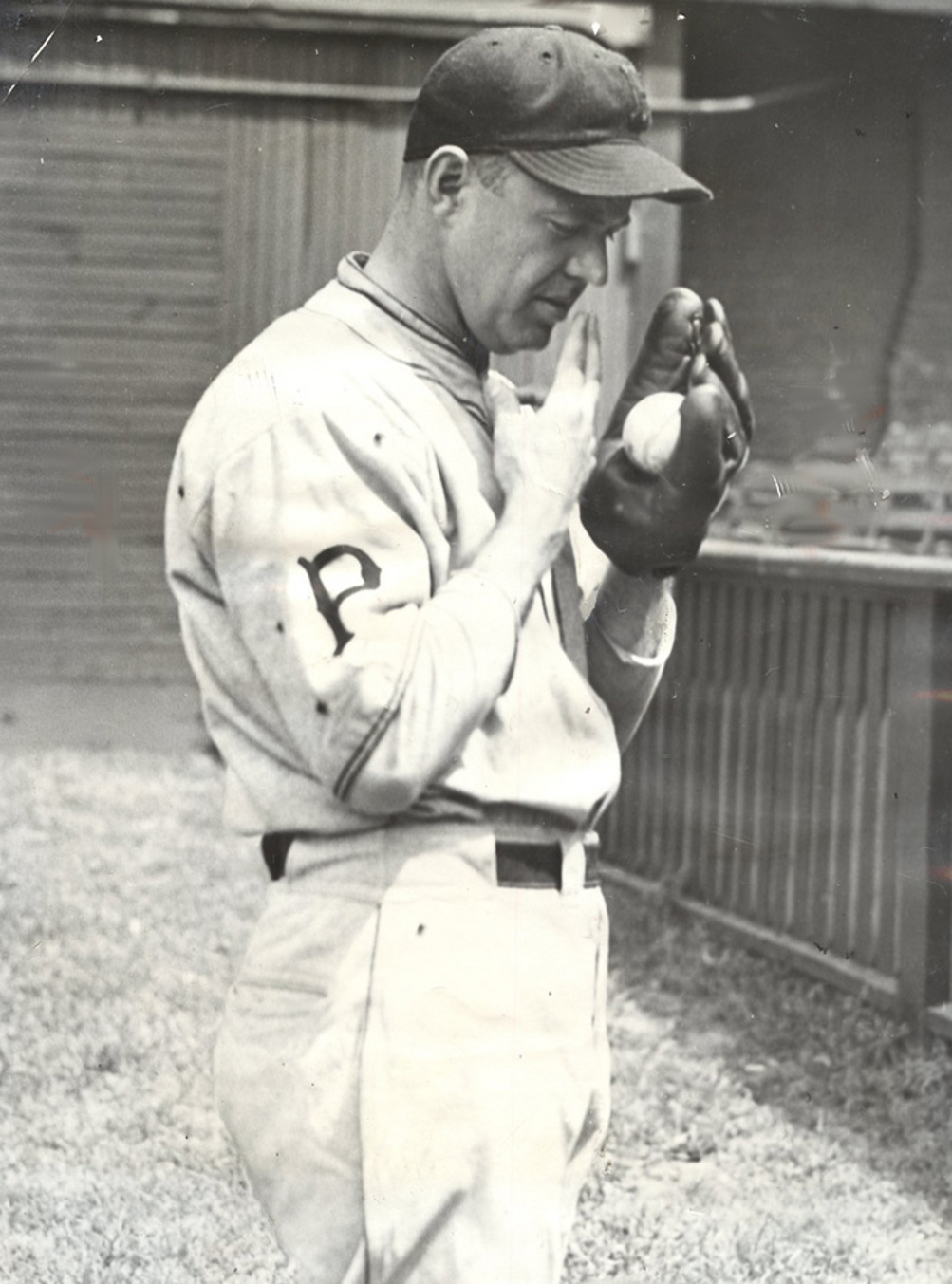
Burleigh Grimes Demonstrates How To Throw A Spitter – July 12, 1929

The spitball was officially banned from baseball in 1920. Existing spitball pitchers were grandfathered to be allowed to legally throw the pitch. Hall of Famer Burleigh Grimes was the last of these legal spitball pitchers playing when he retired in 1934 after winning 270 games over 19 seasons. Grimes pitched for nine teams during his career and is one of only fourteen players to play for all three New York teams: the Brooklyn Dodgers, New York Giants and New York Yankees.

In this news photograph, which looks like it was taken in a backyard rather than a ballpark, Grimes demonstrates his method for throwing the spitter.

The news caption reads:

World Wide Photos

The National League’s Leading Hurler

Philadelphia, PA. – Burleigh Grimes veteran spitball pitcher of the Pittsburgh Pirates, who is leading the National League throwers with 14 wins and one defeat, demonstrates how he starts to throw his famous ‘spitter’ 7/12/29

illustration New York Times

Grimes won only three more games for the rest of the year and ended up with a 17-7 record. The Pirates finished in second place, ten and a half games behind the Cubs.

The object of the spitter is to have it sink. You first apply a good amount of saliva to an area of the ball. The two top fingers go over the wet part of the ball. The rest of the hand grips the ball tightly. You control the direction of the drop by tilting the top of the fingers slightly to the left or to the right. In order to be effective, your wrist must be straight and rigid when releasing the ball. This combination will give the ball a reverse spin. Controlling the location of the pitch is difficult and that is why when it was outlawed in 1920 there were only 17 pitchers using it effectively and they were grandfathered to keep using it.

Even though it has been banned for over 90 years, there are still many managers and batters who swear there are pitchers who throw the illegal pitch. In a 1967 Sports Illustrated article it was estimated that approximately 25% of pitchers were throwing spitballs.

A Rose By Any Other Name

The Aaron’s, Clemente’s and Mays’ Of A Lesser Ilk

Roberto, Willie and Hank

In major league baseball history there was only one Ruth, Gehrig, Koufax, Medwick, Seaver and Carew. You know who is being referred to when you hear the name Mantle.

Yet there have been several Robinson’s, Johnson’s, Ryan’s and Smith’s of varying playing ability. Some were great, some were good, and others were let’s just say, not so great. If you say, “Robinson was a fantastic player,” you usually have to clarify which- Jackie, Frank or Brooks.

What if you were a professional ballplayer and your last name happens to be Jeter, but your first name is not Derek?

Sharing a baseball great’s last name can sometimes be a drag because comparisons may be drawn to your famous counterpart. You can be sure that with the exception of your family and close friends, most references by the baseball loving public to your last name, go to the superstar.

So as a professional ballplayer if you share that famous last name but you never achieved super-stardom, at least you can always say you had your name on a baseball card.

So which baseball card would you rather have?

Hank Aaron or….

Tommie Aaron?

Derek Jeter or…

Johnny Jeter? Continue reading

Faces In The Rocks

The Incredible Rock Sculptures Of Rotheneuf France

photo courtesy flickr – Drisc67

Location of Rotheneuf Rock Sculptures

In the village of Rotheneuf on the Brittany coast of France, one man carved over 300 magnificent sculptures into the granite cliffs overlooking the sea.

This amazing work of faces, creatures and scenes were sculpted into the rocks painstakingly by a priest, Adolphe-Julien (Abbé) Fouré (1839-1910) over about a fifteen year period. (Sources vary on the number of years he was active.)

It was painstaking because when he was older, Abbé Fouré suffered a stroke which caused the left side of his body to be paralyzed. Over the years he eventually became deaf and his speech got very slurred.

Fouré  retired from the priesthood and became a hermit, renting a cabin by the cliffs of the village. In the early 1890’s with one side of his body crippled,  Fouré, began creating sculptures in the rocks, that told the history of the powerful Rotheneuf family. He continued carving up until about three years before his death on February 10, 1910.  Continue reading

All New York City Streets Are Not Created Equal

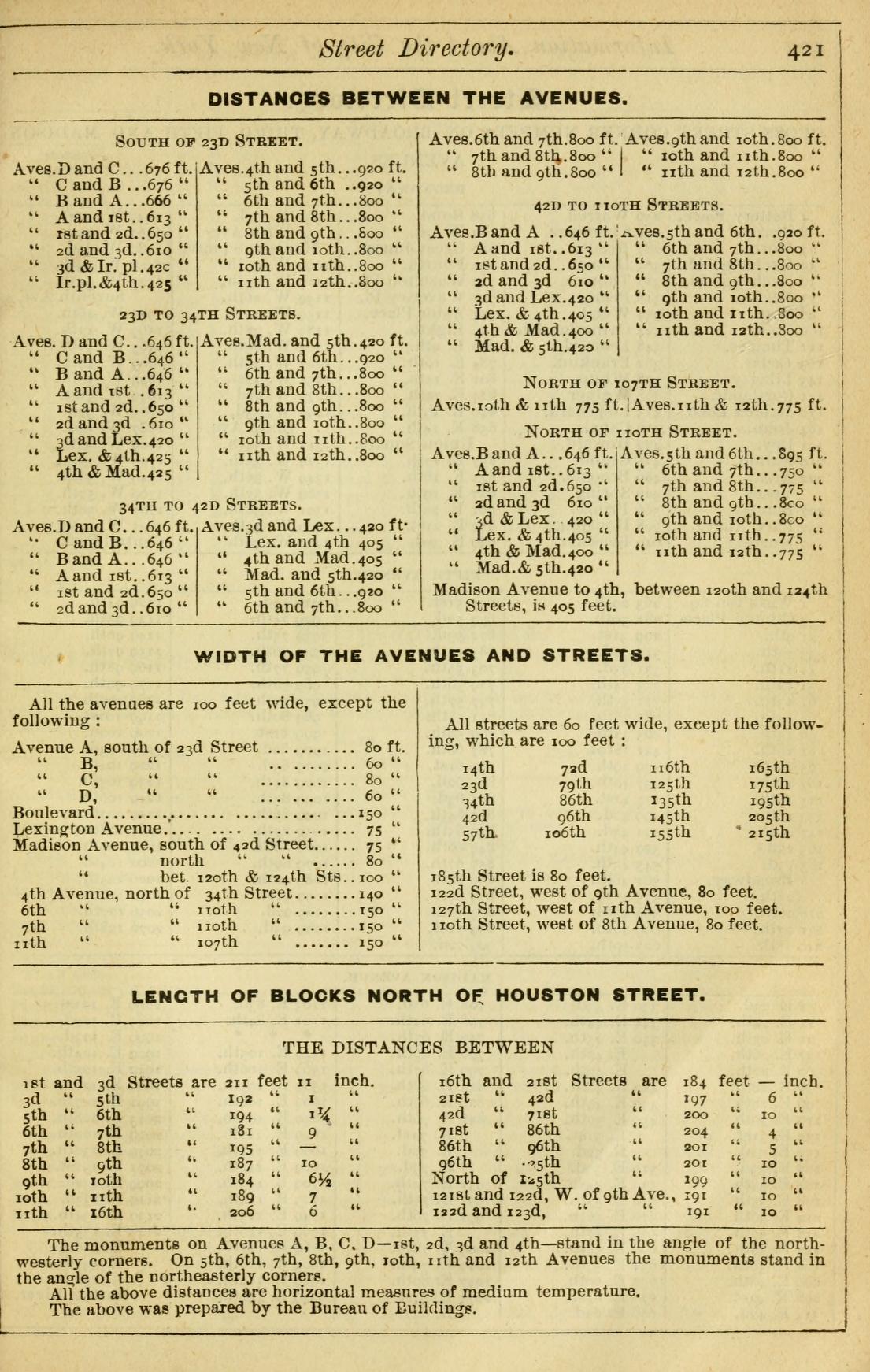
The Distances Between Streets & Avenues – Things You Probably Didn’t Know

If you are traveling at the same pace, regardless of the avenue, it is faster to walk between 6th and 7th Streets than walking from 13th to 14th Streets. Why? Because the block between 6th and 7th is only 181 feet, 9 inches while the block between 13th and 14th is 206 feet, 6 inches.

Anyone walking around Manhattan is sure to notice that street distances between blocks and avenues vary widely. But few know that the block lengths can vary by several feet.

When the grid plan for Manhattan’s streets were laid out, you’d think that the streets would be equidistant. They are not.

Maybe this is the sort of thing that almost no one would care about, but living up to this web site’s name, I found this chart very interesting. It is from the New York Bureau of Buildings in the 1892 edition of The World Almanac.

1892 World Almanac (click to enlarge)

As you see, the chart lists the distances between the avenues, the width of the avenues and streets and the length of blocks north of Houston Street.

There are a few interesting things to note. One is how far Avenues A, B, C and D extended northward in 1892. Avenue A was later renamed Sutton Place north from 53rd Street and York Avenue north from 59th Street. Avenue B was renamed East End Avenue from 79th to 90th Street. Many portions of Avenue A, B, C and D were never completed (the landfill required to extend them was never done), or wiped out with map changes and construction in the 20th century (e.g. The Franklin D. Roosevelt Drive). Regardless, the almanac still lists the proposed dimensions for the phantom avenues via the Bureau of Buildings.

The other thing to note is that the main cross streets of 14th, 23rd, 34th etc. are all the same: 100 feet wide as compared to the other streets which are all 60 feet wide.

I have used the modern names of avenues in parentheses. Below are some highlights of the chart.

Avenues in Manhattan are 100 feet wide with some notable exceptions:

Lexington Avenue – 75 feet

Boulevard (Broadway) above 59th Street – 150 feet

Madison Avenue South of 42nd Street – 75 feet

Madison Avenue North of 42nd Street – 80 feet

Madison Avenue From 120th to 124th Streets – 100 feet Continue reading

Philip Roth On The Death Of Readership, Not The Novel

Novel Readership, Not The Novel, Being Killed By The Screen According To Philip Roth

On the front page of the November 18, New York Times, Philip Roth discusses his retirement from writing fiction.  2010’s Nemesis, Roth’s last published work of fiction will remain his final novel.

In the article he clears up a long held misquote, that “the novel is dying.” He says, “I do not believe the novel is dying. I said the readership is dying out. That’s a fact, and I’ve been saying it for 15 years. I said the screen will kill the reader, and it has. The movie screen in the beginning, the television screen and now the coup de grace, the computer screen.”

Miss Pigtail Contest – New York 1955

Childhood Innocence In A Unusual Contest

Chester Bugello age 7, borrows Maureen Albanese’s pigtail at the Miss Pigtail contest held at the Sullivan Street Children’s Center, New York City, July 8, 1955.

The look on Maureen’s face is priceless.

There were no “classy” contests like Toddler’s and Tiaras in the 1950’s. Whatever became of Chester and Maureen?

From our reader (comment below) – Margaret Mangiero Campbell winner in 1962 of the longest pigtail (year based on the crown worn by 5-year-old Michelle Paolercio.)

Classic Hollywood #18 – James Cagney At Grand Central Terminal

James Cagney Grabs Lunch At Grand Central

In the days before air travel became popular, almost everyone took the train to get around the United States.  On February 6, 1945 before boarding the Twentieth Century Limited for Chicago, James Cagney stopped in at a restaurant at Grand Central Terminal for a bite to eat. It appears he was enjoying a cup of coffee and a danish. Then he glanced up to see a photographer snapping this picture.

The difference between the “old days” and today is that movie stars of the golden years were not hounded by what has come to be known as the paparazzi – ruthless parasites, who violate every modicum of human decency. Yes, the old newspapers and magazines would send their  photographers out to capture celebrities and news events. But there was a mutual quid pro quo back then, even if the celebrities dd not enjoy the attention, they knew the press generally helped their careers and would accommodate them. The press also kept somewhat of a respectful distance. Those days are long gone.

What It Was Like Riding A Turn Of The Century New York Stagecoach

New York Transportation In The Early 1900’s

Hamilton Fish Armstrong was the longtime editor of the magazine Foreign Affairs. His charming memoir, Those Days published in 1963 by Harper and Row is a wonderfully evocative description of an upper middle class boyhood spent in New York City, the Hudson Valley and Quebec. The book’s dust jacket description states that it is: “A lively, spontaneous re-creation of the childhood of a famous editor and writer at the turn of the century – an unforgettable picture of a vanished New York.”

It’s one of those out of print, forgotten books that deserve to be read by a new generation. I highly recommend it.

Here is an excerpt from pages 68-69 where Armstrong describes getting uptown to school from his home on 10th street via the Fifth Avenue coach which was pulled by horses.

When I was nine the time came for me to go to a “real” school uptown, and unless it was pouring pouring rain or snowing I went of course, on skates. When the weather ruled this out I used the Fifth Avenue stage or the Sixth Avenue El.

On the stage I rode by choice  on the outside, either perched up behind the driver or, if I was lucky, along side him. Continue reading