Author Archives: B.P.

The Greatest TV Game Show Ever

What’s My Line 1950 – 1967

Whats-My-Line-Cast-Dorothy-Kilgallen-death-November-8-1965 cr

A few years ago my Tivo was tuned into the Game Show Network weeknights at 3:00 a.m., taping every episode of the greatest TV game show ever made, What’s My Line.

Let me state it was not just a great game show, but one of the best television shows ever.

Unfortunately the series is not being broadcast now, but many segments of the show are available on Youtube.

To describe the brilliance of the show better than I ever could, we will refer to The Complete Directory to Prime Time Network TV Shows 1948 – Present by Tim Brooks and Earle Marsh (Ballantine 1988), an indispensable television reference book.

What’s My Line was the longest-running game show in the history of prime-time network television. It ran for 18 seasons, on alternate weeks from February to September 1950, then every Sunday at 10:30 p.m. for the next 17 years. The format was exceedingly simple. Contestants were asked simple yes-or-no questions by the panel members, who tried to determine what interesting or unusual occupation the contestant had. Each time the contestant could answer no to a question, he got $5, and a total of 10 no’s ended the game. The panel was forced to don blindfolds for the “mystery guest,” a celebrity who tried to avoid identification by disguising his voice.

That little game, by itself, hardly warranted an 18-year run, when other panel shows of the early 1950’s came and went every month. But What’s My Line was something special, both for the witty and engaging panel, and for a certain élan which few other shows ever captured. There were no flashy celebrities-of-the-moment or empty-headed pretty faces on this panel; they were obviously very intelligent people all, out to have some genteel fun with an amusing parlor game. Like (moderator) John Daly with his bow tie and perfect manners, it reeked of urbanity [“that’s three down and seven to go, Mr. Cerf?”]

The panelists who created this special atmosphere were an elite group. Continue reading

The Difficulties Of The Used Book Store Business

Thinking Of Opening A Used Bookstore? “Don’t Do It!” Advises Bookseller Greg Gibson

Interior of Iliad Bookshop North Hollywood California

Interior of Iliad Bookshop North Hollywood California

Greg Gibson, the owner of the Ten Pound Island Book Company wrote about his nearly 40 year odyssey in the world of second hand books and used book stores in an excellent article called “Don’t Do It!” published here. You don’t have to be interested in collecting or  the book business to enjoy this very well written story.

Many people who love books, daydream about setting up a second hand book shop. Not the paperback emporiums or remainder stores that dot many towns throughout the country, but a real general used book store where when you walk in there is an aroma of old books and the possibility that a customer will find a long sought after treasure.

Running a used book store is a profession that will not make you rich and runs counter-intuitive to the notion that publishing is in a perpetual state of decline and printed books are dying.

Used bookstores that keep regular hours that are open to the public are called open shops. Where there were literally thousands of open shops in the United States twenty years ago,  there are about 1,000 in existence today, victims of a combination of an aging populace; both proprietors and collectors/readers, changing technology and rising rents.

Fewer people have the opportunity to apprentice in a used book store and get the experience necessary to open their own book business. Barely making enough money to survive also discourages many young people from considering books as a career. This is why it is mostly retirees who will entertain the book store notion as a career. The internet has changed the pricing structure for used books and many people who deal in used books do so via mail order through the internet or by eBay without a thorough knowledge of books.

While not completely a warning against going into the book business, the article does describe the lessons Gibson took many years to learn. If you still have dreams of running a used book store, you can get some valuable advice from Gibson before you start on your venture.

Posture Queen And The Creation Of The World War II Pin-Up Girl

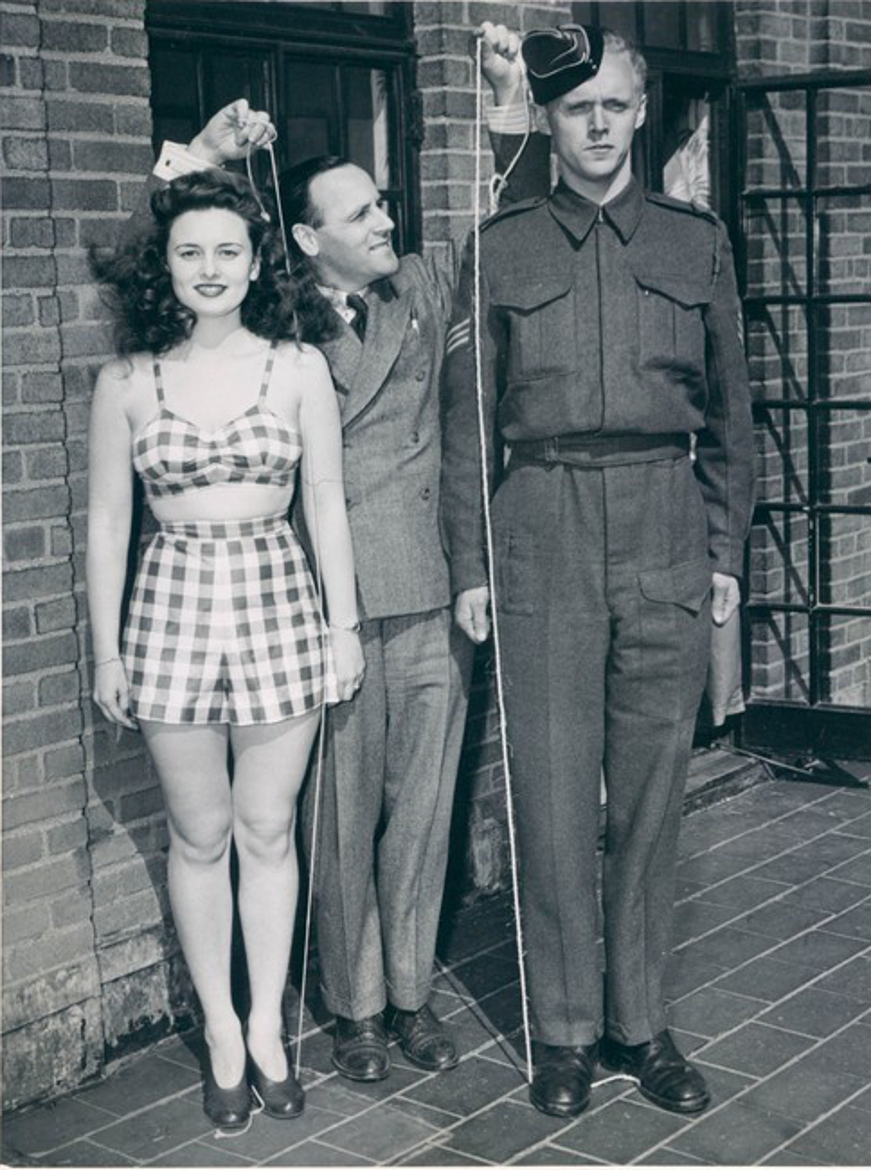
Stand Up Straight Please, This Is A Publicity Stunt

Lillian McKevitt

New York, NY – Miss Lillian McKevitt, of Jackson Heights, New York is chosen as “Posture Queen” from among forty beautiful Walter Thornton models who demonstrated exercises to provide good posture in celebration of Good Posture Week (May 4-11), has her posture matched by Mr. Thornton with that of Sgt. Lester Hare of the military police of the Canadian army, who attended the matinee performance on the penthouse terrace of the Mayflower Hotel.  –  April 27, 1942: Acme News Photograph

By whom Lillian McKevitt was chosen Posture Queen is not noted in the news photo caption.

The interesting story here is about the modeling agency Lillian came from, The Walter Thornton Modeling Agency which began its business in 1931.

A June 27, 1948 Associated Press article describes how Walter Thornton created the World War II “Pin-Up Girl.”  Strangely this is based only on Walter Thornton’s assertion.

The story goes, “while in the service, Thornton pinned his girlfriend’s picture to the canvas wall of his tent. The pin put a hole in the tent and the Sergeant put Thornton on K.P. (Kitchen Punishment duty).  The new soldiers however lived in lush barracks and could pin up pictures of pretty girls without punching a hole in the wall. So one day in 1940, Thornton dug out about 5,000 photos of girls from his modeling agency and sent them to Fort Dix, NJ. The idea was a winner and the World War II pin-up girl was born.”

Allegedly.

Thornton also put on a hair-pulling match in 1940 at Palisades Amusement Park which we previously profiled here.

Time Magazine noted in 1954, “He (Thornton) also has shown a talent for getting publicity for Walter Thornton.” Continue reading

Babe Ruth’s Funeral

Paying Respects To Babe Ruth

New York says goodbye to Babe Ruth at Yankee Stadium August 17-18, 1948.

Babe Ruth funeral Yankee Stadium 8 18 48

Sixty five years ago today, when Babe Ruth died of cancer at the age of 53 on Monday, August 16, 1948, New Yorker’s and the baseball world mourned as it never had before.

As lines stretched into the night on August 17, 1948 for a last look at the Babe lying in state in the rotunda at Yankee Stadium, the stream of fans never let up. It was estimated that 50,000 fans on August 17th and 55,000 on the 18th filed past the open coffin. Among the mourners at the stadium were baseball executives Dan Topping, owner of the Yankees, Will Harridge, president of the American League, Commissioner, Happy Chandler and former players Hank Greenberg and Leo Durocher.

Babe Ruth funeral fans line up 8 17 1948


They filed by at the rate of 100 people per minute. People waited all night. To see this…

Babe Ruth Lies in state 8 18.1948

Some were given more than a moment to mourn.

In this photograph above, Frankie Haggerty, 10, of Danvers, MA wipes away a tear as he looks upon Babe Ruth lying in his casket at Yankee Stadium. When Ruth was too ill to attend the funeral of one of his mentors, Brother Gilbert, he gave Frankie permission to attend as his personal representative.

One father said, “I wanted my boy to come see this so he could always say he had seen the Babe in person.”

Another elderly white haired visitor lifted his grandson for a look into Ruth’s casket. “Take a good look sonny,” he said. “You’ll never see another man like him.”

Eleven-year-old Peter Carter said, “I feel very sad. Every night I pray the Babe’s soul will go to heaven.”

A requiem mass and funeral for the Babe was held at St. Patrick’s Cathedral on August 19, 1948.

6,000 mourners bowed their heads as Cardinal Spellman made a special prayer at the end of the solemn 1 hour service. 75,000 people waited outside the Cathedral in the pouring rain.

What was unexpected was that after the funeral over 100,000 people lined the route in silence from Manhattan to Westchester as the Babe was driven to his final resting place at Gate of Heaven Cemetery in Mt. Pleasant, NY.

At the cemetery another 6,000 people were there to see the Babe off.  Ruth was put into a receiving vault until the family selected a site for burial.

Millions of people from around the country all said the same thing that you always hear after someone famous passes away, “he will never be forgotten.”

This time they were right.

150th Anniversary Of The New York City Draft Riots

July 13, 1863 The Civil War Draft Riots Begin + Related Book Recommendations

"The Battle in Second Avenue" from John Shea's 1886 book, The Story of a Great Nation

“The Battle in Second Avenue” from John Shea’s 1886 book, The Story of a Great Nation

If you’ve watched Martin Scorcese’s 2002 film The Gangs of New York, you saw a vivid depiction of what the Civil War Draft Riots may have looked like. In reality the tumult was probably a lot worse than what was portrayed on the screen. It was the most violent civil disorder in 19th century American history.

Protesting the conscription act, mobs of citizens went on a multi-day rampage of killing and looting.  The riots were quelled after four or five days. The estimated number of people killed was 105. The number of injuries was in the hundreds.

In a November 26, 1938 New Yorker story, journalist Meyer Berger wrote about combing through the original blotters at the West Forty-Seventh Street Police Station. Berger came across the station’s last riot related arrest which occurred on July 30, 1863.  Fergus Brennan, 35 was charged with being a leader of the rioters. He was held on $2,000 bail by Justice Kelly.

There are several books which cover the draft riots in detail. Among the best are: July 1863 by Irving Werstein (Julian Messner, 1957); The New York City Draft Riots by Iver Bernstein (Oxford University Press, 1990); The Second Rebellion by James McCague (Dial Press, 1968); The Devil’s Own Work The Civil War Draft Riots of 1863 by Barnet Schecter (Walker & Co., 2006) and The Armies of the Streets: The New York City Draft Riots of 1863 by Adrian Cook (University of Kentucky, 1974).

Things You Didn’t Know About The George Washington Bridge

The George Washington Bridge Was Going To Have Its Steel Towers Covered In Stone

George Washington Bridge Under Construction circa 1930

The George Washington Bridge seen here during construction in 1930, was built from 1927 until 1931. Architect Cass Gilbert intended its towers to be sheathed in stone. Still visible on the towers are the hooks for which the stone was to be attached.

George Washington Bridge Original Design

Proposed Original Design With Stone Arches

It was decided for practical reasons that the bridge towers did not need to be encased in stone. The Depression hit soon after construction started and the cost of procuring and installing the stone would have been prohibitive. The designers and builders reevaluated the whole look of the bridge and felt that there was a natural beauty in showing the function through the form of the exposed naked steel.

The bridge’s chief designer and engineer Othmar Ammann had incredible foresight. Though the bridge had only one level when originally constructed, the design he came up with allowed for the eventual addition of a lower level which was added in 1962. This increased the number of traffic lanes from eight to fourteen. Morning and evening rush hours can create delays of one hour or longer. Can you imagine what the delays would be like without the second deck?

12 other interesting facts about the George Washington Bridge:

1. When completed in 1931 the George Washington was the longest suspension bridge in the world. It was eventually displaced as the longest bridge by San Francisco’s Golden Gate Bridge in 1937.

2. The bridge was completed eight months ahead of schedule and under budget.

3. To finance the bridge, the states of New York and New Jersey each advanced $5 million and $50 million in bonds were issued.

4. Tolls were set to pay off the bonds, which would mature serially starting in 1953. It was assumed after paying off the bond holders, the tolls would eventually be reduced or even eliminated. (Hah!) Continue reading

Chart of The World’s Religions In 1890 – Over 100 Million Barbarians

In 1890, Almost 10% Of The World Contained “Nondescript Heathens”

Click to enlarge

Click to enlarge

This plucky statistic is from a chart entitled “Estimated Number of all Creeds” in S.T.W. Sandford and Sons Book Of Information published in 1890.

The 32 page booklet was given away by the company to promote their patent medicines. Dr. Samuel T.W. Sandford was made wealthy during the mid to late 19th century by selling his cure-all Dr. Sandford’s Liver Invigorator. The information is presented in almanac-like fashion, yet interspersed with advertising for Dr. Sandford’s products on practically every page. Most of the information presented is basic “did you know” material. But the chart caught my eye. 

The world’s estimated 1.3 billion people are broken down as follows:

Number of all people Proportion to total Number percent
Buddhists 405,000,000 31.2
Christians 399,200,000 30.7
Mahomedans 204,200,000 15.8
Brahamanists 174,200,000 13.4
Nondescript Heathens 111,000,000 8.3
Jews      5,000,000 0.6

A 19th century Anglo-American viewpoint that over 100 million people could be described as “Nondescript Heathens” would not be considered anything out of the ordinary.

Vintage 1978 Yankees Schedule Including Ticket Prices And Other Surprises

A Nostalgic Look At The 1978 Yankees Schedule Handout

Yankee Schedule 78 Seating

click to enlarge

I attended about 25 games in 1978 at Yankee Stadium. I was a young lad with a minimal allowance. So how could I afford it? Mostly I would buy general admission tickets. The cost, $2.50.

When I would splurge, about six times a year, I could buy a box seat for $6.50. Anywhere in the stadium. Field box, mezzanine, upper box, it didn’t matter, they were all available.

The Yankees drew over 50,000 fans 13 times during the year. Seven of the large crowd games were against the Red Sox. The average home attendance for the season was only 28,838.

I pulled this tri-fold schedule from my collection. The ticket prices are displayed below: Box Seats $6.50; Reserved Seats $5.00; General Admission $2.50 and Bleacher Seats $1.50.

click to enlarge

click to enlarge

There are several other things to notice here. First the schedule itself. Continue reading

Old New York In Photos #29 – Times Square In Vintage Color Photographs

Advertisements & Scenes of Times Square In Vintage Color Photographs 1954

Times Sq 7 1954

It’s been almost 60 years since these photographs were taken by an anonymous amateur photographer who was interested in the signage, ads and the streets surrounding a vibrant, now vanished Times Square.

The city began sterilizing all the flavor from the crossroads of the world in the late 1980’s. It was a few years later that most New Yorker’s began noticing the mall-ification of Times Square. True, Times Square had denigrated into a rather sleazy place from the mid-1960’s until the “revitalization” took place. But what has it become?

For anyone who lived through Times Square’s final heyday in the 1950’s, today the place must seem extremely distasteful with its countless tourist barkers, ill-planned pedestrian plazas and glass monolith buildings sheathed in gaudy LED light ads. It’s overcrowded with people moving slowly, chain stores, costumed kitsch characters and modern day hucksters hawking their products to tourists for a “real New York experience.” Give me the days of three card monte games and prostitutes over eight people wandering around in Mickey Mouse costumes any day.

As Nik Cohn said in 1997, ‘Times Square has always changed every 20 years. But this time it’s changed to a corporate, generic American city that doesn’t particularly express the uniqueness of New York.”

Times Sq  looking southeast 1954But let’s go back in time to 1954 when it was a better time for Times Square. Legitimate theatre was still great, movies offered up Cinemascope entertainment and real Broadway characters (not criminals and freaks) roamed the streets.

Enjoy these Kodachrome views of what you would have seen looking around Times Square on a sunny, warm July day in 1954.

Minimal commentary has been added for identification purposes. Click any photo to enlarge.

Times Sq 6 1954Times Square looking south from 46th Street. Shown are: Times Tower Building, Bishop’s Crook Light, Hotel Astor with The Astor Roof Garden, Victoria Theater showing About Mrs. Leslie starring Shirley Booth and Robert Ryan, on the extreme left a portion of the statue for the giant block long Bond Clothes advertisement.

Times Sq 1954 1Looking west from Broadway and Seventh Avenue along 45th Street. Shown are: the Astor Theater with a large billboard for Indiscretion of an American Wife starring Jennifer Jones and Montgomery Clift, and Rodgers and Hammerstein’s musicals Me and Juliet  and The King and I, and the 26 story Hotel Piccadilly at 227 West 45th Street. Continue reading

As President, Theodore Roosevelt Carried A Handgun

The 26th President Didn’t Take Chances In Public

Theodore Roosevelt Campaigning in CarTheodore Roosevelt said, “Speak softly and  carry a big stick.”

Roosevelt however didn’t carry a stick, but a .45 caliber Colt revolver.

After William McKinley’s assassination in 1901, Roosevelt didn’t want to be at the mercy of some random shooter without the opportunity for self defense.

In Theodore Rex by Edmund Morris, Random House, 2001, Morris describes how Roosevelt shocked the president of Harvard, Dr. Charles William Eliot when Roosevelt was being awarded an honorary degree.

“Dr. Eliot escorted him (Roosevelt) to a guest suite to change, and watched with fascination as he tore off his coat and vest and slammed a large pistol on the dresser. Eliot asked if it was his habit to carry firearms. ‘Yes, when I am going into public places.'”

Morris also tells about Roosevelt vacationing at his home in Oyster Bay, NY during the summer of 1902:

“The sight of a gun butt protruding from the presidential trouser-seat caused some consternation in Christ Episcopal Church.”

Can you imagine President Obama carrying a handgun?