Monthly Archives: April 2012

Old, Curious and Unusual Epitaphs

Some Selections From “Here Lies” A Book About Graveyard Epitaphs
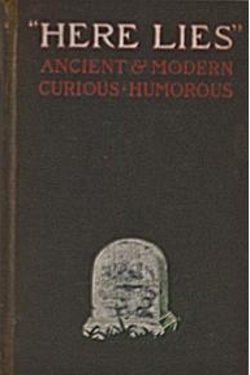
This book from 1900 whose full title is: Here Lies: Being a Collection of Ancient & Modern, Humorous and Queer Inscriptions from Tombstones compiled and edited by W.H. Howe, published by The New Amsterdam Book Company contains 197 pages of fascinating epitaphs, mostly from Great Britain. It was originally published in England in 1891 as Everybody’s Book of Epitaphs.

It’s difficult to believe that hundreds of years ago people were this creative about their own demise. Probably in many cases it was the friends and relatives of the deceased who were responsible for these final words etched in stone. Do you know what you would want written as your epitaph?

Here are a few of the better ones from this out of print gem:

Stephen Remnant

Here’s a Remnant of life, and a Remnant of death,
Taken off both at once in a remnant of breath;
To mortality this gives a happy release,
For what was a Remnant proves now the Whole piece.


Mr. Edward Pardon (a bookseller)

Here lies poor Ned Pardon, from misery freed,
Who long was a booksellers hack;
He led such a damnable life in this world,
I don’t think he’ll ever come back.


Continue reading

Bill Moose Skowron Dies at 81 – An Appreciation of a Kind Man

Casey Stengel and Bill “Moose” Skowron

Bill “Moose” Skowron died today, April 27, 2012 of congestive heart failure in Arligton Heights, IL.

In this news photograph above, the caption says, “Bill Moose Skowron reports for his first day, at Comiskey Park in Chicago, September 19.”

The only problem with this is that Moose’s first game was April 13, 1954 and it was not at Comiskey Park.  And the Yankees did not play in Chicago on September 19, 1954.

So what is the answer to this problem? Continue reading

Classic Hollywood #12 – Lili Damita

Lili Damita in Fighting Caravans 1931

The beautiful Liliane Marie Madeleine Carré also known as Lili Damita poses for Eugene Robert Richee, one of Hollywood’s great glamor photographers.

Lili was in the process of filming Fighting Caravans, a Western based upon a Zane Grey book, co-starring Gary Cooper.

Born in France in either 1901 or  1904 (sources are unclear), Lili was briefly married to director Michael Curtiz (Casablaca,  The Adventures of Robin Hood, Mildred Pierce, etc. ) from 1925-1926.

Lili announced her engagement on May 1, 1929 to the Crown Prince of Germany, Louis Ferdinand, who was only 21 at the time. They would be married, Lili declared “when he makes a success.” The marriage never took place.

Lili is best known today not for her movies, but for her marriage in 1935 to a then virtually unknown Errol Flynn. Lili was several years older than Errol and their marriage would be complicated, contentious and filled with wild love-making and even wilder fights. As Lili said in a 1939 interview:

“Being married to Flynn is exactly like living on top of a volcano. I like that. A volcano which does erupt. Constantly – yes, but daily! We are always just arriving or just leaving. Flynn and I. As the term is generally understood, Flynn is not a ‘good husband’ at all. But he is an exciting person to live with. And that makes him, for me, a very good husband. Because I like to live dangerously, unpeacefully.”

While Lili’s movie carrer ended in 1937, Errol’s career skyrocketed and the hedonistic Flynn was indulging just too much for Lili’s taste. After many separations and reconciliations, Lili sued for divorce on November 7, 1941.

Their only child, Sean Flynn born May 31, 1941, tried acting, became a photographer, and was captured in Cambodia in 1970 by communist guerillas. Lili spent the remaining years of her life having investigators search for her missing son. He was never seen again.

Lili married Eskimo Pie executive Allen R. Loomis in 1962. That marriage ended in divorce in 1983.

Lili Damita died in Palm Beach, FL on March 21, 1994 from complications of Alzheimers.

Walter Alston Managing

Dodgers Manager Goes Through Various Emotions – 1955

2012 marks the 50th anniversary of the Los Angeles Dodgers playing at Dodgers Stadium. For the first fifteen of those years at Chavez Ravine, the manager was Walter Alston who was most notably retained by the Dodgers management on a series of one year contracts throughout his career.

Alston started managing the Dodgers in 1954 when they were still in Brooklyn and retired after the 1976 season at the age of  64. During that time Alston won seven NL pennants and four world championships.

This news composite photograph shows Alston managing on June 16, 1955 in Brooklyn against the Cincinnati Reds. Alston shouldn’t have worried so much. After the Reds tied the game 4-4 in the top of the ninth, the Dodgers won the game 5-4 in the bottom of the 9th on a Duke Snider solo homerun, his second homer of the game. Clem Labine picked up his 9th win and the attendance was 6,655.

The Brooklyn Dodgers won only one World Series while in Brooklyn.  1955 would see Alston and the Dodgers defeat the hated New York Yankees in seven thrilling World Series games, sending all of Brooklyn into a delirious state of happiness.

Walter Alston was inducted to the Baseball Hall-of Fame in 1983 and died in 1984 at the age of 72.

Subway Song

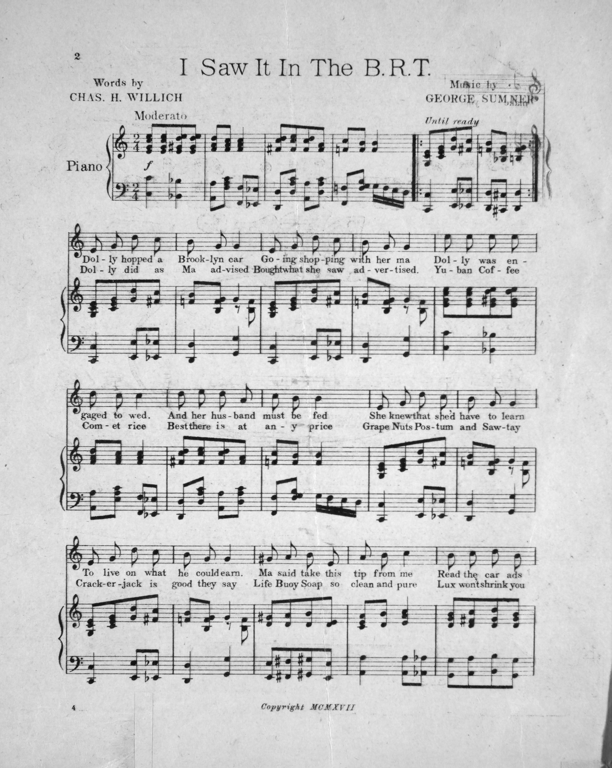
“I Saw It in The BRT”

An ode to the subway.

This 1917 ditty was written about the BRT (Brooklyn Rapid Transit System), which was the former name to the BMT (Brooklyn Manhattan Transit System).  The words which extoll the virtues of the advertising you would see on the train were written by Charles H. Willich and the music by George A. Sumner.

It is amazing how many products mentioned in the song are still around from almost 100 years ago: Grape Nuts, Wrigley’s Gum, Cracker Jacks, Aunt Jemima Pancake Mix and many others.

New Yorker’s have no more BRT, BMT, IND (Independent) or IRT (Interboro Rapid Transit). Now we just call it the subway, run by the oligarchal fiefdom called the MTA (Metropolitan Transit Authority).  And most of the ads you see are for acne treatments, learning English, and filing lawsuits.

Lyrics can be read here (click to enlarge):


The Birth Of The Movie Palace, Roxy, and The Best Deal Ever For A Screenwriter

The Strand Theatre Opens, April 11 1914

When the Strand Theatre opened on April 11, 1914 in New York at 47th Street and Broadway, it marked the beginning of a new era in the exhibition of motion pictures; the age of the movie palace.

The Strand seated an astounding 3,500 people and was the largest and most ornate theatre ever built exclusively to show movies. The Strand covered 20 city lots and had a frontage of over 155 feet on Broadway and over 277 feet on 47th Street.

Innovations in design Continue reading

Old New York In Photos #17 – Where Was The Easter Parade Held In The 19th Century

The Easter Parade, circa 1900

This view looking north on Fifth Avenue taken at the turn-of-the-century shows New York City holding its famous Easter Parade. The parade, known for its display of beautiful bonnets and fancy hats, has been occurring since the 1870’s in New York.  You can see how packed the streets near St. Patrick’s Cathedral.

Anyone could walk Fifth Avenue on Easter, but it was generally the well to do who participated in the exhibition. Fifth Avenue being home to some of the most expensive homes made this a natural gathering spot for the wealthy. But is that where the tradition began?

One of the first places crowds gathered to display their Easter finery in New York City was not Fifth Avenue, but Central Park. Continue reading

Was Only One Piece Of Baggage Saved From the Titanic?

The Baggage Mystery of The Titanic

We continue from last week to look at the lesser known stories surrounding the sinking of the Titanic. This time we examine the story of the one piece of baggage that seems to have made it off the Titanic.

When the Titanic’s passengers were being loaded into the lifeboats, they were told by the crew they could not bring any luggage with them. Some survivors did bring small bags containing personal effects, but most carried nothing with them.

So how did a canvas bag three feet high and two feet thick filled with personal belongings of a Titanic passenger get back to New York? Continue reading

When Ballplayers Spent Time With The Fans

Bobby Thomson and A Young Fan

Sure it’s just a posed publicity photo, but there was a time when ballplayers actually did interact with fans.  At the New York Giants’ spring training home in Phoenix, Arizona,  Bobby Thomson demonstrates to a little cowboy, Dennis Filan age five, the proper way to grip a baseball bat on March 6, 1953.

Thomson, who will forever occupy a spot in every Giants fans heart for hitting the most famous homerun in baseball history the  “shot heard ’round the world” in 1951, was typical of  many ballplayers before astronomical salaries became the norm for baseball.  These players spent time among the fans.

Not only that, most players worked other jobs in the off-season to make ends meet. They lived among regular people, who went to the ballgames and had daily interactions with them. In New York and many other major league cities, most players took public transportation or walked to the ballpark from their homes. The players were an integral part of the community they played in.

It’s one of the reasons baseball is so screwed up today. Continue reading