Tag Archives: Subway

50 Years Ago – New York’s Big Blackout Of 1965

Tuesday, November 9, 1965 – The Night The Lights Failed

Blackout Grand Central stranded 1965 11 10Nov. 10, 1965 – New Yorkers During Blackout – People sleep sitting up and lying down in New York’s Grand Central Terminal early today during the power failure. This area is lit up with emergency lighting. (AP Wirephoto)

In the past 50 years New York has experienced three huge blackouts; August 14, 2003; July 13-14, 1977; and the first large scale blackout that affected much of the northeast, November 9-10, 1965.

30 million people were affected when the electricity went off, cascading from Ontario to Buffalo to New Hampshire and on through to New York City where at 5:40 pm the power failed, plunging the city into darkness. Trains, elevators, traffic lights and all electric ceased to function as many New Yorkers were literally stopped in their tracks.

Blackout: Using a candle for a light passengers look at another passenger sleeping on the floor of a stalled subway train during power failure. November 10, 1965 (AP Wirephoto)

Blackout: Using a candle for a light passengers look at another passenger sleeping on the floor of a stalled subway train during power failure. November 10, 1965 (AP Wirephoto)

There was no looting Continue reading

New York City Subway Advertising 1912

Broadway & 207th Street IRT Subway Station – 1912

Subway Station Broadway 207th St 1912Some things in New York have not changed in 100 years and advertising in the subway is one of them. Paper ads are still put up at stations all along the subway system.

The IRT’s Broadway and 207th Street station is captured here on June 12, 1912 and shows a deserted station. Currently the “1” train runs on this line and the station is elevated and outdoors.

Looking at the photo we notice the thin strip wood plank flooring and tasteful globe lighting to illuminate the station at night.

As for the ads we see from right to left: Continue reading

Graffiti As Vandalism, Not Art

Museum of The City Of New York Graffiti Exhibition Doesn’t Show What The Majority Of Graffiti Is – Unintelligible Scrawls By Vandals

I caught the newest exhibit at The Museum of the City of New York entitled “City as Canvas,” which glorifies the practitioners of graffiti and their “work” during the 1970’s and 1980’s in New York City.

For anyone who thinks that graffiti is something to be celebrated in a retrospective by an exhibition at an important cultural institution, here is some evidence to contradict that viewpoint.

Iouri Podladtchikov, Olympic half-pipe king visits the lower east side with typical graffiti defacing a grand old building. photo - Casey Kelbaugh for the New York Times

Iouri Podladtchikov, Olympic half-pipe king visits the lower east side with typical graffiti defacing a grand old building. photo – Casey Kelbaugh for the New York Times

A typical display of current graffiti “art” as seen in this building covered by spray paint on the lower east side really is a better representation of the so called graffiti artist. It pains me to see old handcrafted stone buildings covered with paint. The beautiful Queensboro Bridge girders and stonework are always being cleaned and re-painted due to these miscreants who attack our public property with their spray cans, markers and etching knives.

Subway graffiti photo taken Feb 8, 1982

Subway graffiti photo taken Feb 8, 1982

The onslaught of graffiti began in earnest in the subway system in the 1970’s where riding a train was a demoralizing prospect. Almost every single car was covered in dripping unintelligible paint and marker scrawls, which obliterated any blank spaces. Continue reading

When The New York City Subway Opened On October 27, 1904

20 Cool Facts About The New York City Subway When It Was Brand New

"What The Subway Means To New York City" New York Evening World October 27, 1904 (click to enlarge)

“What The Subway Means To New York” New York Evening World October 27, 1904 (click to enlarge)

109 years ago on October 27, 1904, the New York City Subway was opened to an enthusiastic public with great fanfare and accolades.

New Yorker’s were proud of this engineering sensation and its features were highlighted in newspapers and magazines around the world.

On the occasion of the opening, the New York Evening World published a “Subway Souvenir Special” to commemorate the event. With articles describing many aspects of the subway, the special issue compiled a list of 100 facts about the subway. Here are some of the better ones:

1. In 1894 the people of New York voted to create a tunnel for a subway which was to be owned by the city. After six years of preliminary work by the Rapid Transit Commission, bids were accepted to build and operate the subway on November 15, 1899.

2. Only two companies bid for the job. John B. McDonald and the Onderdonk Construction Company. McDonald’s bid was accepted January 15, 1900.

3. McDonald proposed to construct the tunnels for $35 million with an additional $2,750,000 for station sites, terminals and other incidentals.

4. The money for the construction was loaned by the city. It was to be paid back with interest in fifty years.

5. McDonald organized a construction company with August Belmont as its president. Another company within this company, the Interborough Rapid Transit Company (IRT) was organized to operate the subway.

6. The IRT had the privilege of operating the system for 50 years, with an option for a 25 year renewal. When the subway passed into the hands of the people, the equipment was to be purchased by the city at a valuation to be determined by arbitration.

7. McDonald sublet the construction to thirteen sub-contractors. Ground was broken March 25, 1900 in front of City Hall.

8. McDonald pledged to have the subway ready in four and a half years. The actual time spent on construction was only 1275 days.

9. The final amount spent was just $40 million.

Union Square June 8, 1901 Subway Construction

Union Square June 8, 1901 Subway Construction

10. There were 120 lives lost during the construction. Continue reading

Old New York in Photos #32 – Subway Explosion 1915

1915 Subway Explosion Kills Seven, Injures Scores: 7th Avenue Between 24th and 25th Streets

This photograph taken on September 24, 1915 looking east across Seventh Avenue between 25th and 24th Streets shows the extent of a tragedy that took the lives of seven people and injured more than 100.

At about 7:50 a.m. on September 22, 1915 during the subway excavation for a new line, an explosion followed by a massive street collapse threw 7th Avenue into a scene of pandemonium and carnage.  A blast of dynamite caused the temporary roadway of wood planking to give way. A trolley loaded with passengers plunged 30 feet into the abyss created by the cave in. A beer truck minus the driver also fell into the excavation.

The reason more people were not killed was because the street undulated for a few seconds before collapsing which allowed precious time for people on the street to scatter to safety.

The motorman of the northbound trolley, John Mayne said, “The car sank just where I stopped it. I had no stop at Twenty-fourth street and there was no warning there. When I was half way to Twenty-fifth street I saw a flagman and set my brakes. As I set the brakes I felt the earth going from under me. The next thing I knew I was being pulled out of hell.”

Fanny Borie, 18,  of Brooklyn was on the trolley, on her way to work when it went down into the hole. “When the car started to sink there were terrible screams, and I think I fainted,” she said. “I remember feeling people tugging at my feet, as I was buried under some timbers. Then I lost consciousness and came to again when I was being carried up a ladder to the street.” Continue reading

Old New York In Photos #23 – Subway Excavation Along Broadway & 49th St. 1901

Subway Excavation, Broadway and 49th Street – 1901

While the MTA is currently striving to build the new Second Avenue subway without disturbing businesses along the route, the Interborough Rapid Transit Company (IRT) had no such compunction about hampering businesses as demonstrated by this photograph taken on November 26, 1901.

We are looking north along Broadway towards 49th Street. The J.B. Brewster Carriage Continue reading

Old New York in Photos #22 – History of Times Tower Building & Times Square In Detail

Times Square And The New York Times Tower Building 1908

Times Square featuring The Times Tower 1908 – click to vastly enlarge (six megabytes!)

Times Square is burgeoning with activity in 1908 and there is so much to see in this picture.

This photograph of Times Square was part of The Detroit Publishing Company collection, now housed at The Library of Congress. The company made picture postcards from these original photographs at the turn of the century.

The area formerly known as Longacre Square became Times Square after the New York Times opened their iconic flagship office building in 1905 at what would become known as “the crossroads of the world,” the southern end of Times Square, the triangular intersection of 42nd and 43rd streets where Broadway and Seventh Avenue diverge.

Flatiron Building in 1903

The Times Tower Building design is reminiscent of the Fuller Building, which became popularly known as the “Flatiron Building” soon after it opened in 1902 between 22nd and 23rd Streets where Broadway and Fifth Avenue intersect. The two buildings don’t look alike at all. But because they were each built on irregular plots of land, the triangular buildings both resemble flatirons.

The original Times Tower Building was a Gothic structure of beautiful light limestone and featured intricate terra-cotta and granite on the facade. More about the building later in the article. Continue reading

The Forgotten Brooklyn Elevated Train Crash Of 1923

June 25, 1923 Intersection of Atlantic and Flatbush Avenues

Photo © Osmund Leviness

“Those who died were fortunate it seemed to me when I looked inside the cars. As long as I live I can never forget it. All the people were in a mass there, struggling and screaming, with blood running over them. They all seemed to be bleeding or stained with blood. One woman’s head was terribly cut on top, and one jaw seemed to be crushed in. The hand of another woman was almost cut off. One woman I took out through a window died a few minutes after I carried her into the post office. I can’t forget the inside of those cars. They looked like my idea of purgatory.” –  Traffic Officer Joseph J. Ryan who was on the scene immediately after the crash.

This incredible accident happened 89 years ago, Monday, June 25, 1923  as two cars of the BMT derailed and plunged 35 feet into the street at the intersection of Atlantic and Flatbush Avenues in Brooklyn. Continue reading

The New York Times Obituaries Occasionally Celebrates Low-Lifes, Yet Ignores Deserving Artists and Notables

Who Gets A New York Times Obituary Write-up?

What do legendary blues and heavy metal guitarist, Gary Moore, rock album photographer Jim McCrary and playwright, screenwriter, author and jazz champion Max Wilk all have in common?

When they died, the New York Times did not cover their deaths in the obituary column. We all know space is limited, but these people were significant in their artistic fields, enriching the lives of countless others.  It would be nice had the self-proclaimed “newspaper of record” recorded and noted their amazing lives. But The Times editors felt these people were not deserving.

The official policy about who the The Times decides to write up is :

When we look to see whether someone had made a newsworthy impact in some way — who “made a wrinkle in the social fabric,” — we don’t equate significance with fame. In point of fact, 9 out of 10 people we write about are indeed not household names (the 10th is — a movie star, a secretary of state). But that doesn’t negate their importance. Most made their marks in quiet ways, out of the public limelight, but they still made a mark, possibly on your life and mine.

So who is deserving?

Apparently an unremarkable low-life, graffiti tagger, StayHigh 149, a.k.a. Wayne Roberts , can get a full write-up.

Yes, Roberts definitely, as the Times puts it, “made a mark on your life and mine.”

More like a blemish.

Especially in New York City in the 1970’s when the city was bombarded with the eyesore of graffiti defacing public and private property.

As is noted in the obituary, this great man (sarcasm) in the 1960’s was working as a messenger on Wall Street and smoking about an ounce of marijuana a week, earning the Stay High nickname.

Inspired by other vandals tagging subway cars, he then began defacing public property.

Chris Pape a fellow graffiti  aficionado says in the Times obituary:

“He (Roberts) rode empty trains all day with markers in his pocket, and he wrote everywhere.” By the early ’80s, Pape said, drugs had begun to take their toll. Roberts left his World Trade Center job, and his wife, because of his drug use. “He was a functional junkie who occasionally did time in prison for stupid things,” Pape said. “He was like that for 20 years. He didn’t want to be found.”

For some reason, I can only think of the millions of wasted dollars that it cost taxpayers to eradicate the vandalism this cretin created.  As I have said before – graffiti is definitely not art.

This is the sort of person The New York Times chooses to cover in their obituaries?

For the record, when one of the most influential singers in heavy metal history, Ronnie James Dio, died on May 16, 2010, the following day The Times devoted 493 words to summing up his life.

Graffiti vandal Wayne Roberts had 838 words written about him.

Subway Song

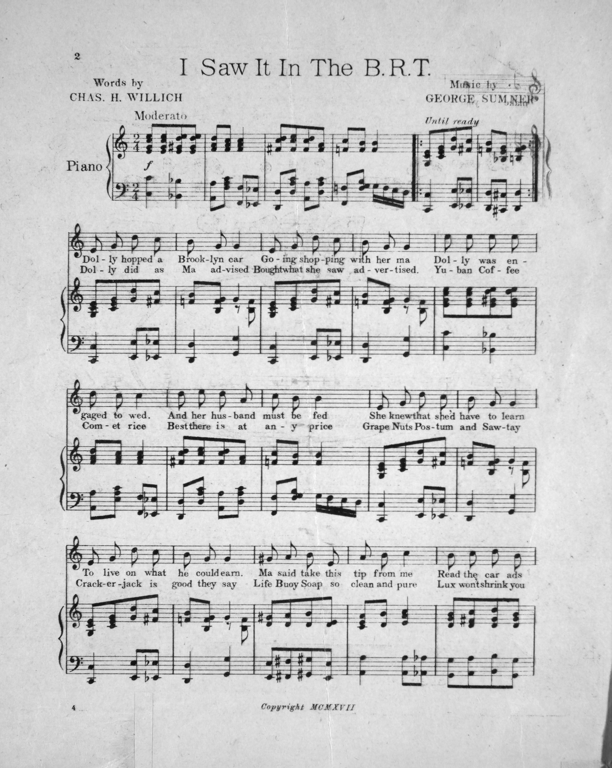
“I Saw It in The BRT”

An ode to the subway.

This 1917 ditty was written about the BRT (Brooklyn Rapid Transit System), which was the former name to the BMT (Brooklyn Manhattan Transit System).  The words which extoll the virtues of the advertising you would see on the train were written by Charles H. Willich and the music by George A. Sumner.

It is amazing how many products mentioned in the song are still around from almost 100 years ago: Grape Nuts, Wrigley’s Gum, Cracker Jacks, Aunt Jemima Pancake Mix and many others.

New Yorker’s have no more BRT, BMT, IND (Independent) or IRT (Interboro Rapid Transit). Now we just call it the subway, run by the oligarchal fiefdom called the MTA (Metropolitan Transit Authority).  And most of the ads you see are for acne treatments, learning English, and filing lawsuits.

Lyrics can be read here (click to enlarge):