Tag Archives: News – Press Photo

An Incredible Babe Ruth Accomplishment

The Babe Hit Homers, But Didn’t Give Them Up

Babe Ruth 1916 at Comiskey Park LOC 2When I’m asked who was the greatest baseball player of all-time, I never hesitate in my answer that it was Babe Ruth. For the few people still living who saw Ruth play, they will attest to his skills as not just a great hitter, but an excellent fielder, surprisingly fast base runner (excepting his 1926 World Series blunder) and of course a dominant pitcher.

In 1916 with the Boston Red Sox, Ruth did something that only five other pitchers in the modern era have accomplished. Ruth pitched over 300 innings (324) without allowing a home run. Can you imagine that? Even in the deadball era when home runs were tough to come by, this is still an amazing achievement and one that will likely never be done again.

Starting pitchers today do not come close to pitching 300 innings, let alone not give up homers. The last pitcher Continue reading

Old New York In Photos #30 – Cooling Off During Heat Waves

Heat Waves In New York And Children Cooling Off

NYC Kids Playing at Hydrant

As New York City endures a heat wave this week, realize that for the majority of the 20th century there was virtually no air conditioning in most homes. The streets provided the easiest and most accessible way for children to cool off.

In New York, it is only recently that a heat wave has been defined as at least three straight days with temperatures reaching 90 degrees or more. Who decided this I do not know. Every region of the world has their own definition of what comprises a heat wave. Years ago, any sustained combination of high heat and humidity used to qualify as a heat wave.

This undated photograph above from the mid-1940’s shows city children on a Manhattan street playing and wallowing in the water. I like the fact that some of the people are looking directly at the photographer who is perched high above the street capturing the scene.

Cooling off Harlem 1933

This photo shows a Harlem street in 1933 with children gathering around a center stand sprinkler connected by a hose to the fire hydrant.

A four day heat wave in New York City that began June 7, ended on June 10, 1933 with a violent thunderstorm which dropped the temperature down to 86. The day before, the thermometer in the city reached the mid 90’s and reportedly hit 120 degrees in Hammonton, NJ, wilting strawberries right on the stem.

Joe Funranolla and Ray Bardini beat the heat by diving into the river July 22 1955

As unthinkable as it is now, for decades up until the 1970’s, to cool off many children would swim in the polluted East and Hudson Rivers. With the FDR Drive and the United Nations Secretariat Building in the background Joe Funranolla and Ray Bardini beat the heat by diving into the East River July 22, 1955. The temperature hit 96 that day.

It was the eighth day in July 1955 that the mercury went above 90 degrees. According to the New York Times, the record up to that time for 90 degree days in July was ten, which was accomplished in 1876 and 1952.

Boys Swimming East River 1937

This 1937 photograph shows teen boys making daring dives into the East River. The Williamsburg Bridge is in the background. I wonder how long it took to get back up to where they were diving from?

Hell Gate Bridge bathers Astoria Pool 1937

One thing has remained the same over the years: if they can get to one, kids still flock to the city pools. In this 1937 photograph the Astoria Pool entices a huge crowd, while the Hell Gate Bridge looms in the background.

The current heat wave will soon be over and when winter arrives, you can bet your bottom dollar many New Yorker’s will be saying they can’t wait for the warm weather.

Things You Didn’t Know About The George Washington Bridge

The George Washington Bridge Was Going To Have Its Steel Towers Covered In Stone

George Washington Bridge Under Construction circa 1930

The George Washington Bridge seen here during construction in 1930, was built from 1927 until 1931. Architect Cass Gilbert intended its towers to be sheathed in stone. Still visible on the towers are the hooks for which the stone was to be attached.

George Washington Bridge Original Design

Proposed Original Design With Stone Arches

It was decided for practical reasons that the bridge towers did not need to be encased in stone. The Depression hit soon after construction started and the cost of procuring and installing the stone would have been prohibitive. The designers and builders reevaluated the whole look of the bridge and felt that there was a natural beauty in showing the function through the form of the exposed naked steel.

The bridge’s chief designer and engineer Othmar Ammann had incredible foresight. Though the bridge had only one level when originally constructed, the design he came up with allowed for the eventual addition of a lower level which was added in 1962. This increased the number of traffic lanes from eight to fourteen. Morning and evening rush hours can create delays of one hour or longer. Can you imagine what the delays would be like without the second deck?

12 other interesting facts about the George Washington Bridge:

1. When completed in 1931 the George Washington was the longest suspension bridge in the world. It was eventually displaced as the longest bridge by San Francisco’s Golden Gate Bridge in 1937.

2. The bridge was completed eight months ahead of schedule and under budget.

3. To finance the bridge, the states of New York and New Jersey each advanced $5 million and $50 million in bonds were issued.

4. Tolls were set to pay off the bonds, which would mature serially starting in 1953. It was assumed after paying off the bond holders, the tolls would eventually be reduced or even eliminated. (Hah!) Continue reading

Frank Chance, Chicago Cubs Player-Manager circa 1912

Frank Chance, Subject of Baseball’s Most Famous Poem

Frank Chance 1912These are the saddest of possible words:

“Tinker to Evers to Chance.”

Trio of bear cubs, and fleeter than birds,

Tinker and Evers and Chance.

Ruthlessly pricking our gonfalon bubble

Making a Giant hit into a double –

Words that are heavy with nothing but trouble:

“Tinker to Evers to Chance.”

Just what is a “gonfalon” anyway? It is a pennant or a flag.

When columnist Franklin P. Adams wrote the poem “That Double Play Again” (later retitled “Baseball’s Sad Lexicon”) in 1910, Frank Chance was the manager and first baseman of the Chicago Cubs. With double play partners Johnny Evers and Joe Tinker, the three would be immortalized first in the popular poem and later in the Baseball Hall of Fame.

Chance played for the Cubs from 1898 -1912 and was claimed off waivers by the Reds after the 1912 season. A month later he was claimed off waivers again from the Reds by the Yankees. In 1913, Chance became the manager of the New York Yankees and played a few games at first base.

He managed the Yankees for two seasons, leading the team to 7th place in 1913 and 6th place in 1914.

Frank Chance died at the age of 48 on  September 15, 1924. He was elected to the Hall of Fame in 1946, 22 years after his death by the Old Timers Committee.

As President, Theodore Roosevelt Carried A Handgun

The 26th President Didn’t Take Chances In Public

Theodore Roosevelt Campaigning in CarTheodore Roosevelt said, “Speak softly and  carry a big stick.”

Roosevelt however didn’t carry a stick, but a .45 caliber Colt revolver.

After William McKinley’s assassination in 1901, Roosevelt didn’t want to be at the mercy of some random shooter without the opportunity for self defense.

In Theodore Rex by Edmund Morris, Random House, 2001, Morris describes how Roosevelt shocked the president of Harvard, Dr. Charles William Eliot when Roosevelt was being awarded an honorary degree.

“Dr. Eliot escorted him (Roosevelt) to a guest suite to change, and watched with fascination as he tore off his coat and vest and slammed a large pistol on the dresser. Eliot asked if it was his habit to carry firearms. ‘Yes, when I am going into public places.'”

Morris also tells about Roosevelt vacationing at his home in Oyster Bay, NY during the summer of 1902:

“The sight of a gun butt protruding from the presidential trouser-seat caused some consternation in Christ Episcopal Church.”

Can you imagine President Obama carrying a handgun?

Nellie Fox, Eddie Robinson and Phil Rizzuto

Before The Game -1951

Nellie Fox Eddie Robinson Phil Rizzuto 1951

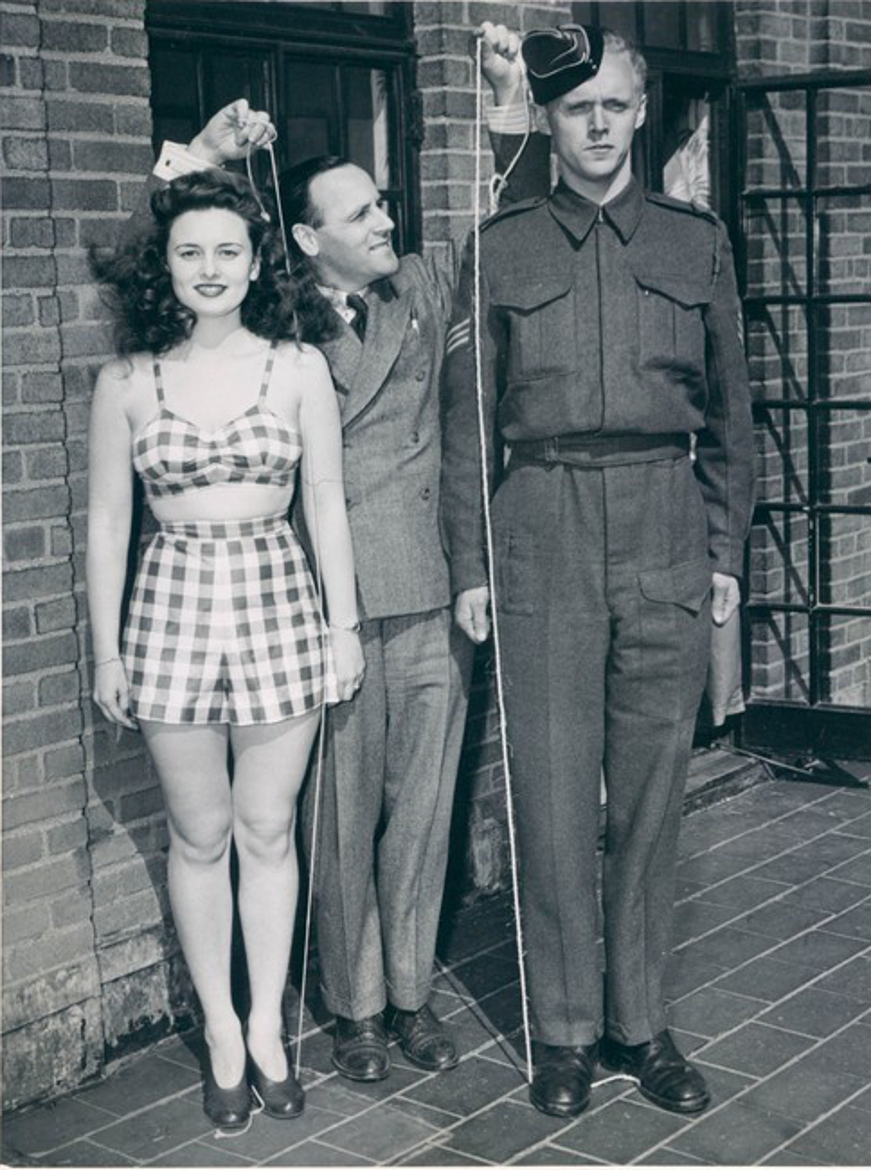
Chicago, June 10, 1951 – Scooter Makes Them Laugh — Phil “Scooter” Rizzuto (right), diminutive New York Yankees shortstop, draws a laugh from Chicago White Sox infielders Nelson Fox (left) and Ed Robinson before game in Comiskey Park yesterday. Fox is batting at a healthy .360 clip while Robinson leads the American League in the runs batted in department with 48 and is tied with Ted Williams in homers with 11. Rizzuto drew the laugh when he told Fox not to stand on his toes in an attempt to look taller than he. (AP Wirephoto)

Beauties Of The Past – Annabelle Whitford

Annabelle Whitford Moore Buchan And The Original “Gibson Girl”

Gibson Girl Annabelle Moore Whitford Buchan Follies 1908

The epitome of feminine beauty at the turn of the century was captured in artist Charles Dana Gibson’s skillful drawings of women, that came to be known as “Gibson Girls.”

Gibson Girl Social Ladder 0040

Annabelle Whitford was 15 years old when she achieved notoriety dancing at the Columbian World Exposition in Chicago in 1893. Annabelle appeared in movies performing her dances under the name Annabelle Moore from 1896 -1902. She went onto a successful stage career hitting the top as a star in the Ziegfeld Follies of 1908 playing one of the “Nell Brinkley Girls.” Brinkley (September 5, 1886 – October 21, 1944) was a female newspaper artist whose creations were very similar to the Gibson Girls. In 1910 Annabelle married Dr. Edward James Buchan and retired from performing.

Gibson Girl Annabelle Moore Whitford Buchan Nell Brinkley Girls Follies 1908

In her obituary in the New York Times it was said Annabelle “was the symbol of beauty in her day. She was billed as ‘the original Gibson Girl’ because of her striking resemblance to the Charles Dana Gibson portrait.” The illustrations below are from Gibson’s 1902 book The Social Ladder.

Gibson Girl Social Ladder 0074 Gibson Girl Social Ladder 0081 Gibson Girl Social Ladder 0012

Continue reading

May Day Parade New York City 1935

Or What’s Wrong With This Photograph?

May Day Parade 1935 5 1

New York City used to have an annual May Day Parade where Socialists, Communists, unions and other pro-labor forces would march down a route and finally assemble around Union Square. Most of the time the assemblies have been peaceful. There were some exceptions during the Depression when work was in short supply and occasional violence would break out on May Day.

In recent years, May 1 in New York City has turned into the flavor of the moment, general protest or demonstration for a wide array of left-wing causes.

In 1935 there were two May Day Parades both held without incident. One was held by the Socialists whose route took them along Eighth Avenue from 15th Street to Columbus Circle and then up Central Park West to 72nd Street. The Communists held their own parade starting at Madison Square on Fifth Avenue up to 32nd Street, across to 7th Avenue and then down to 17th Street and back across to Union Square.

There is no description on this May 1, 1935 photograph which parade this was taken at, but the buildings in the background tell us this is Union Square looking east along 17th Street, so it is surely the Communist parade.

Everyone seems to be paying a lot of attention to the parade…except the one man in the white fedora reading a newspaper.

If this picture was taken in 2013 instead of 78 years ago, I’m sure conspiracy theorists would say there is something very suspicious underfoot here.

Classic Hollywood #22 – Hedy Lamarr & Cecil B. DeMille

Hedy Lamarr and Cecil B. DeMille On The Set Of “Samson and Delilah”

Hedy Lamarr Cecil B Demille On Set 10 28 1949

The 1949 biblical epic, Samson and Delilah starred the beefy Victor Mature and the beautiful Hedy Lamarr in the title roles. According to legend, when Groucho Marx was asked what he thought of the movie he replied with one of the greatest bon mots ever. Groucho said he “couldn’t enjoy a film where the leading man’s tits were bigger than the leading lady’s.”

The caption on the back of this October 28, 1949 publicity photograph reads:

THERE CAN BE QUIET — This is one of the few serene moments in “Samson and Delilah.’ Hedy Lamarr (left) with Producer- Director Cecil B. DeMille maintain an interested silence  while technicians set up the equipment for the next scene. It is Ms. Lamarr’s first Technicolor picture and also her first under the DeMille banner. In it she enacts one of history’s most exotic and celebrated personalities, the Delilah of the Book of Judges, from which Mr. DeMille has extracted the framework of his big-budget production.  (PLEASE CREDIT SAMSON AND DELILAH)

Remembering Bobby Murcer And A Good Day At The Plate

Bobby Murcer: 40 Years Ago Today, April 11, 1973

Baseball Murcer vs Indians 4 11 73

Bobby Murcer vs. Cleveland Indians April 11, 1973

On this date, Wednesday, April 11, 1973, the New York Yankees were at home against the Cleveland Indians and playing their fifth game of the year. They had lost their first four.

Bobby Murcer batting clean-up went 3 for 4 with a double and two singles and scored two runs in a Yankee 4-0 victory.

It is sometimes hard to believe that decades have passed on events that seem like they occurred only a few years ago.

Growing up in the Bronx, my two favorite Yankees were Ron Blomberg and Bobby Murcer. It was a little easier to root for Murcer because he was in the line-up a lot more than the oft-injured Blomberg.

Murcer was probably the best position player on those late 1960’s, early 1970’s Yankee teams which were generally not very good.  Until Thurman Munson, Lou Pinella, Chris Chambliss, Graig Nettles and others joined the Yankees, the team had few bright spots.

Because of their shared Oklahoma heritage and other vague similarities, some fans were expecting (unfairly) for Murcer to be the next incarnation of Mickey Mantle and carry the team to the playoffs.

No player should have that burden placed upon him. Murcer had solid season after solid season, but he knew that he was never going to be the next Mickey Mantle.

Bobby Murcer was traded in a shocking blockbuster deal after the 1974 season and missed out on being a member of the Yankee world championship teams of 1977 and 1978. He returned to the Yankees in 1979 and did get into a World Series in a losing effort against the Dodgers in 1981. Bobby Murcer retired after 1983 and became a Yankee TV and radio announcer. Beloved by many fans and players in baseball, Murcer contracted a brain tumor and died of cancer at the age of 62 in 2008.

Some interesting notes concerning this April 11 game –

It was a day game. Why play night games in New York in early April? So the temperature can drop an additional 25 degrees and fans and players can freeze? MLB and the teams didn’t try and maximize attendance figures by playing in conditions not conducive to baseball (see current November World Series as an example).

The attendance was 5,059. (Which is the rationale that now most weekday games are scheduled as night games.)

The game was completed in two hours and 29 minutes.

Mel Stottlemyre pitched a complete game two hit shutout, striking out six but walking eight.

Indians starter Gaylord Perry also went the distance. Perry ended up with 19 wins and 19 losses in 1973 and pitched 29 complete games. That is four more complete games than the top five (Verlander, Dickey, Hernandez, Peavy and Harrison) complete game leaders combined for in 2012.

All three of Bobby Murcer’s hits were to left field. Murcer generally could not stand hitting against Gaylord Perry and constantly complained publicly that Perry was cheating by loading-up the ball. For his career Murcer batted .232 against Perry.