
How Macy’s, Tiffany & Co. And Other New York Firms Advertised Their Businesses In 1874
 The 1874 book New York Past and Present by Charles Edwin Prescott (Mercantile Publishing) contains interesting advertising which provides a look at how various companies sold their wares.
Some companies or the buildings they occupied in 1874 are still here today, other companies vanished long ago without a trace and are completely forgotten.
Click on any advertisement to enlarge.
R. H. Macy was down on 14th Street at the corner of Sixth Avenue. They had a collection of buildings joined together on 14th Street as the company kept growing throughout the late 1800’s. They moved to their Herald Square location in 1902. I remember up until the 1980’s looking up at some of the buildings on 14th Street and still being able to see the Macy’s red star emblazoned on the facades of a few buildings.
In 1874 Macy’s top line for advertising was that they were “importers and dealers of embroideries and lace goods.” The rest of the ad goes on to describe carrying goods:”various ladies’, gents’ and childrens’ furnishing goods,” “white goods,” “fancy goods” and “kid gloves”
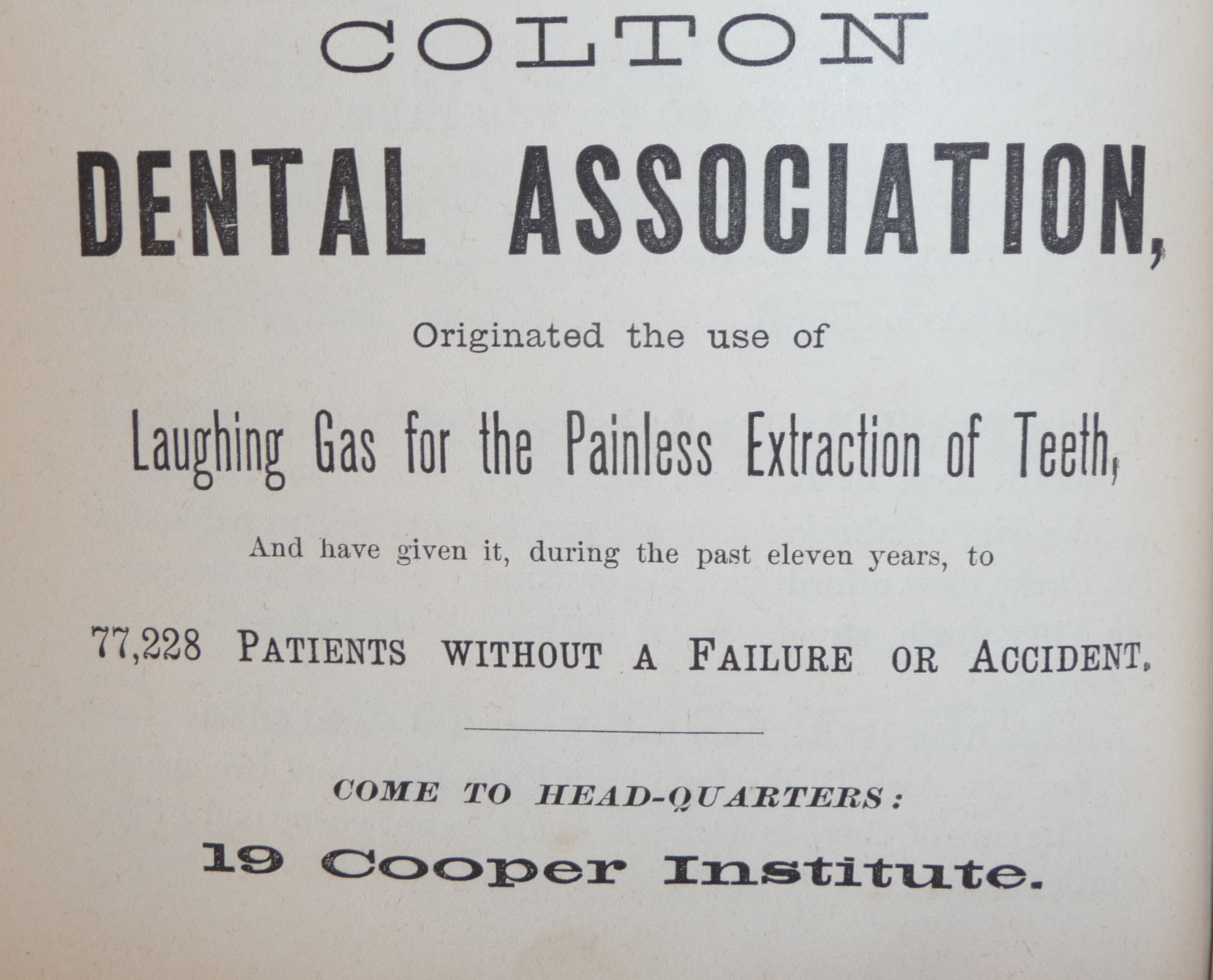 The advertisement for the Colton Dental Association located at 19 Cooper Institute says they originated the use of “laughing gas for the painless extraction of teeth.” Who knew?
In the 19th century, people were really scared of the dentist because it was generally a painful experience. The interesting part of the ad: “77,228 patients without a failure or an accident.”
 Seeing the word “refrigerator” in an 1874 ad may cause you to do a double take. But this is not a modern refrigeration system advertised by Alex M. Lesley, the manufacturer of the Zero Refrigerator with offices located at 224 -226 West 23rd Street. The Zero Refrigerator was merely an icebox with “water, wine and milk cooler.” Mr. Lesley simply says the Zero “is the best food and ice keeper in the world.” The world’s first refrigerator was built in 1834. Refrigerators for home use didn’t come into existence until 1913. Continue reading


