Tag Archives: 1920s

Old New York In Photos #49 – Broadway & 80th Street

Broadway & 80th Street 1898 and 1928

What A Difference 30 Years Makes

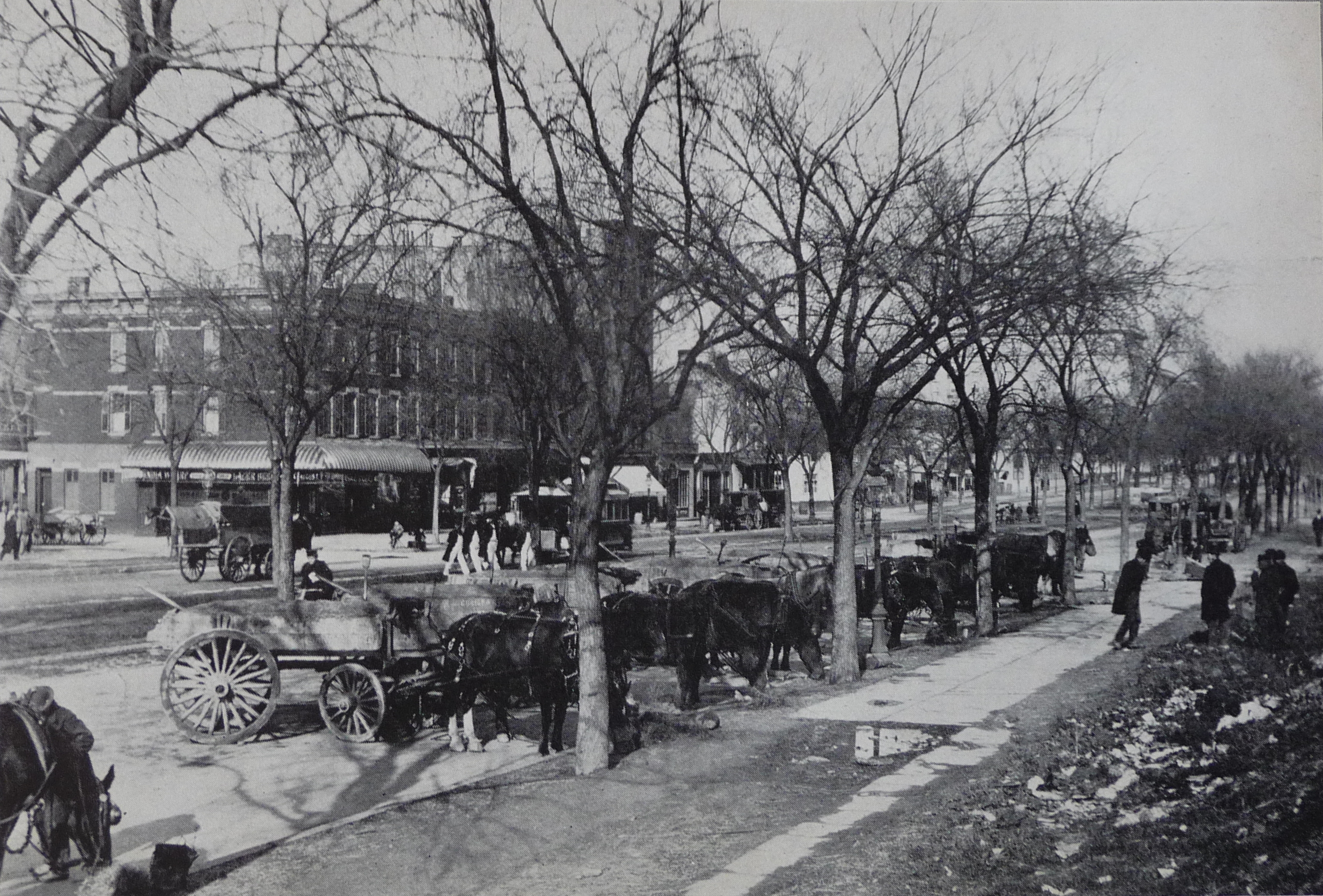
Broadway 80th 81st Street 1898 photo H. N. Tiemann

Broadway looking north and west between 80th & 81st Streets. 1898 photo: H.N. Tiemann

Up until the late 1800’s Broadway above 59th Street still retained much of its sleepy Dutch ways and was still called the Boulevard which followed the course of the Old Bloomingdale Road. The upper west side neighborhoods had their own unique character which were based upon the villages of Harsenville, Striker’s Bay, Bloomingdale and Manhattanville.

In the photo above from 1898 we see the Boulevard looking north and west from 80th Street with horses lined up along the curb. Building is sparse with low profile two and three story buildings. Commercial structures might contain blacksmith’s, grocery shops and tailors. Open land and farms were still nearby. In thirty years the change would be striking.

Land speculation and the coming of the subway would end the ruralness of the area.

Broadway 80th 81st Street 1928 photo H. N. Tiemann

Broadway looking north and west between 80th & 81st Streets. 1928 photo: H.N. Tiemann

This photograph taken in 1928 from the median of Broadway and 80th Street and looking in the same direction as the previous photo shows that almost everything from 1898 has vanished.

We see automobiles, but no horses. The trees that lined the street are gone and there is quite a bit of pedestrian activity along the street. Commercial stores line Broadway and 80th Street to the west and the north. The white building in the foreground is still standing today and now contains Zabar’s.

Continue reading

1925 Police Chief Suggestion: Pay Bounties To NYPD For Killing Criminals

In 1925 A New York Police Chief Proposed Paying Cops Extra To Kill Criminals

Across the country complaints are rising against police officers using excessive force against alleged criminals. So it probably would not be politically correct today to make a suggestion that cops get paid extra to kill criminals. But that didn’t stop one top cop 90 years ago from making that proposal.

Second Deputy Police Commissioner George S. Dougherty c .1912

Second Deputy Police Commissioner George S. Dougherty c .1912

In January 1925 George S. Dougherty former NYPD Second Deputy Commissioner and Chief of Detectives wrote to the New York Times recommending that large bounties be paid to police officers who kill hold-up men.

Dougherty suggested that a police officer killing one hold-up man be paid $1,000, $2,500 for killing two and the astounding sum of $5,000 for killing three. This bounty would mean a regular patrolman could earn substantially more than the $2,500 annual base salary for killing a robber.

Though many citizens may have agreed and responded positively to the Chief’s populist proposal, it never gained any momentum. The New York Times commented that “of course no one goes into mourning when one of these land pirates meet the fate they deserve as enemies of the human race, and if a policeman in the exercise of his duty kills one of them it properly is regarded as a good job, well done. But Mr. Dougherty’s proposal is a very bad one.”

Several officials at the police department concurred with the Times opinion saying that if Dougherty’s suggestions were put into force, “they might incite indiscriminate shooting.”

Other positions advocated by Dougherty included: Continue reading

Babe Ruth And Lou Gehrig Comedy Record -1927

A Commercial Recording Release By The Bambino and The Iron Horse

Gehrig and Ruth at League Park Cleveland 1927 photo L Van OeyenRecently I was reading an old New York Times column from October 7, 1956 by Gay Talese in which he wrote about the history of baseball records. Not home run or pitching records, but baseball related music and spoken word records.

In the article Talese mentions that one of the first record companies to release a baseball record was Pathe records in 1928 when they got Babe Ruth and Lou Gehrig to make a recording explaining how they hit home runs. It did not sell very well. Almost all baseball related recordings have traditionally done poorly with sales, with the exception of Take Me Out To The Ballgame written in 1908 by Albert Von Tilzer and Jack Norworth. Incredibly neither Von Tilzer or Norworth had ever attended a baseball game prior to writing their hit song.

So I searched for the Ruth – Gehrig recording on youtube and couldn’t find the exact recording mentioned in the article, but came up with this version instead. (Click on the youtube video below). Apparently it is the exact same record as in the Talese article, but Talese is mistaken about  the content and the date.

It’s a comedy skit (which is not very funny) advertised Continue reading

Worst Snowstorms In New York History – January 1925

January 2015, Not As Bad January 1925

Trolley stuck in snow during storm

Trolley stuck in snow during storm

It was bad for Suffolk County, NY and Boston, MA, but New York City’s 2015 “worst blizzard of all time” did not live up to its billing.

Official records for the city have been kept since 1869, and so far this January, New York City has received a relatively small amount of snow with 14.3 inches accumulating.

January 1925 arrived and departed like a polar bear and New York City was the unwelcome recipient of 27.4 inches of snow, the most ever recorded for any January up to that time. (This record was finally eclipsed in January 2011 when the city recorded 36 inches of snow.)

But it was not only New York City that got hit multiple times in January 1925 with lots of snowstorms, but upstate New York got slammed as well.

The tally for the city read like this: A relentless snowstorm that lasted two days occurred from January 2-3. On January 12 the city required 12,000 shovelmen to tackle another snowstorm that clogged the streets. January 20 New York City got hit with two blizzards in one day. January 27 more snow fell and then the coup de grace; the giant storm on January 30 that affected the metropolitan area.

Ninety years ago today on January 30, New York City was hit hard, but so was the entire region. How bad was it? Cattle in the streets? Ferry service ground to a halt? Here are a few excerpts of what Continue reading

How Much Did A Working Girl Need To Live On In 1922?

According To One Report – A Miniscule $468 Per Year Would Supply A Working Girl “All The Necessities Of Life.”

1922 Women Dressed NicelyIn 1922, a single working woman could live comfortably on $9 per week and, $17 a week with “luxuries” according to a report issued by the Minimum Wage Commission of Massachusetts.

Even without debt, an annual salary of $468 would barely keep you at subsistence level. $884 would afford you the luxuries of life? Talk about underestimating the needs of the working poor.

The New York Tribune of August 26, 1922 sarcastically mocks the report, as being completely unrealistic.

BOSTON, Aug. 25 – If you are a working girl, $9 a week is enough to supply you with all the necessities of life, according to an investigation just completed by Miss Ethel M. Johnson, assistant commissioner of the Minimum Wage Commission of Massachusetts, who fails to set down for public information just how much she, herself, is contented to earn for her services. For $17 a week the working girl should be able to keep herself well supplied with all the reasonable luxuries of life.

In order to live on the commission’s wage you are supposed, if you are a working girl, to make one pair of corsets last two years and a $2.98 kimono must be stretched over five
years of service.

Your principal recreation should be semi-annual trips to the dentist, and you may contribute 7 cents a week to charity, presumably that which does not begin at home.

According to the commission’s budget, you should spend $154.92 for your clothes and $1 a day for three meals –  breakfast, 25 cents; lunch, 30, and dinner 45. Your one dress and two hats should go through the 365 days- but your heavy coat, costing $40 is supposed to last three winters.

You must not have more than three union suits a year and six pairs of stockings Miss Johnson says few working girls know how to spend their money. “Working women waste most of their money because they actually do not know how they are spending it. They spend §1.50 for a jar of face cream and then quiet their consciences by saving 40 cents a week on cheap lunches.”

By the way, $468 in 1922 adjusted for inflation is equivalent to $6,608 in 2014 dollars.

Miss America, Not Once, But Twice

There She Is, Mary Campbell, The Only Two Time Miss America

Miss America 1922 1923 winner Mary Campbell

Growing up I have slight memories of the Miss America Beauty Pageant: mostly of the perennial emcee Bert Parks singing the “There She Is, Miss America” song, while some young woman was given flowers and started crying.

The Miss America Beauty Pageant and all beauty pageants are generally a bore. They are really thinly disguised T & A shows.

But back in the 1920’s when the Miss America Beauty Pageant began, things were set up a little differently.

In 1922 Mary Campbell was named the winner of the second Miss America Beauty Pageant. Nothing extraordinary in that. As you can see in the above portrait and below that Mary Campbell was not breathtakingly beautiful, but still an attractive girl.

But what caught my attention was that this 17-year-old was not just the winner of the Miss America Beauty Pageant in 1922, but also the winner of the pageant in 1923!

Miss America 1922 winner Mary Campbell on beachHow Mary Campbell became the only two time Miss America winner is an amusing story.

Mary Campbell did not even consider herself the least bit good-looking. In 1922 when Campbell was watching the preliminaries for an Ohio beauty contest, a judge suggested she enter the contest. She did and surprisingly won the contest becoming “Miss Columbus.”

Later she was told she won because of her figure, which was 35-26-36. Being self admittedly  very naive, Campbell did not even know what a “figure” was. She asked her mother who replied, “It’s none of your business.” Continue reading

Old New York In Photos #38 – Fifth Ave. & 44th St. 1923

Fifth Avenue Looking North From 44th Street 1923

Fifth Ave north from 44th st 1923

There is a lot of activity in this photograph taken in 1923 showing Fifth Avenue looking north from 44th Street.

No traffic signals impede the two way traffic which runs on the avenue. A Fifth Avenue double-deck bus is heading northbound packed with passengers. Pedestrians walk along on the avenue while deliveries are being made from trucks, like the one in the lower center of the photograph.

Among the buildings seen are H. Jaeckel and Sons Furriers which occupied the west side corner of Fifth Avenue at 45th street and further in the distance at 48th street is the spire of the Collegiate Reformed Protestant Dutch Church of Saint Nicholas. The church was designed by architect Wheeler Smith and was built from 1869-1872. Theodore Roosevelt and his family occupied pew number number 39. The church was demolished in 1949 and the land was leased to Rockefeller Center.

1923 News Report – Girls Are Becoming Bad, Boys Becoming Good

Cheap Literature & Gay Cabaret Life Making Girls 12-20 Unfit To Be Wives & Mothers

This small item worthy of national news is from the November 9, 1923 edition of the New York Times:

Girls Bad Article

Best line- “Too many women want a career in business away from home. The only career in every girl’s life should be the developing of a real home”

Part 3 Even More Vintage New York City Books With Great Art Deco Dust Jackets

The Art of The Book #3 – New York City Deco Dust Jackets From The 20′s & 30′s

We continue with our look at vintage books about New York City with great dust jackets. (click here to read part 1 and here to read part 2)

Starting with a look at an all-time classic of deco design, New York Nights. (click on any photo to enlarge)

Art Deco dj New York NightsNew York Nights by Stephen Graham, New York: George H. Doran, 1927, dj illustrator, Kurt Wiese

A native of Scotland, author Stephen Graham (1884-1975) goes on a tour of  jazz age nightclubs, speakeasies and cabarets. Graham provides the grittier side of life in an up to the minute description of prohibition New York neighborhoods, establishments and people.

Kurt Wiese (1887-1974) illustrated over 300 books and later became an award-winning children’s book author. Besides the knockout jacket cover, Wiese drew all the illustrations contained in the book. This was the first American book he worked on. Continue reading

Part 2 More Vintage New York City Books With Great Art Deco Dust Jackets

The Art of The Book #2 – New York City Deco Dust Jackets From The 20′s & 30’s

We continue our look at some great New York City books from the 1920’s and 1930’s with exceptional artwork on their dust jackets. (click here to read part 1)

We begin with graphics on a dust jacket worthy of a large size poster from the quintessential art deco New York book. (click on any photo to enlarge)

Art Deco dj New York Paul MorandNew York by Paul Morand and Joaquin Vaquero Palacios. New York: Henry Holt, 1930, dj illustrator, Joaquin Vaquero Palacios.

A witty description of New York, via French writer Paul Morand, (1888-1976) from four visits he made to New York, none longer than a month, from between 1925-1929. Morand later became a supporter of the French Vichy regime.

Joaquin Vaquero (1900-1998) as he is credited in the book without the Palacios surname, was a Spanish architect and painter. His paintings are held in museums across the globe. Continue reading