From Steer Of The Year To The Dinner Plate in Two Weeks
A Contest Where The Winning Bovine Gets A Trip To The Slaughterhouse
Reading old Life magazines, you can come across some unusual pictorials and stories. This graphically illustrated story from 1940 could lead you to vegetarianism. Unlike dog and cat shows, livestock shows don’t necessarily have a happy ending for the winner.
The Life story concerns a steer (a castrated male bull) ironically named “Lucky Boy II.” Below is the brief text and photographs from the January 8, 1940 issue. Continue reading →
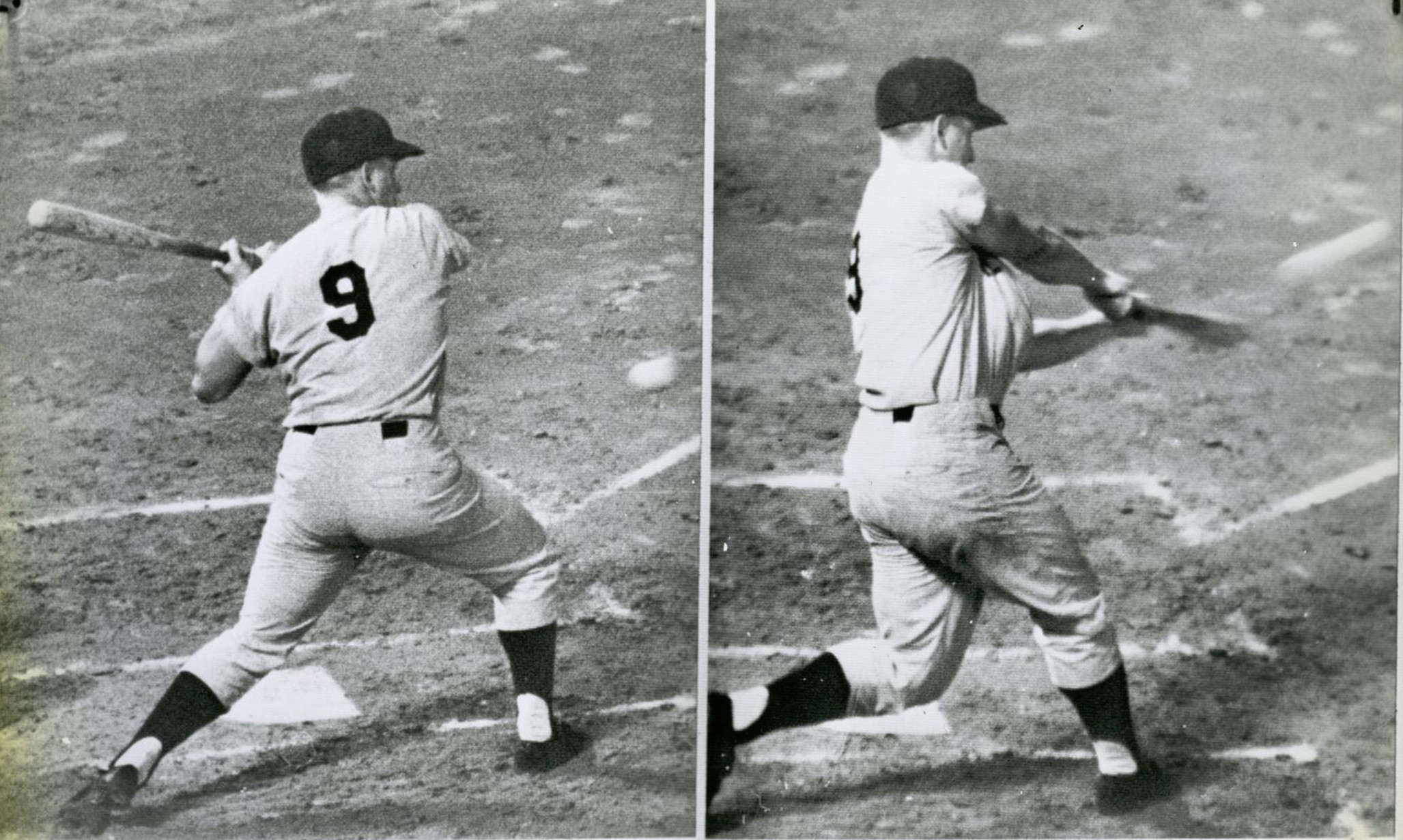
55 Years Ago Today Roger Maris Hit His 59th Home Run Putting Him One Behind Babe Ruth
In the pre-steroid era of baseball, Roger Maris had one magical season. Shown above, Maris connects for his 59th home run of the season on September 20, 1961.
Maris would hit 61 home runs during the 1961 season, breaking Babe Ruth’s record of 60.
Yet Maris’s accomplishment wasn’t considered an “official” record. That is because Ford Frick, the former sportswriter and then Commissioner of baseball, ruled that Maris had to beat Babe Ruth in the same number of games that the Babe was eligible to play in 1927, which was 154.
If Maris did not hit 60 by his 154th game the record would be denoted with an asterisk, indicating that Maris had more opportunities (163) than Ruth did.
The news caption for this photo reads:
Baltimore, Sept 20 – Homer No. 59 For Maris – Roger Maris of the New York Yankees swings into the ball in the third inning tonight as he connects for his 59th home run of the season. The blow came against Baltimore Orioles pitcher Milt Pappas. If Maris can add one more during the game he will equal Babe Ruth’s official 1927 record of 60 in 154 games. He has hit two homers in one game seven times this season. The ball is just a streak as it flies off the bat, right. (AP wirephoto)
Believe it or not, this bucolic scene shown above, from March 1914, is in the Bronx at Jerome Avenue looking north from Clarke Place.
I have not been able to identify the lone building on the left. Besides some telephone and telegraph wires, Belgian block paved streets and trolley tracks, modernity had not yet touched most of the Bronx. The population according to the 1915 police census was 649,726.
In 1914 the Bronx was prosperous and living there was considered to be a sign of upward mobility.
Fast forward 102 years later. Below is the same street from about the same spot.
Jerome Avenue was transformed by the construction of the El in 1917 and 1918, darkening the street, but fostering a building boom. Continue reading →
Gruhak? Yes Gruhak From Croatia. An Amazing Rock ‘n’ Roll Cover Band
If Gruhak ever does a concert in the United States, I’m going to see it.
Since the 1970s I’ve seen over 300 concerts. Among them: AC/DC, Deep Purple, Paul McCartney, Motörhead, The Rolling Stones, Metallica, The Clash, Kiss, Iron Maiden, Rush and countless other classic bands.
Sometimes the shows have been great, other times it’s been a disappointment. Especially now because as the older the bands get, the harder it is for them to perform live. In the past 10 years I’ve mostly stopped going to shows rather than see my rock ‘n’ roll illusions shattered.
Enter the tribute or cover band, that in some cases can deliver a performance that sounds better than the band they are copying. Cover and tribute bands are a dime a dozen, many of them are not very good and they play the bar circuit. There are a handful of bands that can make a full time living at it and have developed their own fan following.
It is rare that there is a band that can have the energy, the vibe and the talent to cover multiple groups and do it well.
That fits the description of Gruhak, a five piece band from Dubrovnik, Croatia. The word “gruhak” means a loud and obtrusive person.
Rather than go on and on about their talent, have a look and a listen.
First up – The Who – We Won’t Get Fooled Again.
Now performing in a totally different style, Gruhak takes on The Doors with Love Me Two Times.
It’s not that Gruhak sound like The Doors. It’s not an imitation, but an interpretation and it’s a damned good one. Gruhak’s singer Boris Kosović, has Jim Morrison’s intonations and the band sounds more like the Doors, than the band that Doors members Ray Manzarek and Robbie Krieger put together a dozen years ago with Ian Astbury, formerly of The Cult, on vocals.
As far as Gruhak’s version of We Won’t Get Fooled Again, it’s as if we’re hearing Roger Daltrey and company in their prime. The other musicians in Gruhak are equally accomplished. Continue reading →
Under The Brooklyn Bridge & The Classic Manhattan Skyline At Night -1928
The Brooklyn Bridge frames this unique view of lower Manhattan at night in 1928. The Woolworth Building (partially seen behind the tower of the bridge) was still the tallest building in the world.
In the center of the photo is the third tallest building in the world, the Singer Building at Liberty Street and Broadway. The second tallest building at the time was the Metropolitan Life Insurance Building on 23rd Street and Madison Avenue.
The next skyscraper to the left of the Singer Building is the Equitable Building. Just south of the Equitable with the pyramid shaped roof is the Bankers Trust Building.
The Beautiful Veronica Lake – The Smallest Waistline in Hollywood
Veronica Lake publicity photograph for “I Wanted Wings” November 1940
Veronica Lake was born Constance Ockelman on November 14, 1922 in Brooklyn, NY. After the death of her father in a ship accident, she adopted her stepfather’s last name of Keane in 1934. Because of her great beauty, after graduating high school, the family moved to Beverly Hills, California so Constance could take acting lessons.
After a series of bit roles in 1939 and 1940 Constance Keane had a meteoric rise to fame.
The publicity machine started to roll in 1940 when Constance was “discovered” by producer Arthur Hornblow Jr. She was cast in I Wanted Wings (1941) co-starring Ray Milland and William Holden. For the film, Constance was given a new name – Veronica Lake.
Syndicated gossip columnist Hedda Hopper wrote about Lake on August 24, 1940, “It’s her first part in pictures, though she’s had a couple of years of little theaters and after they saw her (screen) test, and said, ‘You’ve got the part,’ she turned pale, said, ‘Oh yes?’ Her knees started to cave in, she whispered, ‘Gee Whiz!’ and fled. If she’s as good as her test, the audience won’t be able to keep its mind on its work either.”
Hopper’s column is typical Hollywood ballyhoo of the period. Short on facts and stretching the truth. So is the back caption of our studio publicity photo above, which has many inaccuracies, such as Lake’s birthday and birth name.
Lake was just under five feet tall and became known for her peekaboo hairstyle which covered one eye and waspish figure. At the start of her film career her measurements were reported as 34-18½-34. Continue reading →
How They Squeezed 45,400 Fans Into Boston’s Fenway Park
There’s only one way to get 45,000 people into Boston’s Fenway Park and that is to let the fans sit everywhere, including the outfield.
Yes that’s right, square on the field of play.
Boston’s owner Tom Yawkey never spared expenses when it came to his beloved Red Sox. After the 1933 season during the height of the Great Depression, Yawkey decided to update Fenway Park.
The biggest changes would be the new outfield stands in center and right field. And of course the new 37 foot tall left field wall which would eventually become known as the Green Monster.
During the renovation on January 5, 1934, a large fire destroyed the bleachers and the outfield walls which had wood, oil and debris stored under them.
After the clean-up, work was quickly resumed and the new outfield stands were made fireproof, being encased in reinforced concrete. The new electronic scoreboard indicating balls, strikes and outs was an innovation. The feature known as Duffy’s Cliff, a hill in left field, was removed, leaving only a small incline.
An Unlikely Trio – Alice Cooper, Ethel Kennedy and Andy Williams at The Rainbow Room – 1974
An odd assortment of celebrities gathered together at the Rainbow Room in New York on October 16, 1974. Rocker Alice Cooper (r) sits with Ethel Kennedy widow of Robert Kennedy, as singer Andy Williams stands between them.
Andy Williams is smiling in spite of having been robbed the day before at the Sherry-Netherland Hotel. While Williams was showering, a maid let a woman into the room who claimed she was Williams’s wife. Among the items the woman stole were Williams’s checkbook, four tuxedos and two leather jackets. Continue reading →
In 1782, Thomas Jefferson wrote of the dangers of unrestricted immigration.
What we can apply today from his words of wisdom.
Thomas Jefferson circa 1780 the 3rd President of the United States. Born in Virginia, he drafted the Declaration of Independence,
The United States faced a population problem in 1782. There simply weren’t enough people living in the U.S.: just over 2.7 million according to the census.
Some citizens proposed increasing population by inviting foreigners to settle in the United States.
Thomas Jefferson was firmly against using immigration by “inviting (foreigners) by extraordinary encouragements” as a means of increasing population. Jefferson was not against immigration for people who wanted to come to the United States on their own.
Jefferson’s belief was to allow population to increase naturally through its native stock and continue to allow immigration at its natural pace. While Jefferson wasn’t speaking against any particular group of immigrants flooding our shores, he knew that foreign allegiancesand ideas could cause great upheavals. Jefferson questioned whether increasing population just for the sake of increasing population was a wise move for our young country.
Jefferson espoused civilized values, the current “Western ideals” that the United States was founded upon and that are currently under attack by terrorists. Continue reading →
The New York Times Tower Building Under Construction – 1904
Recently I had the misfortune of passing through Times Square, now a symbol of the mall-ification of New York.
Dead center, standing at 42nd Street where Broadway and Seventh Avenue diverge is the mutilated former New York Times Tower Building. The iconic building that gave Times Square its name, is now basically an electronic billboard. Before The New York Times moved from Park Row to their new headquarters, this area was known as Longacre Square. We covered the history of the building in a previous story.
What was once a classic building has become emblematic of the entire area. Times Square now means: chain stores, thick crowds moving s-l-o-w-l-y and solicitors every five feet hawking something. Then there’s a bunch of beggars in costumes who somehow get paid by having chump tourists hand over money to take a picture with them.
Our photograph from above shows the New York Times Building in the midst of construction in 1904. The George A. Fuller Construction Company advertises that they are erecting the new skyscraper. The Fuller Company put up a similar building on a triangular plot two years previous to this at 23rd Street, the much beloved Fuller Building, better known as the Flatiron Building. Continue reading →

 Reading old Life magazines, you can come across some unusual pictorials and stories. This graphically illustrated story from 1940 could lead you to vegetarianism. Unlike dog and cat shows, livestock shows don’t necessarily have a happy ending for the winner.