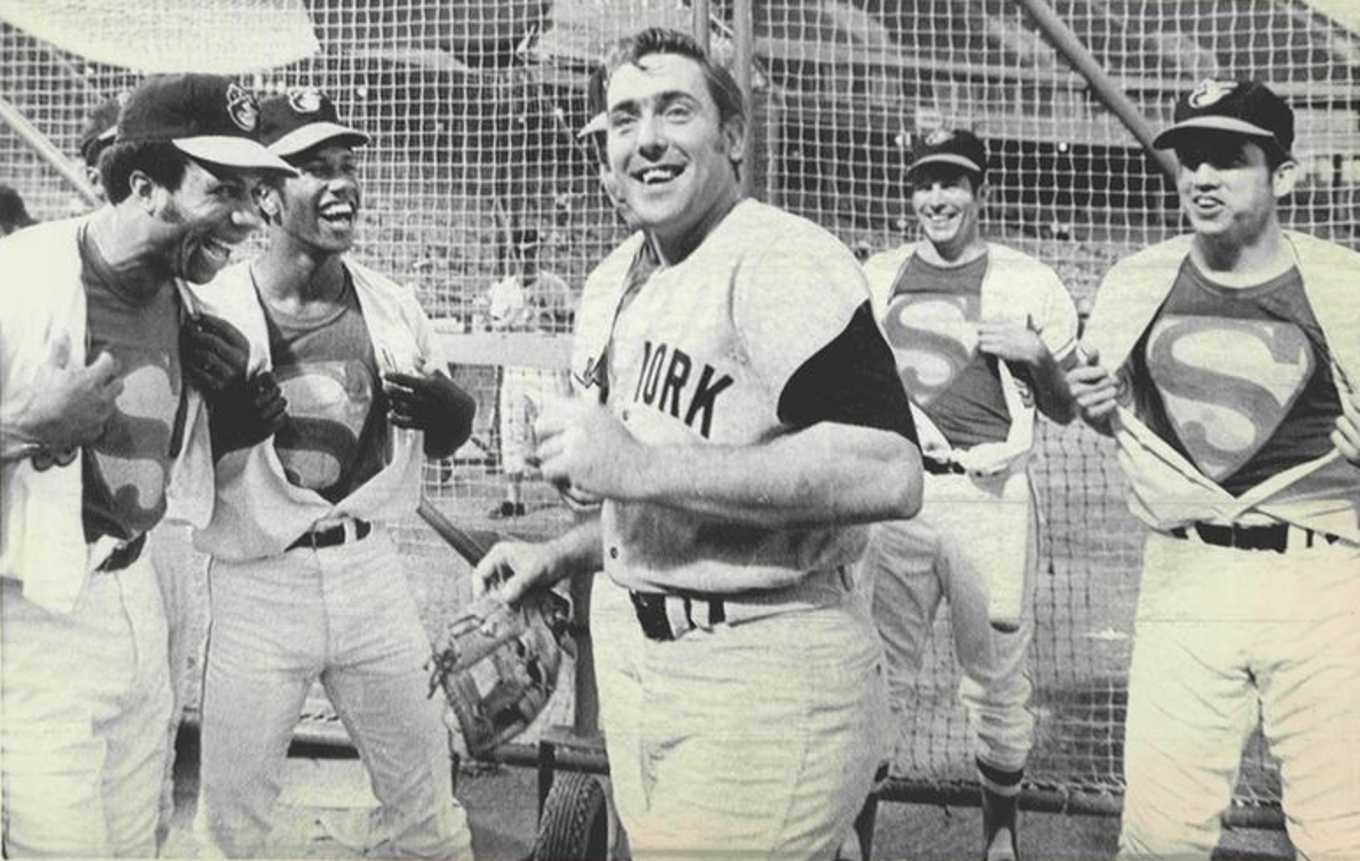
Joe DiMaggio’s Comeback 1949

The Yankee Clipper Gets Ready To Return To Play – June 21, 1949

Many who saw Joe DiMaggio play say he was the greatest all-around ballplayer who ever lived. Everything he did seemed effortless. Of course this is a huge exaggeration. Everything DiMaggio did so well required practice, patience and hard work.

When DiMaggio missed the first three months of the 1949 baseball season with a painful heel injury, many fans, players and sportswriters thought he might never play again.

So it was hush-hush when DiMaggio went to an empty Yankee Stadium to test out his heel in a full workout on June 21, 1949.

Things went well and DiMaggio returned to the Yankee line-up on June 28, 1949 at Fenway Park against the Red Sox to start a three game series. He hit a homerun in the first game which the Yankees won by a score of 5-4. The Yankees swept the series and when DiMaggio left Boston, he had hit four homeruns and driven in nine runs.

The impact of his return cannot be understated. In the 76 games DiMaggio played for the remainder of the year, he batted .346, hit 14 homeruns and drove in 67 runs. His on base percentage was the highest of his career, .459. In 329 plate appearances he struck out only 18 times.

The Yankees ended up edging the Red Sox by one game in the final season standings, propelling the Yankees into the World Series against the Brooklyn Dodgers.

DiMaggio would go on to have the worst World Series performance in his storied career, batting just .111. But the Yankees still defeated the Dodgers four games to one, starting their stretch of winning five World Championships in a row.

The New York Times Obituaries Occasionally Celebrates Low-Lifes, Yet Ignores Deserving Artists and Notables

Who Gets A New York Times Obituary Write-up?

What do legendary blues and heavy metal guitarist, Gary Moore, rock album photographer Jim McCrary and playwright, screenwriter, author and jazz champion Max Wilk all have in common?

When they died, the New York Times did not cover their deaths in the obituary column. We all know space is limited, but these people were significant in their artistic fields, enriching the lives of countless others.  It would be nice had the self-proclaimed “newspaper of record” recorded and noted their amazing lives. But The Times editors felt these people were not deserving.

The official policy about who the The Times decides to write up is :

When we look to see whether someone had made a newsworthy impact in some way — who “made a wrinkle in the social fabric,” — we don’t equate significance with fame. In point of fact, 9 out of 10 people we write about are indeed not household names (the 10th is — a movie star, a secretary of state). But that doesn’t negate their importance. Most made their marks in quiet ways, out of the public limelight, but they still made a mark, possibly on your life and mine.

So who is deserving?

Apparently an unremarkable low-life, graffiti tagger, StayHigh 149, a.k.a. Wayne Roberts , can get a full write-up.

Yes, Roberts definitely, as the Times puts it, “made a mark on your life and mine.”

More like a blemish.

Especially in New York City in the 1970’s when the city was bombarded with the eyesore of graffiti defacing public and private property.

As is noted in the obituary, this great man (sarcasm) in the 1960’s was working as a messenger on Wall Street and smoking about an ounce of marijuana a week, earning the Stay High nickname.

Inspired by other vandals tagging subway cars, he then began defacing public property.

Chris Pape a fellow graffiti  aficionado says in the Times obituary:

“He (Roberts) rode empty trains all day with markers in his pocket, and he wrote everywhere.” By the early ’80s, Pape said, drugs had begun to take their toll. Roberts left his World Trade Center job, and his wife, because of his drug use. “He was a functional junkie who occasionally did time in prison for stupid things,” Pape said. “He was like that for 20 years. He didn’t want to be found.”

For some reason, I can only think of the millions of wasted dollars that it cost taxpayers to eradicate the vandalism this cretin created.  As I have said before – graffiti is definitely not art.

This is the sort of person The New York Times chooses to cover in their obituaries?

For the record, when one of the most influential singers in heavy metal history, Ronnie James Dio, died on May 16, 2010, the following day The Times devoted 493 words to summing up his life.

Graffiti vandal Wayne Roberts had 838 words written about him.

Old New York In Photos #18 – Henry Hudson Parkway Improvement 1937

Henry Hudson Parkway and Riverside Park December 6, 1937

Photo © Ben Heller (Underwood & Underwood)

Looking north from 72nd Street on December 6 , 1937 we see the newly opened stretch of The Henry Hudson Parkway. Continue reading

Unique Antique Vampire Slaying Kit Up For Auction

Die, Dracula, Die!

On June 22, 2012 at Tennants Auctioneers in Yorkshire, England, a 19th century vampire slaying kit will be auctioned off.

Practically everything you would need to kill a fictional character is included. The kit,  housed in a mahogany box, contains a mallet and stakes, a pistol, a silver bullet mold, glass bottles containing holy water and holy earth, garlic, rosary beads, a bible, a crucifix and a handwritten psalm.  It is believed that the kit was made in earnest in the late 19th century. It is being consigned by a woman who inherited it from her uncle.

Because vampire sightings are on the rise and people are looking for extra security from the living dead, the auction has been attracting wordwide attention. The presale estimate of £1,500-2,000 (US $2,300 – 3,100) is probably on the low side considering the number of Dracula fans and strange goths who file down their teeth into fangs believing they are vampires.

UPDATE 7/25/12 – The final hammer price was £7,500 (US$11,700)!

The No-hitter, Break-up King

Cesar Tovar

Pitchers who come close to baseball immortality by throwing a one-hitter will always remember the batter who broke up their no-hitter.

Of all the players who have played big league baseball, you’d think some great or pesky contact hitter like Pete Rose, Ty Cobb, Joe Sewell or Lloyd Waner would hold the record for getting the only hit in a game that otherwise would have been a no-hitter.

But the man who set the record for having the only hit in a game, that ended up being a one-hitter is Cesar Tovar.

Tovar, a .278 career hitter, who played from 1965-1976 spoiled five no-hitters, a record now shared with Eddie Milner.

Tovar got the only hit of the game off of:

  1. Barry Moore of the Washington Senators (April 30, 1967)
  2. Dave McNally of the Baltimore Orioles (May 15, 1969)
  3. Mike Cuellar  of the Baltimore Orioles (August 10, 1969)
  4. Dick Bosman of the Washington Senators (August 13, 1970)
  5. Jim “Catfish” Hunter of the Oakland Athletics (May 31, 1975)

The first four times, Tovar was playing for the Minnesota Twins.  The last time versus Hunter, he was with the Texas Rangers. Tovar’s hits against McNally and Cuellar came in the ninth inning.

Tovar is also one of four players to play all nine positions in one major league game.

Cesar Tovar died at the age of 54 on July 14, 1994.

Chimpanzees In Old News and Publicity Photographs

Monkey See, Monkey Do

People find chimpanzees amusing, especially when they are doing non-chimp activities. News organizations, on a slow news day would send a photographer to see if a good photo-op would come about. Hopefully no one had their face ripped off.

Whatever background information is known, is written below the chimp photo. (Click any photo to enlarge.)

Chimpanzee photographing swimsuit models. Circa 1960’s. (He doesn’t have the viewfinder in the right place, does he?)

Bobby John, chimpanzee tennis player, Rockledge, FL November 20, 1973

“Jiggs” the chimpanzee, on the movie set of  “Her Jungle Love” with Dorothy Lamour. 1938

Chimpanzees eating zeppoles. Circa 1950’s.

Jacko (I swear that is his name) the London Zoo chimpanzee. Circa 1930’s

“The beret hat from Northern France is becomming very popular in London and one was introduced to Jacko the chimpanzee at the London Zoo”

Chimpanzee dressed elegantly, entering a limousine. Circa 1920’s.

Tommy Dorsey Swings It For Chimps – 1939

“Philadelphia – Tommy Dorsey, band leader, gives baby chimpanzees at the zoo here an earful of his trombone music during an experiment to determine the effect of music on animals. Attending the jam session put on by Dorsey and his players were psychologists who studied the animals’ reactions but made no immediate conclusions. January 31, 1939.”

Motörhead Live In Their Prime – 1980

Concert At Nottingham Theatre Royal Is Well Worth Viewing

motorhead tour booklet photo Brian GoodmanFor those of you who are fans of Motörhead this is definitely worth watching.  If you are not a fan, then this video should help make you one. This show captures the band in full control playing a scorching set with good audio and video. The classic line-up of Lemmy, Fast Eddie Clarke and Phil Taylor perform the following set:


Overkill
Too Late Too Late
Shoot You In The Back
Step Down
Jailbait
Leavin’ Here
Metropolis
Train Kept a Rollin’
Bomber
Motörhead


Crime, Murder, Prisons, Hangings and Lynchings in 1891

Some Interesting Facts The 1892 World Almanac

The 1892 World Almanac contains fascinating crime statistics.

Putting the crime numbers in perspective to the population, in 1890 the United States total population was 62,830,361.  The “colored” population  was 7,488,676. So, African-Americans made up about 12% of the population.

There were 45,233 people in penitentiaries, 14,687 were black. That means African-Americans comprised nearly one third of the inmates in the U.S. penitentiary system.

The number of murders and homicides reported by newspapers for 1891 was 5,906.

The murders and homicides are broken down as follows:

  1. Quarrels 2,820
  2. Liquor 877
  3. Unknown 859
  4. Jealousy 449
  5. By Highwaymen 241
  6. Infanticide 208
  7. Resisting Arrest 182
  8. Insanity 102
  9. Highway Men Killed 74
  10. Self Defense 74
  11. Strikes 10
  12. Outrages (?) 2

The number of legal executions reported in the U.S. was 123. The two leading states were Georgia and Texas with 19 and 12 executions respectively. The electric chair as a means of execution was first put into use in New York in 1890.  Almost all the executions in 1891, were by hanging.

The number of lynchings reported was 195. The leading three states were Louisiana 29, Alabama 26 and Mississippi with 23. Six of the people lynched were women.

Below is the full chart on all these statistics. (double-click to enlarge to full size)


Where Did The Saying “Up The River” Come From?

A Movie Cliche’s New York Origins

If you ever watch any gangster films from the 1930’s or 40’s, one of the lines of dialogue that always pops up is: “up the river.”

Somebody would utter it: a criminal; prosecutor; police officer; or a fellow gangster. Listen and it will be said in most of these early crime movies.

Lines like:

“Didn’t you hear, Rocky’s going up the river.”

“If you don’t talk Ike, I can guarantee you’re going to spend a long stretch up the river.”

“I’m not takin’ the fall to go up the river for a heist you did, Spats.”

The term “up the river” as most people know refers to going to prison.

So where did the saying come from?

In the 1800’s, when you were charged with a crime and sent to prison in New York City, the accused would first be taken to the prison on Centre Street in lower Manhattan which was known as “the Tombs” built in 1838.

The Tombs were so named because the original structure had large granite columns on the outside of the building which  resembled Egyptian burial architecture, a.k.a. tombs. The Tombs though, were merely a holding prison for the accused criminals awaiting trial.

After sentencing, convicts were sent to a prison on Blackwell’s Island (today known as Roosevelt Island) in the middle of the East River.

However if you were a habitual offender or committed a very serious offense, you would be sent thirty miles north, up the Hudson River to Sing Sing prison. This is the origin of the phrase being sent, “up the river.” Sing Sing separated the hardened criminals from the run of the mill pickpockets, burglars and ordinary thieves.

Even though, the term “up the river” originally referred to Sing Sing, it was eventually applied to anyone being sent to any prison.