Annabelle Whitford Moore Buchan And The Original “Gibson Girl”
The epitome of feminine beauty at the turn of the century was captured in artist Charles Dana Gibson’s skillful drawings of women, that came to be known as “Gibson Girls.”
Annabelle Whitford was 15 years old when she achieved notoriety dancing at the Columbian World Exposition in Chicago in 1893. Annabelle appeared in movies performing her dances under the name Annabelle Moore from 1896 -1902. She went onto a successful stage career hitting the top as a star in the Ziegfeld Follies of 1908 playing one of the “Nell Brinkley Girls.” Brinkley (September 5, 1886 – October 21, 1944) was a female newspaper artist whose creations were very similar to the Gibson Girls. In 1910 Annabelle married Dr. Edward James Buchan and retired from performing.
In her obituary in the New York Times it was said Annabelle “was the symbol of beauty in her day. She was billed as ‘the original Gibson Girl’ because of her striking resemblance to the Charles Dana Gibson portrait.” The illustrations below are from Gibson’s 1902 book The Social Ladder.
Fascinating Museum Of Memories Collection Displayed At Grand Central Terminal’s Transit Museum Annex
This year marks the 100th anniversary of the current Grand Central Terminal. Jane Greengold is one of a dozen contemporary artists taking part in an exhibition, On Time /Grand Central at 100. Her work is an installation of objects that have been lost and then found over the past 100 years by one family of conductors who worked on various train lines at Grand Central.
Greengold describes how the project came together:
“When I started working on a piece for the Centennial of Grand Central Terminal, I walked around the Terminal for days, looking for inspiration. I was lucky to meet a conductor, Joe Wenham, willing to chat. He told me his father, grandmother, and great-grandfather had all been conductors, starting before 1913. I said his family itself could illustrate the history of the Terminal and he told me that his great-grandfather had begun a family tradition of retrieving items he had brought to the Lost and Found and that had not been reclaimed, even buying items valuable enough to be sold. He began on a whim, but then decided to create a personal museum of memories of his passengers. The family has kept this up for 100 years.
They did not usually keep the kinds of objects most often lost — umbrellas, gloves, hats, glasses – but kept things that happened to strike their fancy. Neither Joe nor his father has been as enthusiastic about collecting as the first two generations, but they didn’t stop. So instead of creating a work for the Centennial, I persuaded Joe to share some of the family collection, and together we chose the objects presented here.”
This is the sort of thing that will bring a smile to your face if you go see it in person. I love the fact that the Wenham family contemporarily tagged each item with where and when the object was found, along with their astute and sometimes witty observations. Below is a sample of objects from the collection.
The photograph caption recaps what is on the tag: the date and train the object was found on and a remark from the Wenham who found it. You can click on any picture to enlarge.
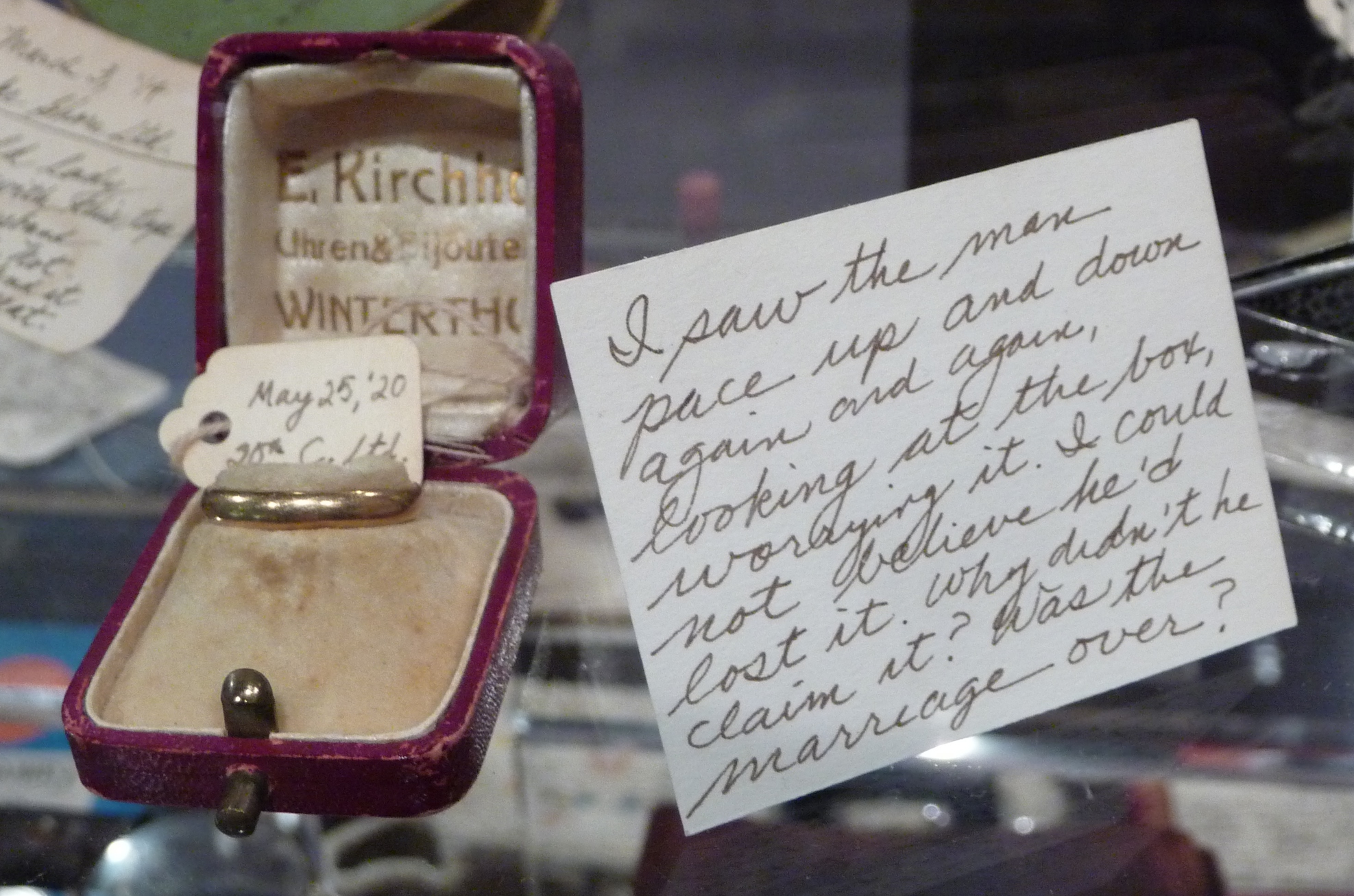
May 20, 1920 – Twentieth Century Limited “I saw the man pace up and down again and again, looking at the box worrying it (sic). I could not believe he lost it. Why didn’t he claim it? Was the marriage over?”
June 25, 1924 – Special “These were the happiest bettors I ever saw”
February 13, 1931 – 20th Century Limited “I never saw anyone wearing this. I don’t even know if it was a man or a woman.”
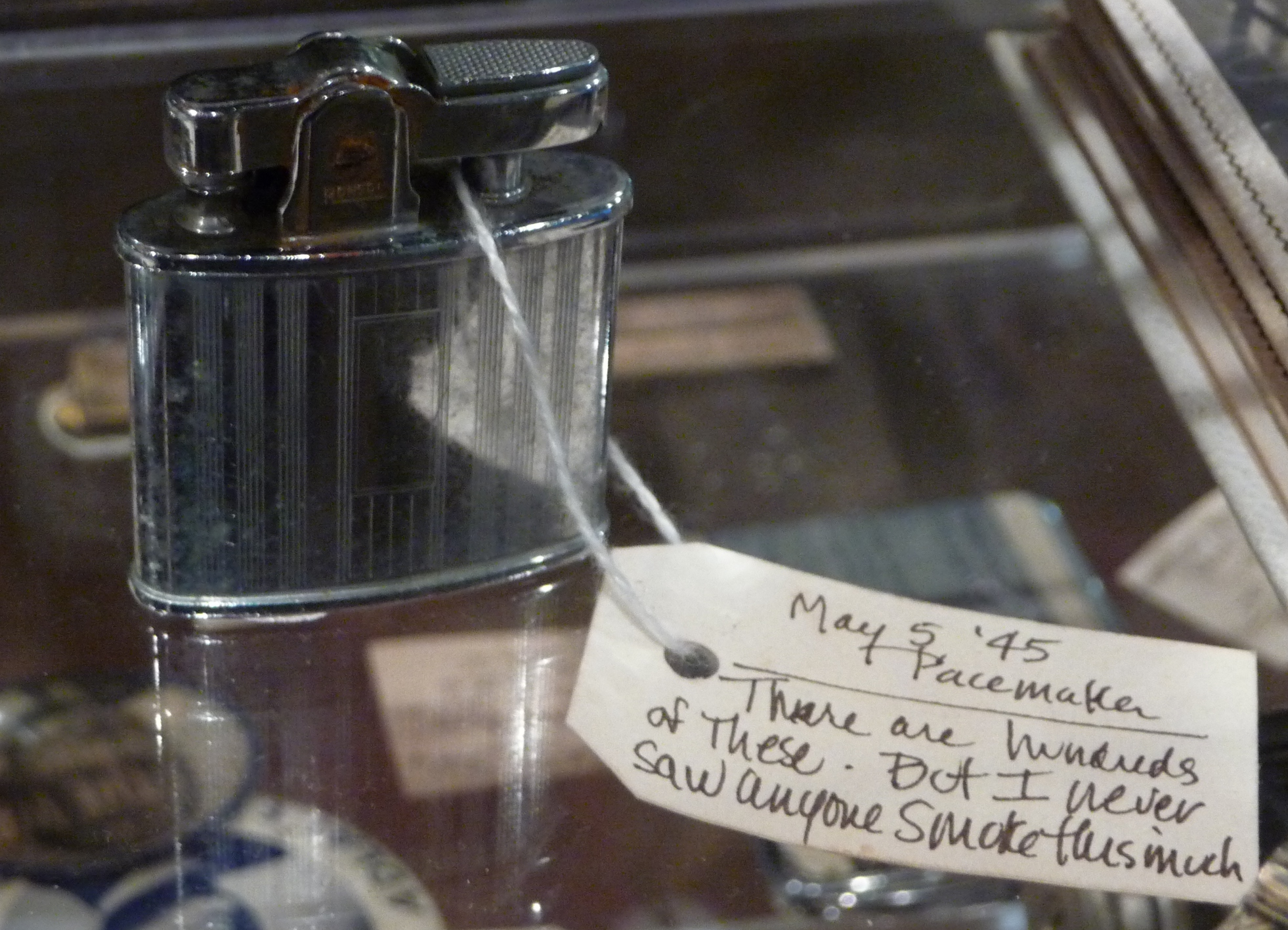
May 5, 1945 – Pacemaker “There are hundreds of these. But I never saw anyone smoke this much”
February 27, 1946 – Pacemaker “I’d be so sad if I lost my babies photos.”
October 3, 1946 – Pacemaker “Girls! were playing with cars! Maybe they’ll be race car drivers! It’s a German car!”
March 3, 1947 – Empire State “The woman was as round as the bottle”
September 17, 1958 – 20th Century Limited “Boring travel diary of a spoiled 13 year old. Went to Europe on Queen Mary, lost diary on a fancy train. Must be a brat.”
November 28, 1963 – Empire State “I talked to the boy who had this. He’d planned to go to the game but then went home for comfort after the assassination. Wasn’t sure he’d go to the game now. I guess he didn’t.”
On Time /Grand Central at 100 is on view at the New York Transit Museum Gallery Annex & Store at Grand Central until July 7, 2013.
Who Cares That New York’s Landmark Library Is About To Be Marred As Part Of A Sweetheart Land Grab Deal?
Who cares? Apparently less than 100 people.
That is about the number of protesters who showed up on Wednesday, May 8 to try and bring about public awareness of the decision by the trustees of the New York Public Library to catastrophically alter one of New York’s greatest buildings, the main branch of The New York Public Library at Fifth Avenue between 40th and 42nd street.
As the stoic group held up signs to the passing throng on Fifth Avenue, some pedestrians slowed or took photos, many just walked by without notice.
The group was protesting the closed door deal that will sell off the land and buildings of two libraries, the Mid-Manhattan branch at 40th Street and Fifth Avenue and the Science, Industry and Business Library at 34th Street and Madison Avenue. Their operations would be condensed and the main library would be remodeled into a circulating library in addition to being a research library. The main library would then store 3.5 million books off-site in New Jersey. This defeats the entire purpose of the building: to be a first-class, on-site repository of research materials critical to tens of thousands of patrons.
The small group of protesters was comprised of mostly older people. It is true that this was a weekday afternoon, but there were maybe ten people under the age of 40 in attendance and one or two in their teens. Continue reading →
Heritage Auctions had Mia Kovacs bible on the auction block on February 21, 2009. There were no bidders.
The bible and portrait pictured above were consigned as part of the estate of Mia’s mother, Edie Adams, the wife of comic genius, Ernie Kovacs. There were many awards, photos, props and autographs that were available to be bid upon belonging to Ernie and Edie. This item was the only one connected with Mia.
While not passing judgment, I understand de-cluttering and getting rid of “things” that have no sentimental or other value to family members. After all you can’t keep everything that was passed down by a family member. Since it went unsold in the auction, hopefully the book was given to one of Mia’s friends rather than discarded.
Today, May 8 marks the 31st anniversary of Mia’s death in a car accident at the age of 22.
Brigitte Bardot co- starred in Viva Maria! (1965) with Jeanne Moreau. The Louis Malle film was partially responsible for the development of the MPAA ratings system for films. Continue reading →
New York City used to have an annual May Day Parade where Socialists, Communists, unions and other pro-labor forces would march down a route and finally assemble around Union Square. Most of the time the assemblies have been peaceful. There were some exceptions during the Depression when work was in short supply and occasional violence would break out on May Day.
In recent years, May 1 in New York City has turned into the flavor of the moment, general protest or demonstration for a wide array of left-wing causes.
In 1935 there were two May Day Parades both held without incident. One was held by the Socialists whose route took them along Eighth Avenue from 15th Street to Columbus Circle and then up Central Park West to 72nd Street. The Communists held their own parade starting at Madison Square on Fifth Avenue up to 32nd Street, across to 7th Avenue and then down to 17th Street and back across to Union Square.
There is no description on this May 1, 1935 photograph which parade this was taken at, but the buildings in the background tell us this is Union Square looking east along 17th Street, so it is surely the Communist parade.
Everyone seems to be paying a lot of attention to the parade…except the one man in the white fedora reading a newspaper.
If this picture was taken in 2013 instead of 78 years ago, I’m sure conspiracy theorists would say there is something very suspicious underfoot here.
Rock lyrics tell stories. Many times those stories are about love. Often they are about sex. Rarely are they about virginity. If they are, the lyrics are cloaked in the language of teenage angst. In the 1970’s bands that would sing about losing your virginity were pushing the boundaries.
For a band to get radio airplay which was a key to sales, they had to carefully construct a song so that they did not arouse the suspicions of the parents of “impressionable” kids. This means the lyrics were not too lascivious or explicit.
These five songs exemplify the “losing it” genre of the 70’s.
1. Foreigner – Feels Like The First Time
Foreigner likes songs with the theme of first time sex. Feels Like The First Time was just part of a trio of songs that play on the whole virgin thing; Urgent (which some people misheard as Virgin) and I Want To Know What Love Is also cover the virginity field.
I liked Feels Like The First Time when it was originally released. It is a very catchy song with a good hook, as are most of the early Foreigner songs. But Feels Like The First Time comes off today a little schmaltzy with lines like “And it feels like the first time, like it never did before (ooh-ooh ooh-ooh oooh), Feels like the first time, like we’ve opened up the door, feels like the first time, like it never will again, never again.”
2. Meat Loaf – Paradise By The Dashboard Light
Probably the most overt and famous rock song about losing it. Graphically described and all rolled up in a mini rock opera. When I hear this song today all I can think of is that every teenager in New York in the 1970’s had a copy of this album in one form or another LP or cassette. If you are ever at a flea market and see a bunch of 8 track tapes I can practically guarantee that this album will be among the stash. A brilliant stroke of this song was to have Yankees announcer Phil Rizzuto do the “play by play” of getting “from base to base” in the middle break. Continue reading →
Andy Johns, Led Zeppelin and Rolling Stones Right Hand Man; Storm Thorgerson, Album Cover Creator Extraordinaire; Christina Amphlett, Lead Singer Divinyls; All Die in April
April has been a bad month for the world of rock ‘n roll, as death has taken away three unique talents.
Andy Johns who worked on some of the greatest rock albums of all-time as a producer and engineer died in Los Angeles on April 7, at the age of 62 due to complications of a stomach ulcer.
Johns was a name not known to casual rock fans because he worked behind the scenes, but his contributions to dozens of classic albums is immeasurable. From the Rolling Stones Exile on Main Street to Led Zeppelin’s greatest period of production in the early 1970’s, Johns was setting up and overseeing the recording of albums that will be played for as long as people listen to rock n’ roll. Some of the many bands and artists Andy Johns worked with included Free, Eric Clapton, Blind Faith, Cinderella, Van Halen, Joe Satriani and Mott The Hoople.
After Andy Johns died I scanned The New York Times on a daily basis in disbelief that they did not cover his death. Nearly two weeks after his passing, an obituary finally appeared.
Here, Andy Johns talks about his experiences working with Led Zeppelin guitarist Jimmy Page and the recording of Led Zeppelin’s classic Led Zeppelin IV (a.k.a. 4 Symbols or Untitled) and the song Stairway To Heaven.
David Gilmour and Roger Waters of Pink Floyd between Storm Thorgerson photo possibly by Jill Furmanovsky
Storm Thorgerson was a name even less known by the general public than Andy Johns, but literally millions of people have seen his work. Thorgerson, as half of the design firm Hipgnosis with Aubrey Powell, created dozens of the most iconic record album covers, sleeve and insert artwork of all time. After the dissolution of Hipgnosis in 1983, Thorgerson ran his own firm and continued working until he died on April 13 at the age of 69 from cancer.
Thorgerson’s work was surreal and many times bizarre. But it caught your attention like any great artwork that was meant to be contemplated. Millions of people who bought albums would study the large canvas that an LP album offered for insights and clues about the music and the band they were listening to. With the supremacy of CD’s in the 1990’s, cover artwork was given a much smaller space and a less important role in point of purchase sales of music. Despite this, Thorgerson maintained a steady stream of clients who wanted original and outstanding works of art to go with their musical output.
Best known for his long association with Pink Floyd, Thorgerson also created album covers for a wide variety of bands including Led Zeppelin, Yes, Scorpions, UFO, Phish, AC/DC, 10cc, Black Sabbath, The Alan Parsons Project, Anthrax and many others.
In the original clip we had up, Thorgerson talks about the beginnings of Hipgnosis, but that clip was taken down. Instead here is the trailer of a documentary about Storm.
The Divinyls lead singer Christina Amphlett was known in the United States as more of a one-hit wonder for the 1991 top ten song I Touch Myself than for anything else. But in her native Australia, Chrissy Amphlett was a rock legend. The Australian Prime Minister Julia Gillard even spoke of the impact of Amphlett’s death and what she meant to the Australian music scene.
Amphlett died in New York City at the age of 53 on April 20 after battling multiple sclerosis and breast cancer for many years.
The Divinyls were not just a pop band, they could rock as hard as anybody as evidenced here in a 1982 live performance of Boys in Town. With her schoolgirl outfit Amphlett displays some head-banging moves reminiscent of AC/DC’s Angus Young.
The McKinley Islands? It could have been, had Congress passed a bill to rename The Philippine Islands after the assassination of the 25th President of the United States, William McKinley.
The Assassination
On September 6, 1901 President McKinley was holding a reception in the Temple of Music at the Pan-American Exposition held in Buffalo, New York. Leon Czolgosz, an anarchist, was in the greeting line and he approached McKinley with hand wrapped up to his right wrist in a handkerchief. As McKinley extended his hand to shake Czolgosz’s left hand, Czolgosz fired two shots at nearly point blank range, one that glanced off McKinley’s breastbone and never entered his body, the other penetrating his stomach.
After initial grave concerns by attending doctors and an operation to remove the bullet, McKinley began showing signs of recovery after a couple of days. McKinley was declared in steady press releases by his doctors to be constantly improving in condition, when he suddenly took a turn for the worse on September 13 and died from his wounds at the home of John G. Milburn, in Buffalo in the early morning hours of September 14, 1901.
Seven little known, interesting facts surrounding McKinley’s assassination
1. Friday’s
Four Presidents’ have been shot to death: Abraham Lincoln (1865), James A. Garfield (1881), William McKinley (1901), and John F. Kennedy (1963). Garfield was shot on Saturday, the other three were shot on a Friday.
2. The Mystery Bullet
An immediate operation was performed to remove the bullet that was lodged somewhere in McKinley’s body. Continue reading →
Rare Postcards Of The Upper West Side And Harlem 1900 – 1915
Broadway and 141st Street Looking North circa 1903
Most old postcards depicting turn of the century New York City usually show the typical tourist attractions, landmarks and notable buildings of the city.
It was uncommon for the big postcard manufacturers to produce postcards of average streets, buildings or scenes in New York City for people to send to their friends back home. After all who wanted to see an apartment building on 117th Street and Seventh Avenue?
That is what makes these scenes of New York City and upper Manhattan rather unique. They feature the areas not frequented by tourists. They are photographs, rather than illustrations, and were typically produced in small quantities by smaller or unnamed card manufacturers. The absence of vehicles and people on the streets belies the rapid housing development that occurred in upper Manhattan during the time. Click on any postcard to enlarge.
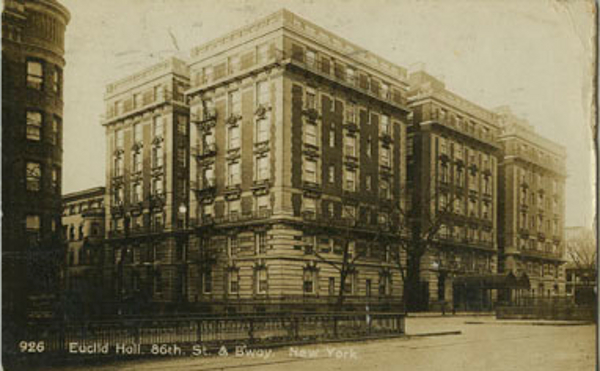
Euclid Hall Apartments 2349 Broadway, northwest corner of Broadway and 86th Street. This view shows the Euclid Hall Apartments which was built in 1903 by Hill and Turner is a heavily ornamented seven story red brick building. It is still standing and the ground floor has been modernized and now houses commercial businesses.
The William Apartments looking west at 243 West 98th Street, northwest corner of Broadway and 98th Street. The William, a seven story building was completed in 1899 and is currently a condominium. To the right of The William behind the trees is the Arragon at 2611 Broadway. Continue reading →