Part 2 More Vintage New York City Books With Great Art Deco Dust Jackets

The Art of The Book #2 – New York City Deco Dust Jackets From The 20′s & 30’s

We continue our look at some great New York City books from the 1920’s and 1930’s with exceptional artwork on their dust jackets. (click here to read part 1)

We begin with graphics on a dust jacket worthy of a large size poster from the quintessential art deco New York book. (click on any photo to enlarge)

Art Deco dj New York Paul MorandNew York by Paul Morand and Joaquin Vaquero Palacios. New York: Henry Holt, 1930, dj illustrator, Joaquin Vaquero Palacios.

A witty description of New York, via French writer Paul Morand, (1888-1976) from four visits he made to New York, none longer than a month, from between 1925-1929. Morand later became a supporter of the French Vichy regime.

Joaquin Vaquero (1900-1998) as he is credited in the book without the Palacios surname, was a Spanish architect and painter. His paintings are held in museums across the globe. Continue reading

Part 1 Vintage New York City Books With Great Art Deco Dust Jackets

The Art of The Book #1 – New York City Deco Dust Jackets From The 20’s & 30’s

From the 1920’s until the 1940’s, book publishers put out some phenomenal books about New York. They also hired talented artists to design the book’s dust jackets.

The eye-catching art deco graphics were meant to attract potential buyers. Unfortunately, most people who purchased books 80 years ago would discard the dust jacket once they brought the book home with them.

Because of that, many of these books from that time are very scarce in their original dust jacket.

This is the first part of a five part series looking at the dust jackets of books about New York City, the artists that created the work and the authors.

Below are some fine examples of New York City books from the golden era of publishing.

(click on any photo to enlarge)

Art Deco dj New York By QuexNew York by Quex.  New York: David McKay, 1928, dj illustrator, Dixon (possibly Arthur A. Dixon)

Quex was the pseudonym of reporter George H.F. Nichols (1881-1933) of The Evening News of London. Nichols was at the time of his death one of the highest paid reporters in the world. Nichols was the originator of articles written in the form of “the diary of the man about town.” Quex’s observations about about New York are well worth reading.

The dust jacket is classic New York, but I am unsure about the attribution to Arthur Dixon, so we will leave biographical information out until someone can provide a conclusive identification on the artist.

Continue reading

Classic Hollywood #20 – Abbott & Costello & Shemp Howard

Abbott and Costello – 1943 In The Navy

Abbott Costello In The Navy

In general I have found that women do not find Abbott and Costello to be funny. Maybe they are an acquired taste.

What is interesting about this particular scene from their 1943 hit movie In The Navy, is that their co-star Shemp Howard (on left)  was a member of another stalwart comedy team, The Three Stooges. Continue reading

Times Square New Year’s Eve: Celebrations Of The Past

4 Photographs Of Times Square On New Year’s Eve 1952-1965

Another New Year’s celebration tonight. What did it look like half a century ago?

Pretty much the same.

Here are four photographs of Times Square as it appeared during New Year’s Eve celebrations during the 1950’s and 1960’s.  The amount of light emanating from the vicinity leads to an overexposure, making this a difficult scene to capture.

Times Square New Year’s Eve 1952

Times Square New Years Eve December 31 1952

Continue reading

Jack Klugman, Odd Couple’s Oscar Madison, Dies At 90

Last Of “12 Angry Men” Cast Passes Away At Home

Jack Klugman with son Adam Klugman promoting Tony and Me 2005 © stuffnobodycaresabout.com

Jack Klugman with son Adam Klugman promoting Tony and Me 2005 © stuffnobodycaresabout.com

When Jack Klugman decided to write a book he insisted it would not be an autobiography. He was too modest for that. Instead he wrote a book about his close relationship with his Odd Couple co-star Tony Randall. The book, Tony and Me A Story of Friendship, published in 2005 by Good Hill Press, was short on details about Klugman’s life, but very illuminating about Randall and Klugman’s close relationship.

After Klugman was treated for throat cancer he thought his acting career might be over. It wasn’t. With the encouragement of Tony Randall, Klugman returned to the stage and began his career anew, re-learning how to use his new voice, a scratchy rasp that pained some people to listen to. Klugman insisted it didn’t hurt him at all to talk, it just sounded that way to others.

The star of one of the best written and best acted television programs of all-time, The Odd Couple, Jack Klugman died on December 24, 2012 at his home in Woodland Hills, CA at the age of 90. He had been in declining health for the past year. He leaves behind his sons Adam and David and his second wife Peggy. His first wife actress Brett Somers died in 2007, they had been separated since 1974, but had never divorced.

I spent quite a bit of time in 2005 with Jack Klugman helping to promote his book. One of the things I asked him was why he didn’t write an autobiography. He said, “This is all there ever will be. I’m the sort of of person who likes to keep things private. I’ll write about Tony because our relationship was special and that story should be told, but that’s it.”

Our conversations about life and acting made me believe that this was a mistake, and I told Jack Klugman he could have told the world so much more about his career and recollections and many people would be fascinated.

He politely replied that it wasn’t that interesting.

I disagree. His full life story would have been very interesting.

Some things people may not have known about Jack Klugman:

Klugman had an incredibly sharp mind and he attended the prestigious Carnegie Tech (now Carnegie Mellon University).

On The Odd Couple, Klugman portrayed Oscar Madison, a sloppy sportswriter who was a New York Mets fan. In reality Klugman knew little about modern baseball and his knowledge after the DiMaggio era of baseball was lacking. I arranged an appearance on the New York Mets pre-game radio show with Gary Cohen to promote his book. After some initial nervousness and hesitancy on Klugman’s part, he did the interview and both Klugman and Cohen were very satisfied with the results and Cohen said it was one of his favorite interviews that he had ever conducted. Klugman’s real love was the track. He loved the horses. But for that interview you would not have known that Jack Klugman was not a real life New York Mets fan.

He worked with some of the most famous actors of their day, such as Humphrey Bogart, on live television. Most of those appearances are now lost forever.

Klugman’s role as Juror #5 in of one of the all-time greatest movies, 12 Angry Men was a breakthrough part for him, leading to many more acting offers. He discounted his importance to that film as being “small.” It wasn’t small. Klugman’s portrayal may have had the most authenticity of all the actors based on his rough and tumble upbringing.

On a bright day in late June 2005 in the midst of the book publicity tour in a chilly New York office building, we had some spare time alone between interviews. Klugman was wearing his trademark V-neck sweater and cap.  I asked Klugman what he remembered about working with Henry Fonda and Lee J. Cobb and rest of the stellar cast of 12 Angry Men. Klugman grew wistful, saying, “I never really liked acting in the movies, the pace was too slow. I always preferred the stage and television. But that cast…that was amazing. It was a privilege to be a small part of that movie.”

We talked about John Fiedler (the voice of Piglet from Winnie The Pooh) who had co-starred with Klugman on a couple of episodes of The Odd Couple and appeared in 12 Angry Men as Juror #2.  I told Klugman he just passed away.

Klugman was surprised and said, “I just spoke to John a few months ago.” Apparently no one had told him about Fiedler’s very recent death. He was silent for a moment or two, looked out toward the window and said slowly, “They’re all gone. Fonda, Balsam, Cobb, Warden. I’m the last of the 12 Angry Men.”

1920’s Bathing Beauty Fur Coat And All

Bathing Beauty Photographed By Charles Gates Sheldon

Bathing Beauty Charles Gates Sheldon

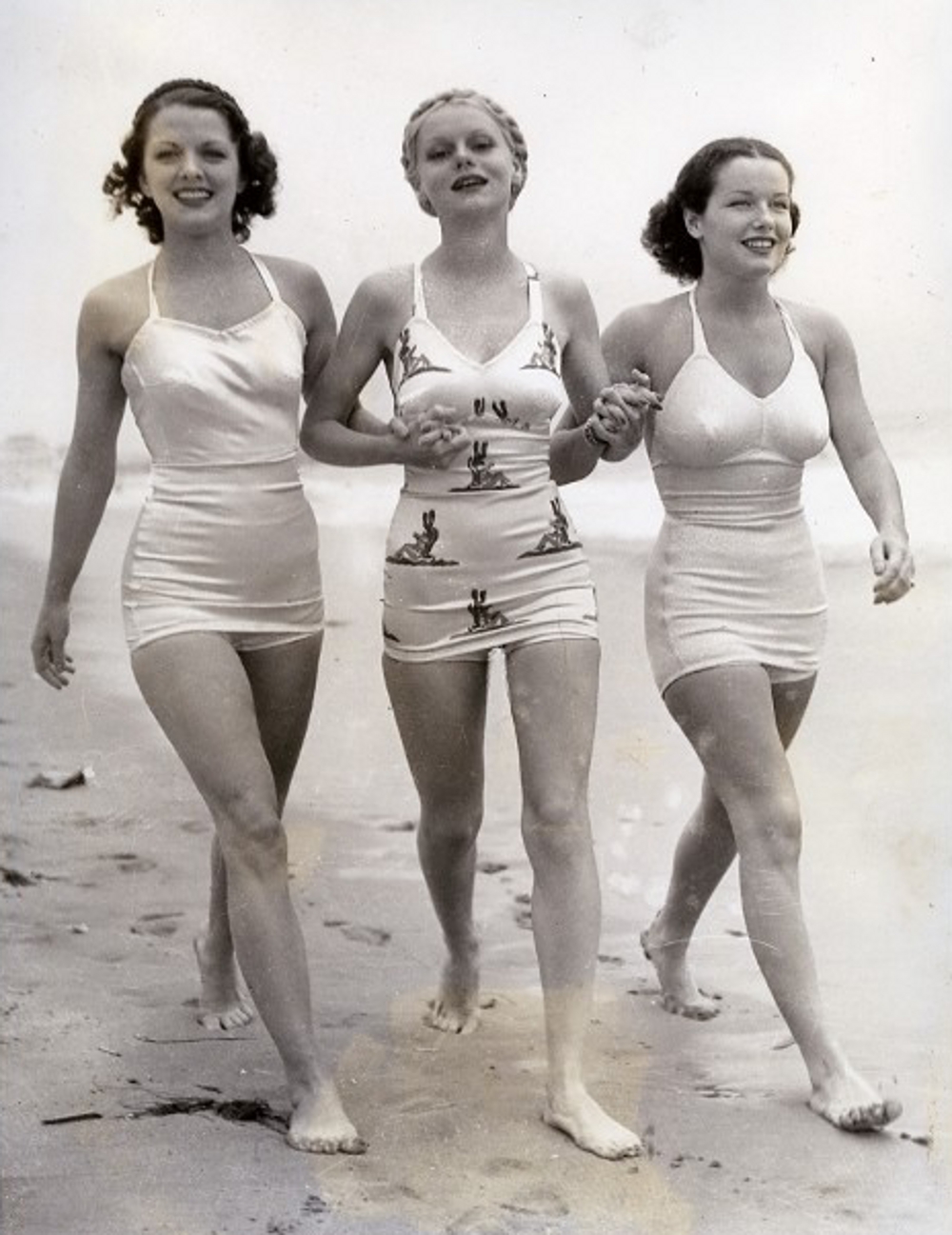
Charles Gates Sheldon was a “pretty woman” illustrator and one of the best at his craft, active in the 1920’s and 30’s, primarily working for many movie magazines such as Photoplay and Movie Classic. Above is one of his photographs featuring an unknown model in a bathing suit with a mink coat!

Classic Hollywood #19 – Cary Grant & Rosalind Russell

Cary Grant And Rosalind Russell Accept Awards

Cary Grant Rosalind Russell December 23 1942

Cary Grant and Rosalind Russell co-starred together in only one movie. The film, Howard Hawks His Girl Friday (1940), is one of the zaniest and funniest screwball comedies of all-time.

The two stars are seen here on December 23, 1942, 70 years ago today, receiving the Women’s Press Club of Hollywood Most Cooperative Golden Apple Prize.

Incredibly, Cary Grant never won an Academy Award for Best Actor. He was awarded an Honorary Oscar for Lifetime Achievement in 1970.When he accepted the award he said “You know that I may never look at this without remembering the quiet patience of directors who were so kind to me, who were kind enough to put up with me more than once, some of them even three or four times. I trust they and all the other directors, writers and producers and my leading women have forgiven me for what I didn’t know. You know that I’ve never been a joiner or a member of any particular social set, but I’ve been privileged to be a part of Hollywood’s most glorious era.”

The talented Rosalind Russell was also nominated by the Academy multiple times for Best Actress and never won. She was ultimately given the Jean Hersholt Humanitarian Award by the Academy in 1973, three years prior to her death in 1976. Interestingly Cary Grant introduced Russell to her future husband Frederick Brisson and Cary was best man at their wedding.

Russell once said, “It’s fine to have talent, but talent is the last of it. In an acting career, as in an acting performance, you’ve got to have vitality. The secret of successful acting is identical with a woman’s beauty secret: joy in living.”

Helen Keller And Al Smith 1929

New York State Commission For The Blind Christmas Fundraiser 1929

Helen Keller Al Smith 1929

This news photograph reads:

Helen Keller “Sees” And “Hears” Al Smith — World Famous Blind Deaf-Mute Meets Ex-Governor For First Time At Sale Benefiting The Blind

New York City – Photo Shows: Helen Keller, remarkable and world-famous blind deaf-mute “seeing” and “hearing”former Gov. Alfred E. Smith, who is greeting her with his famous smile and a word of cheer at the annual Christmas sale for the benefit of the New York State Commission for the Blind. Witnesses at the meeting of the famous people said that Miss Keller’s words could be understood. – December 19, 1929

Helen Keller was deaf and blind from infancy. She was born in Alabama on June 27, 1880.  Early in her childhood Miss Anne Sullivan was employed to instruct her, and so well succeeded that by means of touch she was able to communicate knowledge of the world that was closed to her understanding through the usual senses.

Helen Keller’s sense of touch was so acute that she was capable of understanding the speech of another merely by the placing of her fingertips upon their throat. Through the aid of Miss Sullivan, Keller became a highly educated young woman, earning a degree at Radcliffe College. She would go on to write 12 books and many magazine articles. She devoted her life advocating for people with disabilities.

Keller’s childhood story and that of her teacher Anne Sullivan, was told quite dramatically in the Broadway smash The Miracle Worker which ran for 719 performances from 1959-1961. The show won five Tony awards in 1960 including Best Actress in a Leading Performance for Anne Bancroft.  The1962 movie version featured the Broadway stars reprising their roles; Patty Duke as Helen Keller and Anne Bancroft as Anne Sullivan. Each won an Academy Award for their performances; Bancroft for Best Actress and Duke for Best Supporting Actress.

Alfred E. Smith was born December 30, 1873 on the lower east side of New York. He was elected Governor of New York, 1919-1920 and again from 1923-1928. In 1928 he became the first Roman Catholic to run for President and was defeated soundly by Herbert Hoover.  After the election Smith became president of Empire State, Inc. the firm that built the Empire State Building.

Al Smith died on October 4, 1944. Helen Keller passed away June 1, 1968.

Five Of The Best Latin Quotations

Latin To Impress Your Friends & Improve Your Mind

Certain maxims, proverbs or quotations simply sound better in Latin.  Here are five simple and profound Latin quotations from great books.

“Malum quidem nullum esse sine aliquo bono.”
There is no evil without something good.
(Plinius the Elder, Naturalis historia)

“Mea mihi conscientia pluris est quam omnium sermo.”
My conscience means more to me than all speech.
(Cicero, Epistulae ad Atticum)

“Odi profanum vulgus et arceo.”
I loathe the uneducated mass and keep them away from me.
(Horatius, Carmina.)

“Oderint, dum metuant.”
May they hate me, if only they fear me.
(Suetonius, Vitae Caesarum, Caligula)

“Dulce bellum inexpertis.”
War is sweet to those not acquainted with it.
(Pindar, Greek poet)

Old New York In Photos #24 – Fort Tryon

Fort Tryon Hill As Seen From Fort George Hill

Fort Tryon Hill

The northern area of Manhattan: Washington Heights, Inwood and Fort Tryon were among the last areas of the island to be developed. Much of the area remained somewhat rural until the early 20th century as evidenced in this undated photograph.

The area of Fort George Hill was at the time of the Revolution called Laurel Hill. Upon it the British constructed an extensive fortification called Fort George. The Fort was located at what would today be 192nd Street and Audubon Avenue. The neighborhood that sprung up around this area was given the name of Fort George Hill.

Fort Tryon Hill was one of the last portions of Manhattan to pass from Indian ownership to the possession of the Dutch. The aboriginal owners were the Wickquaskeek corrupted to Wickers Creek Indians.

Fort Tryon Map Showing Land Ownership and Parcels

Fort Tryon Map Showing Land Ownership and Parcels

Fort Tryon was named by the British for Major General William Tryon (1729–1788), the last British governor of colonial New York. Fort Tryon was part of a series of posts running along the Hudson River during the revolutionary war.

Between 1901 and 1904 Cornelius Kingsley Garrison Billings acquired several property lots from many different owners around Fort Tryon Hill. Billings had begun assembling an estate that culminated in a stately mansion being built which was completed in 1907. The mansion can be seen on the right hand side of the photograph. Billings sold the mansion in 1916 to John D. Rockefeller. In 1917 Rockefeller donated the Billings estate and surrounding properties which he had acquired to New York City and the area was turned into Fort Tryon Park. The mansion was destroyed by fire in 1926.