Category Archives: Photography

New York’s Little Italy Described In 1898

“Not a word of English is heard — only a rough, gutteral Italian”

Busy Mulberry Street photo Detroit Publishing CoWhen we ran our story about Chinatown last week we knew it was inevitable we would cover the section on Little Italy as well. It has the same anti-immigrant undertones as the section on Chinatown.

It is probably best not to read the unpalatable descriptions and have modern judgments on 19th century attitudes. What would seem outright racist or prejudicial today was merely the predominant “native” view of anyone who was not a WASP or other accepted creed.

Once again, the guidebook we quote from is Rand, McNally Handy Guide to New York City, Brooklyn, Staten Island, and other suburbs included in the Greater New York edited by Ernest Ingersoll (1898). This section is from the same one as Chinatown and is called “A Ramble At Night”, where the visitor to New York is directed to tour the areas of New York that are off the beaten path after 9 p.m. The purpose of the night ramble is to “give some hints as how the dark, crowded, hard-working, and sometimes criminal portions of the city look at night.” Reproduced below is the section on the Little Italy. Continue reading

Mickey Mantle In Glorious Kodachrome Color Photos

25 Color Photographs of Mickey Mantle In The 1950’s & 60’s

Mickey Mantle portrait 1956 photo Marvin Newman

Mickey Mantle portrait 1956. photo: Marvin Newman

The name Mickey Mantle still evokes strong emotions for baseball fans of a certain age.

For if you ever saw Mickey Mantle play, you would never forget it. If you never had the pleasure, I’ll try and describe it.

Mickey Mantle powerful swing photo Marvin Newman

Mickey Mantle’s powerful swing. photo: Marvin Newman

Mantle swung the bat literally as hard as anyone who ever played the game. You would see his forearms and biceps bulge as he whipped the bat through the strike zone on a slight incline. Watching Mantle swing you could literally see that every muscle in his six foot frame was converging to pulverize the baseball.

When Mantle connected cleanly with the ball, the sound was unique. There was a sharp crack that resonated through the entire ballpark and that ferocious swing would drive countless baseballs deep into the gaps or frequently farther, with balls settling in the outfield stands or bleachers for a home run. There was no home run, like a Mickey Mantle home run.

Mickey Mantle stealing 2nd base and slides hard 1950s photo Marvin Newman

Mickey Mantle steals 2nd base and slides hard 1950s. photo: Marvin Newman

In his prime there were few fielders like Mickey Mantle, who could come out of seemingly nowhere to snag a drive hit in the gap, that when first hit, was thought to be uncatchable. Mantle’s arm could throw bullets, so runners had to think twice about taking an extra base or tagging up when the ball was hit to Mickey.

Mantle played hard breaking up double plays and stealing bases when necessary, even though he was playing on notoriously bad legs which would hamper his entire career. Continue reading

New York’s Chinatown Described In 1898

Joss Houses, Chinese Restaurants and Opium Smoking

Chinatown 1896 looking at 22 Mott Street

Bing Chung Importers (near left) in the heart of Chinatown at 22 Mott Street in 1896

The great thing about reading old guidebooks to New York City is that you can see the world through contemporary eyes. This usually means all foreigners were viewed as curiosities with their exotic customs and provincial ways.

In 1897 the Chinese population in New York City was only 7,000 – almost all living in Chinatown centered around Mott Street. In 2015, New York City’s Chinese population is now over 500,000 people spread throughout the five boroughs.

The guidebook we quote from is Rand, McNally Handy Guide to New York City, Brooklyn, Staten Island, and other suburbs included in the Greater New York edited by Ernest Ingersoll (1898). This portion is called “A Ramble At Night”, and the visitor to New York is directed to tour the areas of New York that are off the beaten path after 9 p.m. such as Little Italy and The Bowery. The purpose of the night ramble is to “give some hints as how the dark, crowded, hard-working, and sometimes criminal portions of the city look at night.” Reproduced below is the section on the Chinatown.  Continue reading

Classic Hollywood #42 – Young Humphrey Bogart

The Young And Handsome Humphrey Bogart

Humphrey Bogart c 1933

Humphrey Bogart in the early 1930’s

If you’ve ever seen the classic film Casablanca (1942) starring Humphrey Bogart and Ingrid Bergman, allow yourself to ask a shallow question, “based on looks alone, how would a beautiful girl like Ilsa (Bergman) fall in love with Rick (Bogart)?”

Humphrey Bogart was 42-years-old when Casablanca was filmed and had a scrawny frame, was not particularly tall, wore a toupee and looked rather haggard. Bogart also smoked cigarettes on screen and in real life like a chimney.

Even with all those perceived shortcomings, most women will tell you Humphrey Bogart was a sexy man. Continue reading

Jackie Robinson Forced Out At Second By Ernie Banks 1955

May 11, 1955 Brooklyn Dodgers 11 Game Winning Streak Comes To An End

Jackie Robinson forced out at second base as Ernie Banks leaps over him May 11, 1955 photo: UPI

Jackie Robinson forced out at second base as Ernie Banks leaps over him May 11, 1955 photo: UPI

The New York Mets recent 10 game winning streak in 2015 may be a sign from the baseball gods that good things are in store for them. For inspiration the Mets can look back 60 years to the winning streak the Brooklyn Dodgers assembled on their way to their only World Series Championship.

The caption for this news photo says:

Chicago: Jackie Robinson, Brooklyn, forced at second in 7th inning of Dodgers – Cubs game here 5/11 as shortstop Ernie Banks throws to first for double play on grounder hit to second baseman Gene Baker by Carl Furillo. Umpire Art Gore calls the play. Cubs won 10-8 halting Dodgers’ winning streak at 11. photo United Press 5/11/55

What many fans may forget is that the Dodgers opened the season on April 13 and won their first ten games. By the time their 11 game winning streak was broken by the Cubs on May 11 they were 22-3 and held on to first place for the entire season. Continue reading

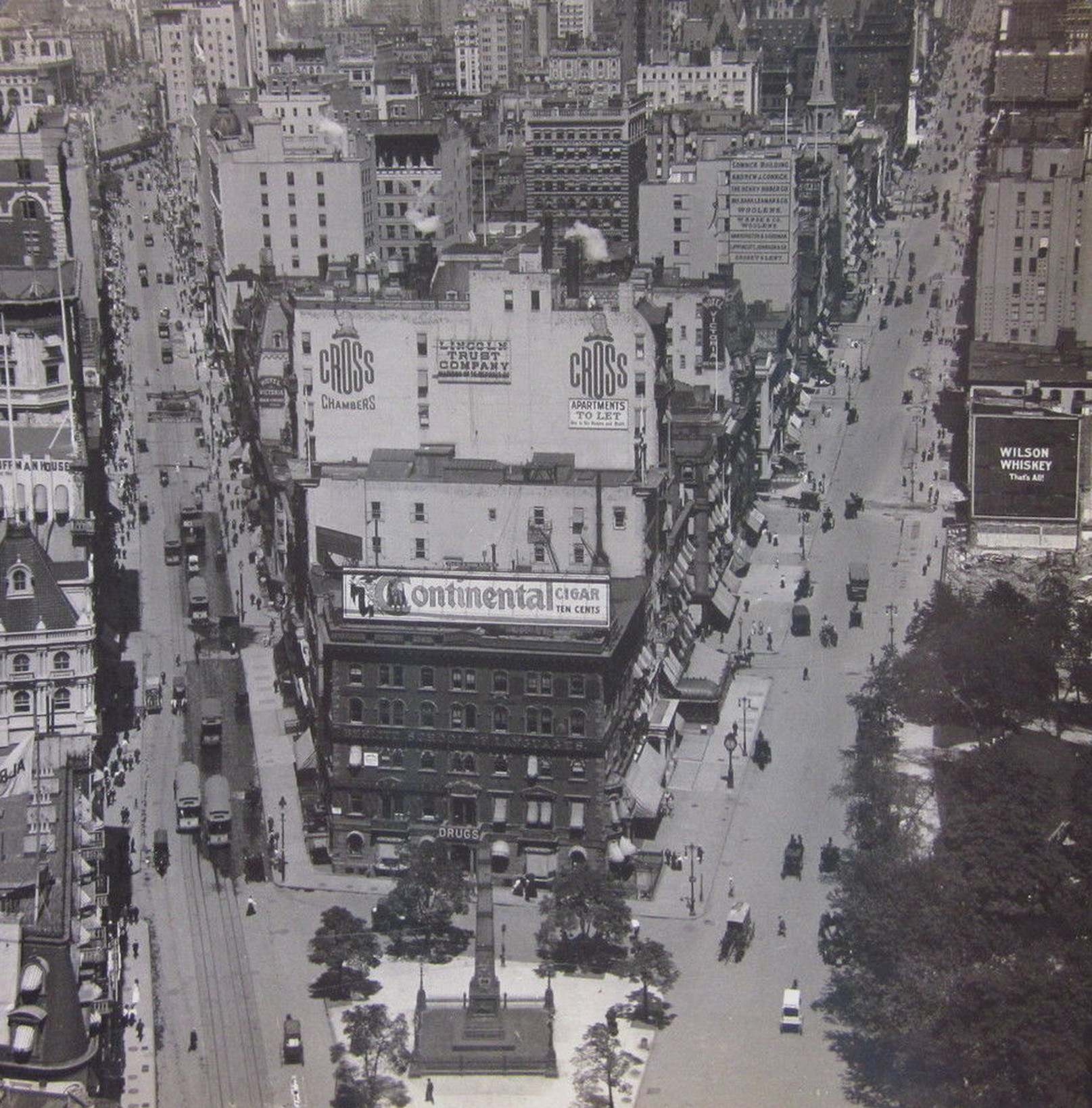
Old New York In Photos #50 – Fifth Ave. & 42nd St. c. 1897

Fifth Avenue & 42nd Street circa 1897

5th Ave 42nd Street c 1897By the shadows we can see it is morning on a somewhat chilly day in the heart of Manhattan in about 1897. We are looking north up Fifth Avenue from the corner of 42nd Street. Pedestrians stroll on the flagstone sidewalks while horse drawn vehicles make their way up and down the avenue.

Croton Distributing Reservoir photo: NYPL

Croton Distributing Reservoir photo: NYPL

On the extreme left the small wall with the iron fence marks the perimeter of the Croton Distributing Reservoir also known as the Murray Hill Reservoir, on the west side of Fifth Avenue between 40th and 42nd Streets. Beyond the fence, stood massive walls 25 feet thick and over 50 feet high which when filled to capacity held 21 million gallons of water. The old reservoir served New York’s thirsty population from 1842 until it was taken out of service in 1897. The structure was demolished in 1900 and the main branch of the New York Public Library now stands on the site.

On the same corner we see an old fashioned fire hydrant and new electric lamppost standing next to what appears to be a gas lamp.

Just to the right of the wall a policeman chats another man perhaps a plain clothes detective as they look east across 42nd Street.  The building just behind them is the eight story Hotel Bristol. In 1903 the hotel would be converted to the Bristol Building.

500 Fifth Avenue Building

500 Fifth Avenue Building

After the Bristol was demolished the art deco 59 story skyscraper, 500 Fifth Avenue Building, would go up on the site between 1929-1931. 500 Fifth Avenue was built  by Shreve, Lamb & Harmon the same architects of the Empire State Building, also completed in 1931.

Next to the Hotel Bristol we see a glimpse of the seven story Hotel Renaissance built in the obligatory French Renaissance style and completed in 1891. Though the hotel was designed with the intention of attracting a “high class family and bachelor clientele” there were a certain class of people that were not welcome.

In 1907 Continue reading

Marching In New York For Their Socialist Agenda May 1, 1934

May Day Parade 1934

May day parade Madison Ave May 1 1934 photo APWhile this may look like a group of Nazi women dressed like stormtroopers marching up Madison Avenue it is actually just a bunch of American socialists resembling the sieg heiling Nazi’s.

The original caption for this news photo reads as follows:

The Red Flag of Socialism

A general view of the parade of the Socialists up Madison Avenue in New York May 1.  A group of women Socialists carried red flags and sang and shouted as they marched. Parades were held throughout the city by various groups but there was no disorder of any kind. (Associated Press Photo 5-1-34)

In the first half of the 20th century, every May Day in New York would bring thousands of activists out into the streets to march and promulgate their ideas . Many were just plain old Socialists, however there would be smaller parades of Communists, anarchists, Industrial Workers of the World, or other labor groups who had a concern or cause.

In 1932, the Socialist party presidential candidate Norman Thomas received 884,895 votes, a little more than 2% of all ballots cast.

Mostly the May Day marches in New York Continue reading

Old New York In Photos #49 – Broadway & 80th Street

Broadway & 80th Street 1898 and 1928

What A Difference 30 Years Makes

Broadway 80th 81st Street 1898 photo H. N. Tiemann

Broadway looking north and west between 80th & 81st Streets. 1898 photo: H.N. Tiemann

Up until the late 1800’s Broadway above 59th Street still retained much of its sleepy Dutch ways and was still called the Boulevard which followed the course of the Old Bloomingdale Road. The upper west side neighborhoods had their own unique character which were based upon the villages of Harsenville, Striker’s Bay, Bloomingdale and Manhattanville.

In the photo above from 1898 we see the Boulevard looking north and west from 80th Street with horses lined up along the curb. Building is sparse with low profile two and three story buildings. Commercial structures might contain blacksmith’s, grocery shops and tailors. Open land and farms were still nearby. In thirty years the change would be striking.

Land speculation and the coming of the subway would end the ruralness of the area.

Broadway 80th 81st Street 1928 photo H. N. Tiemann

Broadway looking north and west between 80th & 81st Streets. 1928 photo: H.N. Tiemann

This photograph taken in 1928 from the median of Broadway and 80th Street and looking in the same direction as the previous photo shows that almost everything from 1898 has vanished.

We see automobiles, but no horses. The trees that lined the street are gone and there is quite a bit of pedestrian activity along the street. Commercial stores line Broadway and 80th Street to the west and the north. The white building in the foreground is still standing today and now contains Zabar’s.

Continue reading

Batman As 007 – Twelve Actors Who Turned Down The Role Of James Bond

Batman’s Adam West Is One Of Many Actors Who Were Offered The Role Of  Agent 007 James Bond, But Turned Down The Part

Adam West Batman

“The name’s West, Adam West”

There is a little of James Bond in every actor. That does not mean that every actor wants to play James Bond.

Bond is an expert in a wide range of subjects, an outstanding athlete and fighter, can drive any vehicle, land, air or sea and seems to have a way with the ladies. There are some critics who have complained that James Bond is a misogynist. If so, he has rarely used his “license to kill” on women. Out of 370 people Bond has killed on screen, only three have been women.

Recently while watching Diamonds Are Forever (1971), the extra features on the DVD mentioned that before Sean Connery agreed to return to the role of James Bond, several actors were considered to play 007 and some turned it down. The reasons varied, but I doubt that any of the actors regretted their decision.

The most surprising decline to me was Adam West who had brilliantly played the campy title role on Batman, ABC’s hit series which ran from 1966-1968. I can see how the producers considered him for the role, but I cannot imagine Adam West being James Bond. But then again neither could West and he was smart enough to pass on the part. On the other hand, some of the actors who turned down James Bond, I could see playing 007.

So here is a slideshow of just some of the actors who turned down the role of the world’s most famous secret agent.

A little more about Patrick McGoohan who had he accepted the role may have been the best actor to ever play the part. But it was not only the womanizing McGoohan objected to; he truly despised the character, calling Bond “contemptible and simplistic.”

McGoohan, a man of very strong ethics said in a 1960’s interview Continue reading

The Beatles, Abbey Road Unused Alternate Cover Photos

The Photos The Beatles Didn’t Use For The Cover Of Abbey Road

Abbey Road 01 photo Iain Macmillan 1938-2006

Abbey Road album cover outtake photo – Iain Macmillan

If you are a Beatles fan, and visit London there is a strong chance that if you venture just outside the Abbey Road studios you will find groups of Beatles fans recreating their own version of The Beatles famous walk across the street while someone photographs the scene. The Abbey Road cover is considered to be one of the best and most imitated album covers in rock history.

The photo session took place on August 8, 1969 and photographer Iain Macmillan was given ten minutes to photograph The Beatles. Macmillan perched himself on a ladder in the middle of the street and took only six photographs of the group, one of which became the final album cover.

Here are the other four photos that did not end up being used for the cover. Click on any photo to enlarge.

For The Beatles fan who owns everything you could purchase your own set of the photos, but you would have to spend some big bucks. A set of the five unused photos with one signed by Macmillan was auctioned Continue reading