AT&T and The Bell Company Develop Modern Video Phone Calling WIth Picturephone
 For nearly 20 years, hundreds of millions of people have been using Facetime, Skype, Zoom or similar services to make video calls or teleconference without ever thinking twice about the technology behind it.
The melding of video with a phone call was an astounding technological breakthrough. But, the initial use of video calls is older than you might realize.
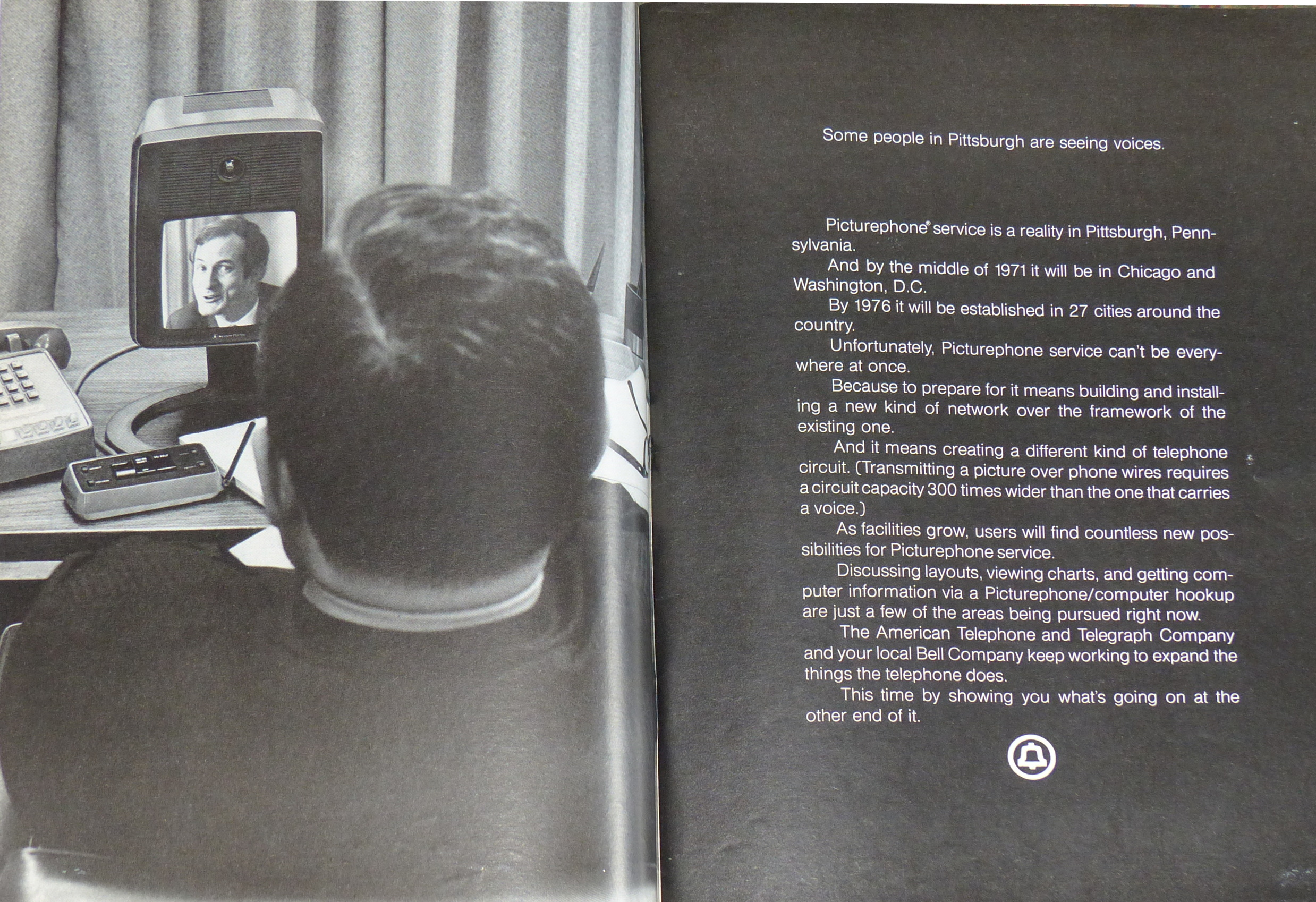
This 1970 New Yorker Magazine ad shown above announces the introduction of American Telephone and Telegraph (AT&T) and the Bell System’s Picturephone.
Development of Picturephone
Significant research on developing a video phone began in 1956. The prototype for Picturephone was displayed at the 1964-65 New York World’s Fair where fair goers could call one another from one of eight phone booths to an adjacent booth within the fair. There was even one booth at the fair that would occasionally have a connection to a Picturephone booth in Disneyland in California.
The vast majority of the public still saw video phone calls as science fiction rather than an imminent reality. In the 1968 Stanley Kubrick film 2001: A Space Odyssey, the AT&T Picturephone was shown in a slightly different form.
In their 1969 Annual Report, AT&T forecast “with perhaps one million sets in use, Picturephone service may be a billion dollar business by 1980.”
By 1970 the Picturephone was ready for commercial use.
Pittsburgh became the first city to have the Picturephone infrastructure implemented. The equipment and service cost $160 per month which included the first 30 minutes of calls. Each additional minute was 25 cents. AT&T anticipated large business customers would sign up.
On June 30, 1970 AT&T and Bell of Pennsylvania hosted a ceremonial first call between Pittsburgh Mayor Peter Flaherty and John Harper, the Chairman and CEO of Pittsburgh based Alcoa.
Picturephone Fails To Find Customers
By 1976 AT&T’s goal was to have Picturephone service available in 26 U.S. cities.
As explained in a 2014 Today’s Engineer article, the service was ahead of its time
Picturephone service expanded to central Chicago and the suburb of Oak Brook the following year. The sets could also transmit documents and graphics, though the latter was somewhat limited by the 250 lines resolution. But the sets failed to find customers; the number of sets in Pittsburgh peaked at 32 in 1972. The number of sets in Chicago, despite AT&T reducing the price to $75 a month for service and the first forty-five minutes of calls to try and stimulate demand, peaked at 453 in early 1973. AT&T got a new CEO, John de Butts in 1973, and he pulled the plug, having concluded that the Picturephone would not be a successful extension of telephone service.
The cost of service and failure to find an enthusiastic customer base doomed Picturephone.
Today video calling is ubiquitous.
Phone technology that is not so old seems antiquated now. How much do we take leaps in technology for granted?
When presented with a rotary phone an entire generation has no idea how to use it.