Tag Archives: World Series

October 3, 2021 Regular Baseball Season Ends / October 3, 1953 World Series Game 4

Baseball’s Regular Season Is Too Long or The Post-Season Starts Too Late

An Easy Out
Jackie Robinson is an easy force out at second in first inning of fourth game of World Series at Ebbets Field, Brooklyn, New York , Oct. 3. Yankee second baseman Billy Martin has thrown to first too late to make double play on Gil Hodges who started play on a grounder to third baseman Gil McDougald – 10/3/1953 credit Wide World Photos

On October 3, 1953 The New York Yankees and Brooklyn Dodgers played game four of the World Series.

On October 3, 2021 baseball’s regular season finally concluded. There will be 10 teams competing in the post-season.

It’s no longer as simple as the best team in each league squaring up against each other. Continue reading

Hall Of Famer Carl Hubbell & His Brother John Hubbell – 1937

John Hubbell Is A Mirror Image of All-Star Carl Hubbell – 1937

Giants star pitcher Carl Hubbell with brother John Hubbell at spring training 1937 photo International News

Unfortunately for the New York Giants the mirror image does not mirror the talent.

Southpaw, Carl Hubbell known as “The Meal Ticket,” was the anchor of the New York Giants pitching staff in the 1930s. Carl was one of five brothers who played baseball and the only one who had big league success.

Our photo’s original caption says: Continue reading

A Superstar Who Knew The Yankees Bobby Brown Was A Special Player

Yankees Bobby Brown Dies At 96

Chose To Be A Great Doctor, Over Being A Great Baseball Player

Bobby Brown 1946 photo: Acme

Bobby Brown 1946. photo Acme

Bobby Brown (Oct. 24, 1924- March 25, 2021) the golden boy Yankee star whose brief career in pinstripes bridged two star-studded Yankee eras, died Thursday March 25 in Fort Worth, TX.

After batting .341 in 148 games at Newark in his only minor league season, Brown was a late September 1946 call-up to the Yankees, playing in only seven games for the big club that year. In this brief stint, Brown made quite an impression with his sure fielding and batting .333 by going 8 for 24.

There’s probably few players more qualified than Red Sox superstar Ted Williams to point out a rival’s strengths .

After playing the Yankees, Ted Williams honed in on how good Brown and another Yankees call-up, Yogi Berra were. In the September 26, Boston Daily Globe Williams wrote:

“Of the new Yankee players I’ve seen the last couple of days, the one who has impressed me the most as a bright prospect, is Bobby Brown, the shortstop. And I’ve seen quite a few of their new players: pitchers Al Lyons and Karl Drews, catcher Larry Berra whom the call “The Yogi,” and he has the facial appearance to fit the name; third baseman Joe Bockman and outfielder Frank Coleman.

Berra is a little man who seems to be all muscles. He looks like he can hit a ball a long way if he connects. The others didn’t show too much, except for Brown. He looks the part of a ballplayer. I thought so when I first saw him in uniform before he even made a play or hit a ball.

The thing I liked best about Brown is that he will make the right play all the time. He showed me something in two games I haven’t seen all season. Twice he came up with a hard hit ball and threw out one of our runners trying to make third from second base. That is one of the most difficult plays for a shortstop to make and he did it twice in as many games  as though he had been doing it all his life,

Bobby has a swell pair of hands. He can run well. Up at bat he reminds me of Red Rolfe. I think he hits at a ball the way the Yankee coach and old third baseman did. He takes a sharp cut at the ball.”

Bobby Brown played alongside the 1930s-40s  era Yankee greats; Joe DiMaggio, Continue reading

Baseball Was Better – The Broadcast & The Game Itself – Watch Game 1 Of The 1970 World Series

50 Years Ago Today, Game 1 Of The World Series Was Played

See How Baseball Was Played & Covered By NBC & Decide For Yourself If Anything Is Better Today

The Cincinnati Reds swept the Pittsburgh Pirates and the Baltimore Orioles swept the Minnesota Twins in the 1970 playoffs. The Reds and Orioles faced each other in game one of the 1970 World Series, 50 years ago today, Saturday, October 10 in Cincinnati.

Here is the entire broadcast of the game Continue reading

Rooting Against Tom Seaver

If You Rooted For The Yankees, Could You Root For Tom Seaver?

Tom Seaver pitching two-hitter in the seventh inning as he makes a bid for his 15th win of the year. August 7, 1975 photo: Paul DeMaria (Seaver wound up with a 3 hit complete game 7-0 shutout over the Expos)

Hall of Famer and baseball great Tom Seaver died Monday, August 31 at age 75 and a piece of my childhood died along with him. The accolades, recollections and recounting of stats will continue to flow for the next few weeks.

But not everyone who saw Seaver play rooted for this consummate pro. Especially kids like me.

Being a Yankees fan in the late 1960s and early 1970s was not fun. A New Yorker has to choose teams. A real New York fan can’t root for both the Rangers and Islanders or the Jets and the Giants. You certainly cannot be a fan of both the Yankees and the Mets. So you make choices.

As a New York baseball obsessed kid who collected trading cards, I examined both teams carefully. I chose to be a fan of the on-his-last-legs Mickey Mantle led Yankees. Bad choice. Mantle retired immediately upon my declaration of loyalty.

The 70s Yankees teams featured players like Jake Gibbs, Jerry Kenney, Mike Kekich, Steve Kline, and Horace Clarke.

Arguments on the summer camp bus about who was better, the Yankees or Mets ended with the words Tom Seaver.

Rooting for the Yankees meant rooting against Tom Seaver. Comparing Tom Seaver to any Yankee player was a futile exercise in partisanship.

“The Yankees have Mel Stottlemyre.”

“We’ve got Tom Seaver.” Continue reading

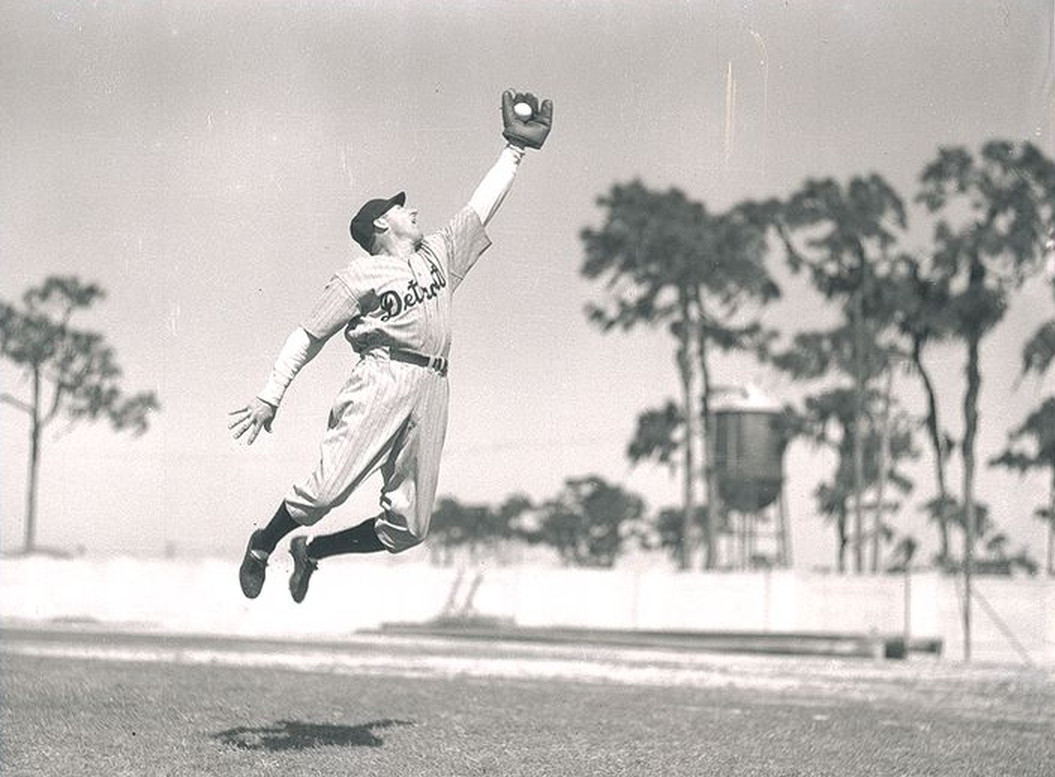
Goose In Flight – 1934 Spring Training Lakeland Florida

Goose Goslin Jumping High In Spring Training

Goose Goslin 1934 spring trainingBefore Rich “Goose” Gossage another great “Goose” played pro baseball. Suiting up  for the Washington Senators, St. Louis Browns and Detroit Tigers  was Leon “Goose” Goslin. Here Goose leaps high to stab a ball at spring training in Lakeland, Florida. Continue reading

Baseball Approves Of Legalized Gambling In 2019 – Isn’t It Time To Re-Examine Joe Jackson?

MLB Approves Gambling On Baseball, Maybe Its Time To Reconsider “Shoeless” Joe Jackson’s Lifetime Ban

Joe Jackson 1915

“Shoeless” Joe Jackson before game vs. Yankees at Comiskey Park August 23, 1915

“Shoeless” Joe Jackson, believed by many to have been the greatest natural hitter of all-time, was banned from baseball for life after the 1920 season by Commissioner Kennesaw Mountain Landis.

Jackson had a .356 batting average in his abbreviated 13 year career. Controversially, Jackson remains on baseball’s permanent ineligible list, meaning he can never be inducted into the Baseball Hall of Fame. His alleged crime, as many people know, was participating in the 1919 “Black Sox” scandal.  Eight members of the Chicago White Sox including  Jackson were influenced by gamblers with promised payoffs to throw the World Series.

As the old car commercial goes “Baseball, Hot Dogs Apple Pie and Chevrolet, they go together in the good ole’ USA.” Where does gambling fit in? Apparently right beside baseball. Continue reading

Was Game 5 “Greatest World Series Game Ever?” Who Knows? The Game Ended At 1:40 A.M When Most Of The East Coast Was Fast Asleep

Was Game 5 Of The 2017 World Series The Greatest World Series Game Ever Played?

How Many Were Still Watching When The Game Ended At 1:40 am EST?

WORLD SERIES game 5 2017 1:39 A.M EST

I started watching game five of the World Series with the Houston Astros and Los Angeles Dodgers on Sunday night.

It looked like it was going to be a great game. The Astros had overcome two deficits and at 11:30 pm the score was tied 7-7 and it was only the sixth inning.

But like most people on the east coast who had to get up for work in the morning, it was getting near time to turn in for the night.

Some  children might get a pass and be allowed to stay up til midnight, but not many, because there is school the next day. And the adults? As much as they want to watch, they know they have real life obligations that require not being exhausted the next morning.

Over 19 million people watched the game but viewership peaked between 11:45  – midnight EST. After that, a steady drop-off in viewers occurred as the game went on and on.

The winning run – game 5 2017 World Series

It did not surprise me that the game ended with a dramatic 13-12 Astros extra inning victory. What was surprising was that the game lasted until 1:40 in the morning. Total time of the game: five hours and seventeen minutes!

How many millions of people missed seeing this great game because of how long it lasted and its starting time? We’ll never know. All I know is that I did not see its conclusion, nor did any of my friends.

As I will continue to point out in story after story, Major League Baseball needs to get their priorities straightened out.

Is it more important to run nonsensical advertisements featuring children “you’re a bigger fan than me? Prove it.” to sell officially sanctioned MLB garbage? Or is it more important to have that target audience watching the games?

Why a Sunday World Series game was not played during the daytime is simply because FOX TV gets to dictate the start time and derive maximum advertising revenue. Money is more important than the future of the game. Continue reading

6 Ways Television Is Helping To Make Baseball Unwatchable

How Television Has Helped To Ruin Baseball

Watching the game from center field – the only way an entire generation of TV director’s have decided to televise baseball

Here are just a few of the ways television has helped to ruin watching baseball. None of the corrective suggestions will be heeded, but someone has to point it out.

1 – The camera angles

Guess what? About 80% of the time you’re not watching baseball. What you are seeing is four guys – a pitcher’s back, a catcher, a batter and an umpire.

What kind of a lead is the runner taking? Where are the outfielders shaded? Is the overused shift in effect? Where was that ball hit? Is it going to be a hit?

How would we know? The audience rarely sees any other part of the field except from the center field camera.

Unless you attend games in person and sit in center field with a high power telescope, this is not the way anyone views an entire baseball game. Nor should it be the way to televise one.

It would be nice to see the return of the overhead mezzanine high camera from behind the catcher so we can see the whole field.

So here are two angles from behind the plate – one high and wide the other not as high. Both of these camera angles are more conducive and infinitely superior to the view you see on most broadcasts.

2- The busy screen

I don’t know about most people but I want to watch a baseball game, not be diverted by ads and a constant scroll of information.

While not every channel is guilty of the news scroll on the bottom of the screen, your view is still cluttered with unnecessary information.

Watching the World Series there are no other scores or news to scroll on the screen so you won’t see the scroll there. Yet that doesn’t stop clutter.

Showing “Fox World Series Game 1” in the upper right hand portion of the screen for the ENTIRE game? Does the score, runners on base, balls and strikes, number of pitches, pitch speed and all other sorts of information need to be shown every second of the game?

Go watch a game from the 1980’s or earlier. How did people enjoy the first 40 years of baseball telecasts with just having the game and nothing else on the screen? Quite well.

Check out a random pre-1980 baseball broadcast on Youtube to see what I mean.

3 – The damn box superimposed around home plate

With the exception of a few local broadcast outlets, most networks televising baseball have adapted their own version of a strike zone box. And it’s getting to be de rigueur instead of a special feature.

This horrible innovation that began a few years ago is an artificial rectangular box on the TV screen surrounding home plate, that supposedly identifies the strike zone and differentiates strikes from balls. Unfortunately it is in the direct line of sight of the television viewer.

The worst part about it is you can’t ignore it. Continue reading

How Baseball Fans “Watched” The 1911 World Series

Before Radio Or Television If You Didn’t Have A Ticket To The World Series – You Could Still Watch It On The Play-O-Graph

Advertisement for the “wonderful Automatic Play-O-Graph” – Philadelphia Inquirer Oct. 13, 1911

In August, 1911 with $10,000 capital, John W. Baker, Henry H. Abbott and Sumner Ford incorporated the Baseball Play-O-Graph Company in Stamford, Connecticut. The men devised a way of transmitting the actions of sporting events “live” through telephone and telegraph.

The depiction of baseball games through mechanical means had been accomplished previously, but not showing the track of the ball, which was what made the Play-O-Graph unique. The Play-O-Graph would show the action without the aid of electric lights.

Baseball fans congregate outside the New York Herald Building during the 1911 World Series

In October of 1911 the American League champion Philadelphia Athletics lead by manager Connie Mack would play John McGraw’s New York Giants for the World Championship.

Giants manager John McGraw (l) and catcher Chief Myers (r) at Polo Grounds before 1911 World Series.

Giants manager John McGraw (l) and catcher Chief Myers (r) at Polo Grounds before 1911 World Series.

There were a couple of oddities in the 1911 World Series. Each game alternated cities with games one, three and five being played in New York and games two, four and six played in Philadelphia. The other strange occurrence was that there was a one week delay between games three and four as a deluge of rain hit Philadelphia for six straight days.

After inspecting the field for playability causing the fifth straight postponement of game four, umpire Bill Klem joked, “There was a pool around second base big enough for a diving exhibition by (swimming champ) Annette Kellerman. I was unable to locate the home plate for the lack of a diving apparatus. The outer gardens would make excellent pasturage for a herd of hippopotami.”

Both teams were considered evenly matched and felt confident they could win the series. Since 1904 each team had won three pennants.

Line outside the Polo Grounds at 7:00 am to buy tickets for game 3 of the 1911 World Series. photo: Bain

When tickets for the opening game of the World Series went on sale on Friday, October 13 at the Giants home field, the Polo Grounds all the tickets were gone within two hours. After the sell-out, the regular ticket price of three dollars shot up to five, six, seven and eventually eight dollars from speculators (scalpers) who had scooped up as many tickets as possible.

With over 38,000 fans cramming the ballpark it would be difficult to see the game without a ticket.

That would be where the Play-O-Graph would come into use. Setting up their machines at four locations in the United States, fans could see the game as it transpired.

“When the pitcher pitches the ball and when the batter hits it and when he is thrown out, is all shown upon the Play-O-Graph. Every move of the game is made clear to the spectator who watches the ball as it moves from place to place upon the board,” the company proclaimed.

The company installed two boards in New York, one in Chicago, one in Detroit and one in Philadelphia. Continue reading