Tag Archives: Stereoview

Old New York In Photos #51 – Broadway & The Astor Hotel 1868

Broadway And The Astor House Hotel circa 1868

Broadway with the Astor House Hotel on the left circa 1868

Broadway with the Astor House Hotel on the left circa 1868

We are looking north on Broadway from Barclay Street on what has to be a weekend, as there is hardly any traffic on this normally bustling part of Broadway.

Enlarging the photograph you can see some interesting details. Horse drawn vehicles line up on both sides of the street as a few pedestrians mill about. A glimpse of City Hall Park and its trees can be seen on the right. Architect Alfred Mullett’s main Post Office has not been built yet (1869-1880) and has not encroached upon the southern end of the park, which was sacrificed for that building.

A few gas lamps provide the nighttime illumination for the area. There are also no overhead telegraph wires or poles visible. Surrounding most trees in the foreground are wrap-around wooden advertising placards. In the left hand corner of the photograph is a large ad for the Pennsylvania Railroad, in what may have been the Astor House’s ticketing office.

Besides the interesting view up Broadway, the famous five-story granite Astor House Hotel on the left is the focal point of this photograph. Astor House was built on Broadway between Barclay and Vesey Streets in 1836 by John Jacob Astor. After it opened it was called “the world’s finest hotel.” Presidents and statesmen like Abraham Lincoln, Andrew Jackson, Martin Van Buren, Franklin Pierce, Henry Clay, Daniel Webster and John Calhoun made Astor House their chosen hostelry when visiting New York. Continue reading
Old New York In Photos #46 – The History of New York’s Shot Towers

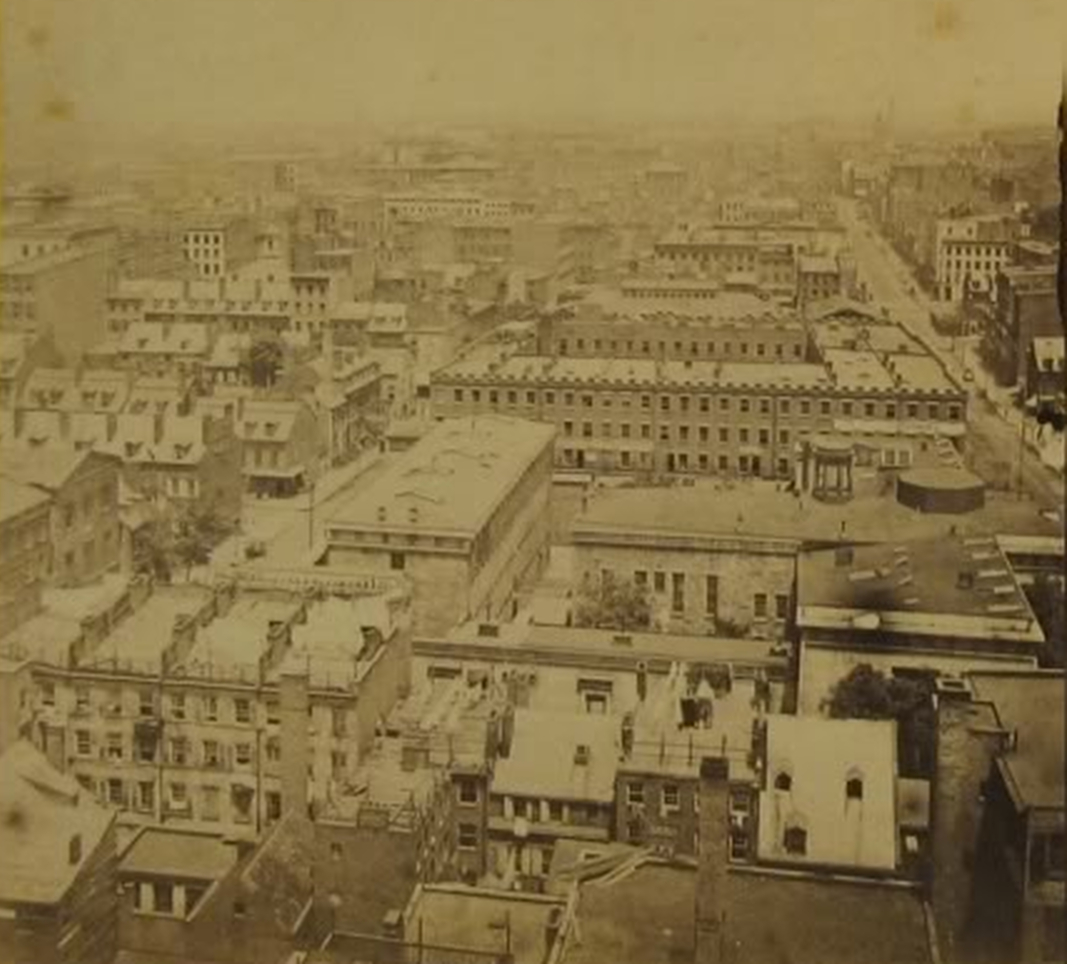
Birds-eye View  Of The City From The Shot Tower At Centre Street

And A Brief History Of New York’s Shot Towers

Birdseye View From shot tower Centre StreetThis view of lower Manhattan looking north is from the top of the Centre Street shot tower and was taken in approximately 1870 by E & H.T. Anthony, providers of some of the best 19th century stereoviews of New York.

The view confirms that New York was a low profile city in the 1870’s. The tallest structures in the metropolis were generally churches and their steeples. This view is dominated primarily by three and four story dwellings (some with laundry on clotheslines drying on the roof) as far as the eye can see.

print shot tower Centre Street 1905 Samuel HollyerThe shot tower was 175 feet tall and was built in 1855 by James Bogardus, a pioneer of cast iron building for James McCullough.

Located at 63 Centre Street and bounded by Pearl Street, Worth Street, New Elm Street and Centre Street, the shot tower was operated for many years by the Colwell Lead Company who acquired it from McCullough after the Civil War.

The Centre Street shot tower was octagonal in shape and constructed of brick with 10 iron pillars reaching from the foundation to the top. The base of the tower was 25 feet in diameter, tapering off to 11 feet in diameter at the summit.

Shot towers were among the tallest structures in 19th century New York. They served a necessity in the manufacture of shot ammunition. Molten pig lead would be mixed with arsenic and dropped from the top of the tower through a sieve. The semi-liquid cooled as it fell through the air into a globular shape, and it was caught in a basin of water below. The process would form perfect spherical shot. It was estimated that the tower could produce 15 tons of shot in a day.

As you approached the shot tower the cacophony of sound was described by a contemporary reporter “as if 1,000 sewing machines were at full play.”  If you stood just outside the room where the shot was produced the noise level jumped incrementally to the sound of “100,000 sewing machines now put in full motion.” And if you entered the production room, it was as if  “1,000,000 sewing machines were at work for all they were worth.”

In a strong gale of wind workers described how the tower would sway, not backward or forward but “like a man full of liquor desirous of taking in all the points of the compass at one and the same time.”

According to the superintendent of the lead company, considering the view which could be obtained from the top of the tower there were few requests from visitors to ascend it.

The Centre Street shot tower was razed in 1908. On its site is Thomas Paine Park.

Shot Towers In Manhattan

All the other shot towers that existed in New York are now gone as well.

They included:

A shot tower was located at 261 & 263 Water Street operated by Continue reading

Old New York In Photos #42 – Central Park Transverses

Central Park Transverses 1863

Central Park Transverse at 79th St looking east 1863

Central Park Transverse 79th St looking east 1863

Central Park Transverse (which one?) 1863

Central Park Transverse (which one?) 1863


Frederick Law Olmstead and Calvert Vaux, the designers of Central Park, had amazing foresight to build transverses through the park so that omnibus, carriage and horse traffic, could get crosstown without disrupting the flow of the landscape. Users of the park today are the beneficiaries of the uninterrupted paths and vistas as automobile traffic crosses the park out of sight and mind.

These two photographs are from stereoviews taken in 1863 by E. & H.T. Anthony & Co. who took some of the best images of mid-nineteenth century New York. They show the recently opened Central Park with little activity and just a few buildings in the background. Continue reading

A Photographic Trip To Green-Wood Cemetery Part 2

Do You Know That Name?

Continuing the journey through historic Green-Wood Cemetery in Brooklyn the next set of photographs concentrates on some names from history, some remembered today, others forgotten.

DeWitt Clinton

DeWitt Clinton has many things named after him in New York including a town, a high school, and a park. Known as the father of the Erie Canal, Clinton was a ten term mayor of New York City. Under his stewardship in 1811 the grid plan for the streets of New York City were instituted. He was also a United States Senator and Governor of New York State. Clinton lost the Presidential election of 1812 to James Madison by less than 10,000 votes and 29 electoral votes.

Clinton was moved to Green-Wood in 1844, sixteen years after his death. Continue reading

Old New York In Photos #14 – Presbyterian Hospital 1872

The Old Men And Women’s Hospital (Presbyterian Hospital) Circa 1872

This photograph is from a stereoview which captioned the Presbyterian Hospital as “the old men and women’s hospital.” This photo was taken by E. & H.T. Anthony Co. about 1872, shortly before the hospital’s first complex of buildings was completed.  The hospital was built by the leading architect of the day, Richard Morris Hunt. Though you cannot tell from the black and white photograph, the contrasting color scheme had bricks that were very red and others that were pale. Continue reading