Tag Archives: Spring Training

George Steinbrenner May Be Dead, But His Yankee “Hair Policy” Remains In Effect

George Steinbrenner’s “No Long Hair Or Beard Rule” Is Still Followed

Thurman Munson’s 1976 Topps baseball card shows something you won’t see on any Yankee today, a defiant beard.

At Yankee Stadium’s home opening game on April 11, 1973, the new owner and managing general partner, George M. Steinbrenner III was on hand to see his team. As he watched his players line up along the foul lines and remove their caps for the national anthem,  Steinbrenner pulled out an envelope from his suit pocket. He began writing down a series of numbers on the back of the envelope.

After the game the envelope was given to manager Ralph Houk.

“What is this?” Houk wanted to know.

Sparky Lyle 1974 Topps Baseball card showing his “long” hair

Players who need a haircut was the reply.

Still not knowing any of his players names, Steinbrenner had listed the players numbers who had hair that was not to his liking.

Among the stars on the list were Bobby Murcer,  Fritz Peterson, Thurman Munson, Sparky Lyle and Roy White.

Houk posted the list in the locker room and reluctantly informed his hippie players to go to a barber.

Steinbrenner had been perturbed about the long hair since first seeing the Yankees in spring training. Now it was time to do something about it.

This incident marked the beginning of George Steinbrenner’s 37 year odyssey of interference and unpredictability as owner of the Yankees.

To Steinbrenner, short hair and being clean shaven represented order and discipline. No one mentioned to Steinbrenner that baseball was not the military.

Mike Burke, part owner and president of the Yankees, had very long hair himself. Burke was not very concerned about Steinbrenner’s meddling and downplayed the hair cutting incident.

NEW YORK – JANUARY 3, 1973 Yankees President Michael Burke & George Steinbrenner at press conference at Yankee Stadium where the announcement is made that an ownership group led by Steinbrenner are the new owners of the Yankees. (Photo by: Olen Collection/Diamond Images/Getty Images)

Burke, who had been Yankee president since 1966, was instrumental in putting the deal together for Steinbrener and his 13 limited partners, to buy the Yankees from CBS. Burke was led to believe he would be considered a co-partner on an equal level with Steinbrenner.

When Steinbrenner spoke to the press on January 3, 1973 , he said he would be an absentee owner and Burke would run the team. “We’re not going to pretend we’re something we aren’t. I’ll stick to building ships.”

Burke should have more concerned about Steinbrenner’s controlling behavior and desire to be solely in charge.  Soon after the haircut incident, Steinbrenner started firing off memos left and right asserting his control of the team. Less than 3 weeks after opening day, Burke resigned. The truth was Burke had been forced out as president of the Yankees and later gave up his ownership stake.

Yankee Third baseman Graig Nettles asked with a straight face, “Was his hair too long?” Continue reading

Yankee Managery Aarony Booney Has A Namey Problemy

Aaron Boone Apparently Has A New Nickname for Every Yankee & It Ends With a “Y”

One of the worst innovations in baseball telecasts has been the managers interview in the dugout during the game.

Without fail the meaningless banter yields no insight and distracts viewers from the game itself.

Listening to new Yankee manager Aaron Boone during spring training, has been especially annoying. In about eight interviews I’ve heard with Skipper Boone, nearly every Yankee has been renamed by placing a “Y” sound at the end of their first or last name. Not being in the Yankees clubhouse I cannot be certain that the Yankees don”t rechristen themselves as Boone has done, but I somehow doubt it.
So during the MLB, YES or ESPN broadcast interviews this spring, Boone sounds more like a schoolboy, than a major league manager.

When Boone is referring to Aaron Judge, he is “Judgey.” Brett Gardner has become “Gardy.” Aroldis Chapman is “Chappy.” Greg Bird is “Birdy.”  Aaron Hicks has become “Hicksy.” Chad Green is “Greeny.”

Jordan Montgomery is now the British expeditionary leader of WWII, “Monty.” Like our 40th president Ronald Torryes is “Ronnie.” Chasen Shreve is “Shrevey” which sounds like something akin to a short pervert. Jacoby Ellsbury who could have remained Jacoby or Ellsbury, is not a cow, but must represent Borden milk, as he has become “Elsie.”. Continue reading

6 Uncorrected Baseball Card Errors. Can You Spot Them?

Topps Made A Mistake

When you produce thousands of baseball cards over many decades you’re going to make some mistakes. Eagle-eyed baseball card collectors usually catch the errors. They would then write in to Topps baseball card company and sometimes the cards would get corrected.  Some mistakes were pretty obvious and could have been caught and corrected.

None of these were.

For a couple of these cards, if you are an old time baseball fan, you might recognize what the mistake is. For the others it takes a sharp eye. See if you can spot the mistake on each of these cards.

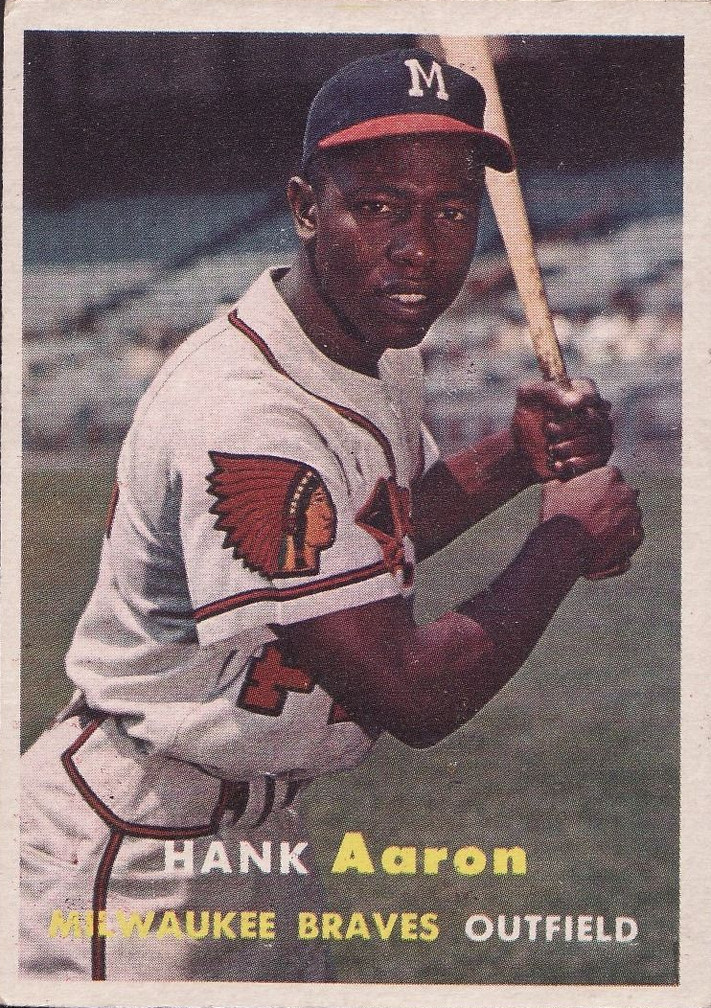
First our lead photo of the 1957 Topps Hank Aaron card. The mistake is not that his proper name is Henry, not Hank. Look closely.

Second, the 1969 Topps Larry Haney card. The Seattle Pilots lasted only one season before moving to Milwaukee and becoming the Brewers. Haney’s error is difficult to discern.

Third up is the 1959 Topps card of 1957 World Series pitching star, Lew Burdette. Lew looks pretty serious doesn’t he?

Fourth is the man who is probably better known for the surgery named after him rather than his pitching career. Tommy John won 288 games. This is his 1969 Topps card.

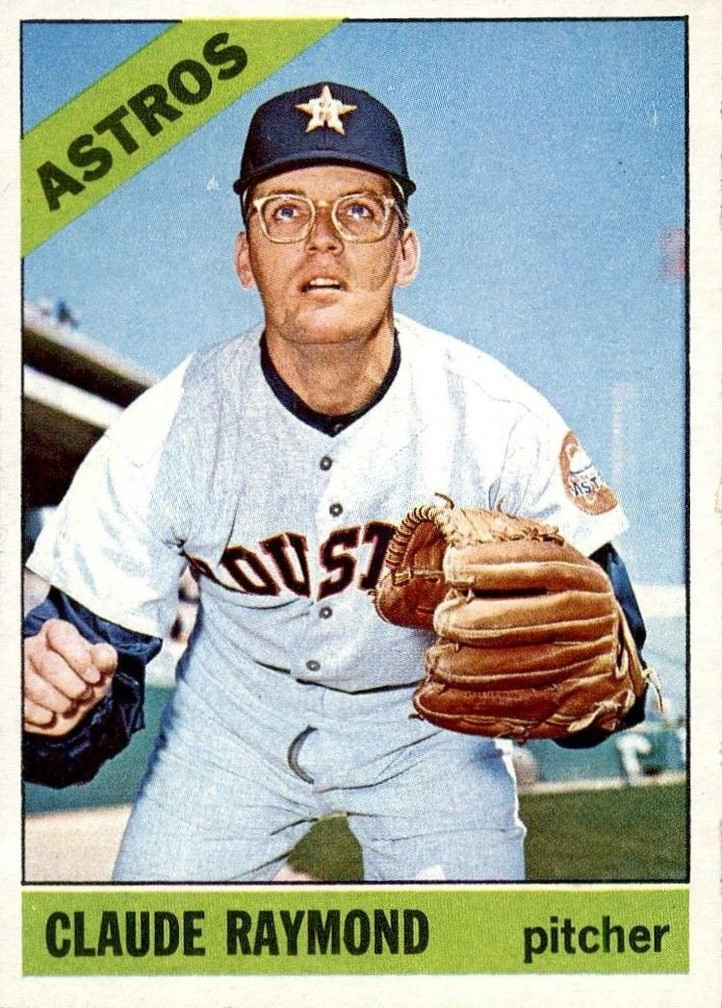
Claude Raymond’s 1966 Topps card poses him looking up at something. Should he really be looking up?

Before Billy Martin’s multiple managing stints with the Yankees, he was the manager of the Detroit Tigers and before that the Minnesota Twins. This is his 1972 Topps card.

So what are the errors that Topps didn’t catch and never bothered to correct?

The first card of Hank Aaron is probably the easiest error to spot. The print is reversed. Look at Aaron’s uniform number 44. Most people know the great slugger batted right handed, not left.

Next, you probably wouldn’t pay much attention to Larry Haney’s card. It shows the catcher posed ready to catch a ball.  Ardent students of the game know that almost no left handed catchers have ever played major league baseball. No, Haney is not the exception, once again, Topps reversed the negative. It is the same photo Topps used of Haney for his 1968 card except they got that one right.

With Lew Burdette’s card, one mistake is right in print and it is not a big deal. It is “Lew,” not “Lou.” But that is not the big error. Lew Burdette had a sense of humor. He asked his teammate and future Hall-of-Fame pitcher Warren Spahn if he could borrow his glove. That would be fine except that Spahn was a lefty and Burdette was a righty. Many children wrote to Topps in 1959 informing them of the “mistake.” Continue reading

Carl Yastrzemski Heads Up The Red Sox Outfield – 1961

Spring Training 1961, Carl Yastrzemski Offers Hope To Red Sox Faithful

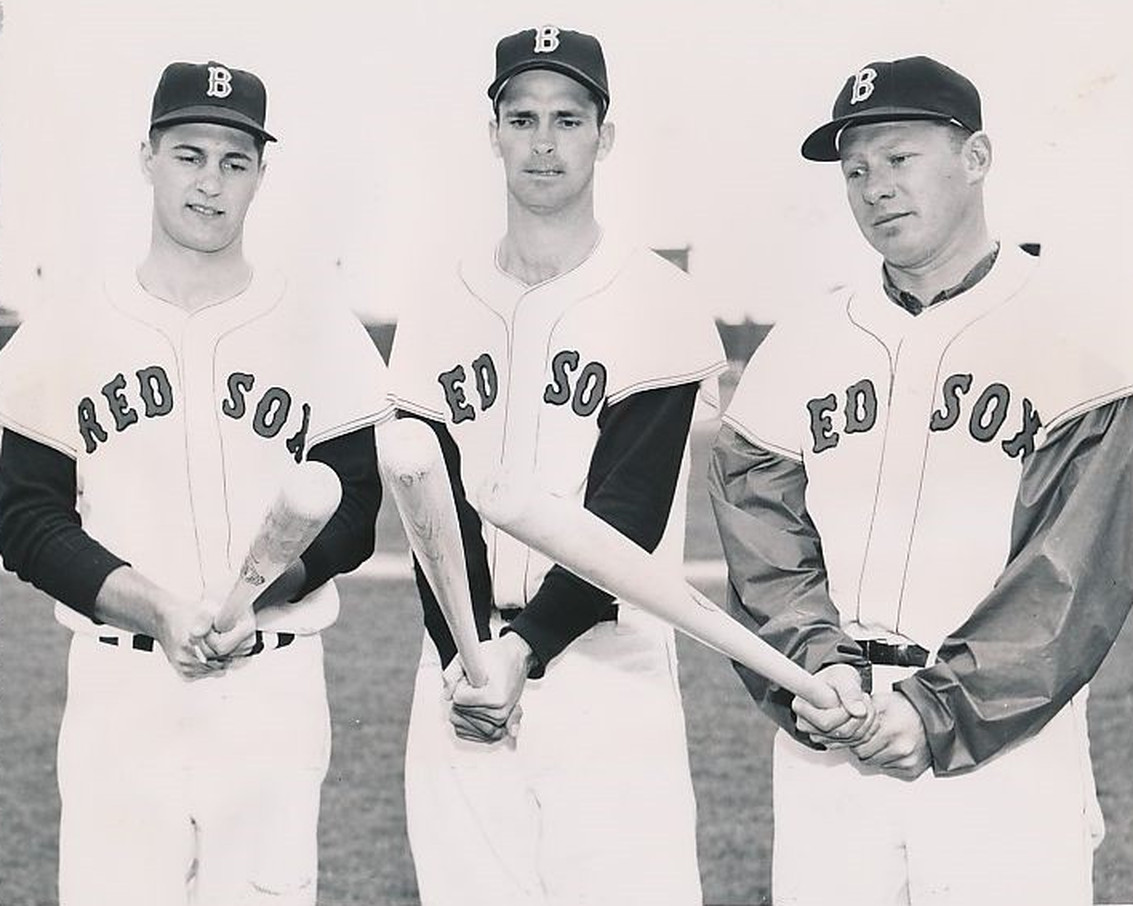
Carl Yastrzemski and Red Sox 1961 outfieldEarly indications in the Red Sox spring training camp in Scottsdale, Arizona are that this trio will be patrolling the outfield for the Red Sox in 1961. (l-r) Carl Yastrzemski, Gary Geiger and Jackie Jensen. (March 1961 – photo: Sporting News)

After 1960, the Boston Red Sox would be without their stalwart star Ted Williams who had retired at the end of the season. The reins to lead the team would be passed to Carl Yastrzsemski and he would not disappoint. Yastrzemski was born and raised in Long Island, NY and was signed by the Red Sox organization in 1958 and rapidly advanced through the minor league system.

Continue reading

Yogi Berra Remembered In Photos

Yogi Berra Dies At 90 – A Remembrance In Rarely Seen Photos Of The Yankee Great

Yogi Berra during the 1960 World Series - photo Marvin E. Newman

Yogi Berra during the 1960 World Series – photo Marvin E. Newman

Lawrence Peter “Yog”i Berra died Tuesday, September 22, 2015 at the age of 90 in West Caldwell, New Jersey where he had been living in an assisted-living facility.

While countless obituaries will appear over the next few days recounting Berra’s storied baseball career, business acumen and quotable life, we thought it best not to dwell on Berra’s passing or try and tell all about his amazing life in just a few paragraphs. Yogi’s life story will be be well covered by his former teammates, friends, journalists and colleagues.

We will tell you that Yogi was not a great catcher when he first arrived in the majors. Yogi worked hard with former Yankee catcher Bill Dickey to make himself into a great defensive catcher. Also three American League MVP awards tell you that Yogi was extremely valuable to the Yankees. What those awards will not tell you was that Yogi was one of the best bad ball hitters ever – whether the ball was up by his eyes or literally in the dirt – Yogi could do massive damage on a pitch that most batters would not be able to do anything with.

We decided the best way to remember this Hall of Famer was with some old press photos that appeared long ago in magazines and newspapers and mostly have not been seen since.

Spec Shea Yogi Berra 1947 first start in World SeriesFrank “Spec” Shea and Yogi Berra before game 1 of the 1947 World Series at Yankee Stadium. 1947 marked the first of a record 10 world championships for Berra.

Berra Rizzuto 5 15 50 photo AcmeYogi Berra and Phil Rizzuto enjoy playing cards on a Yankees charter flight from New York to St. Louis, May 15, 1950 – photo Acme

clockwise - Yogi Berra (without cap), Mickey Mantle, Vic Raschi and Allie Reynolds celebrate 3-2 World Series game 6 victory over Brooklyn Dodgers at Ebbets Field - October 6, 1952

Clockwise – Yogi Berra (without cap), Mickey Mantle, Vic Raschi and Allie Reynolds celebrate 3-2 World Series game 6 victory over Brooklyn Dodgers at Ebbets Field – October 6, 1952. Berra homered in the seventh inning, Mantle homered in the eighth, Raschi got the victory and Reynolds the save.

Yogi Berra Batting sequence 1955 9 6September 6, 1955 – Yogi’s Off And Running – Yogi Berra the New York Yankees formidable catcher, shows the wrist action that provides the power that makes him one of the club’s long ball hitters. Berra currently hitting .273 has pounded out 23 homers and driven in 94 runs. He has hit 18 doubles and two triples. – AP wirephoto  Continue reading

Orioles Practice Sliding – March 1960

Baltimore Orioles – Hansen, Adair and Breeding, Spring Training 1960

Orioles in spring training March 1960 (l-r) Ron Hansen, Jerry Adair, Marv Breeding

Orioles in spring training March 1960 (l-r) Ron Hansen, Jerry Adair, Marv Breeding

Three Baltimore Orioles show off their sliding skills at spring training in 1960, Ron Hansen, Jerry Adair and Marv Breeding.

Hansen didn’t need to practice his sliding – he stole only nine bases in a 15 year career, but led the Orioles in home runs in 1960 with 22 and won the Rookie of the Year Award. When he was playing for the Washington Senators, Hansen turned an unassisted triple play on July 29, 1968 against the Cleveland Indians. It was the first unassisted triple play in the major leagues in 41 years.

I love those vintage flannel uniforms the Orioles are wearing. Marv Breeding Continue reading

New York Teams Spring Training Photos 1910’s, 20’s and 30’s

Old Photos Of New York Yankees, Brooklyn Dodgers and New York Giants Getting Ready For The Season

New York baseball teams have been heading south for spring training for over 100 years.

Here are some photographs showing the Yankees, Dodgers and Giants during spring training from the teens until the thirties.

Yankees spring training St Petersburg March 5 1930The New York Yankees doing their running drills March 5, 1930 St. Petersburg, Fl

Brooklyn Dodgers spring training 1920sThe Brooklyn Dodgers at their spring training complex circa early 1920’s.

Carl Hubbell winding up in Havana Feb 20 1937New York Giants ace Carl Hubbell warming up in Havana Cuba Feb 20, 1937. Continue reading

Orioles In Spring Training – 1972

Mark “Dutch” Weems, Ralph “Mickey” Scott and Wayne Garland

Mark Weems Ralph Scott Wayne Garland March 1972

They were supposed to be the Baltimore Orioles pitchers of the future. Of the three Orioles pitchers seen here at spring training in March 1972, only one would have success in the major leagues.

Mark “Dutch” Weems (left) never made it to the majors and was out of organized ball in 1973 at the age of 22 after posting a 24-19 record in five minor league seasons. Ralph “Mickey” Scott (center – throwing) bounced round the majors from 1972 -1977 appearing in 133 games and compiling a 8-7 record. He passed away at the age of 64 in 2011.

The star of this group was Wayne Garland (right), the Orioles the fifth overall pick in the first round of the 1969 (June secondary) amateur baseball draft.

The Orioles took a chance by drafting Garland who had declined previous chances to play. The Pittsburgh Pirates chose Garland in the fifth round of the 1968 amateur draft but he did not sign with them. The St. Louis Cardinals then made him the first overall pick in the (January secondary) 1969 draft, but once again Garland did not sign.

Wayne Garland had six nondescript seasons in the minors and majors until 1976 when he went 20-7 with a 2.67 ERA for the Orioles. He was paid $23,000 that season and became a free agent in the off season.

It was the beginning of the free agency era in baseball and Garland became one of the highest paid players in the majors when he signed with the Cleveland Indians for $2.3 million for 10 years.

At the time I thought it was bizarre to give any player a ten year contract. As Ira Berkow of New York Times pointed out, “Many baseball people wondered how the Indians could pay so much for a player with only one good major league season. They are still wondering.” Continue reading

Dodgers In Spring Training – 1963

Podres, Koufax And Perranoski Get Ready For A Great Season – March 1963

Podres Koufax Perranoski 1963 March

Three of the anchors of the Dodger pitching staff, Johnny Podres, Sandy Koufax, and Ron Perranoski reach for the same ball at spring training in March 1963.

This trio of Los Angeles Dodgers hurlers would play a big part in helping propel the Dodgers to a World Championship in 1963. The 99-63 Dodgers would humble the 104-57 Yankees in a four game World Series sweep holding the Yankees to a measly four runs.

Johnny Podres hero of the Brooklyn Dodgers 1955 World Series Championship would go 14-12 in 1963 and win game two of the World Series against the Yankees pitching eight and a third innings and allowing just one run in a 4-1 Dodger victory at Yankee Stadium.

Sandy Koufax had his breakout year in 1963 going a magnificent 25-5 with a 1.88 ERA and chalked up 301 strikeouts in 311 innings pitched. He won the Cy Young Award and National League Most Valuable Player Award. In the World Series he won game one and game four allowing just three runs while striking out 23 batters!

Dodgers relief ace Ron Perranoski had his best season ever in the majors with a 16-3 record and 21 saves to go along with a miniscule 1.67 ERA. He received the save in Podres’ victory.

Don Drysdale pitched the third game in the World Series and shut out the Yankees 1-0.

Mets In Spring Training – 1970

Tom Seaver Instructs Duffy Dyer, Ken Boswell And Cleon Jones – March 1970

Dyer Boswell Seaver Jones March 1970

The World Champion Miracle Mets of 1969 were looking forward to 1970. During spring training in March 1970, Tom Seaver has some instructions for Duffy Dyer, Ken Boswell and Cleon Jones.

The Mets would have a disappointing season going just 83-79 and finishing in third place in the National League Eastern division.