Tag Archives: News – Press Photo

Jerry Coleman Baseball Legend Dies At 89

Ballplayer, Broadcaster, World War II and Korean War Combat Hero, Jerry Coleman Passes Away

Jerry Coleman Phil Rizutto 1949

Vaudeville Tactics

New York: Jerry Coleman, second baseman for the Yanks does a nip-up like a vaudevillian to get the ball down to first after putting out Bobby Dillinger of the Browns in the first inning of the game at Yankee Stadium on August 6. The throw was not fast enough to get to first before George Elder who had grounded out to Bobby Brown at third. Yankees won, 9-8. That’s Phil Rizzuto, Yankees shortstop lurking in the background. Credit: (ACME) 8-6-49

Jerry Coleman died at Scripps Hospital in San Diego, CA January 5, 2014 of complications from head injuries he suffered in a fall last month.

In his major league baseball career he hit only 16 home runs and batted just .263, but the slick fielding Jerry Coleman was a beloved baseball legend by fans on both coasts.

Coleman played his entire career for the New York Yankees from 1949 -1957. He appeared in six World Series, was the MVP of the 1950 World Series and appeared in one All Star game.

After his playing career ended Coleman worked in the Yankees front office. In 1960 he became an announcer, first with CBS television on the Game of the Week, then in 1963 he rejoined the Yankees and stayed with their broadcast team for the next seven years. Continue reading

Young Man Swims In Lake Michigan On January 4, 1924

90 Years Ago Today: Victor Barothy Goes Swimming In Lake Michigan January 4, 1924

Victor Barothy swims Lake Michigan on a dare January 5 1924

I’ve seen the polar bear clubs with swimmers who plunge into the Atlantic Ocean on New Year’s Day every year.

But this looks insane. Those large icicles and mounds of snow that loom in the background. Just looking at this photograph gives me the chills.

Unfortunately I cannot find an accompanying story that ran with this news photograph. The caption simply says that “Victor Barothy prepares to swim in Lake Michigan on a dare.” January 4, 1924.

Checking the social security death index, Victor Barothy was born January 4, 1907, so the dare he accepted would have been in celebration of his 17th birthday, even though in the photograph he looks a bit older than 17. With his father and his brother he ran the Barothy Lodge in Walhalla, MI. Victor passed away in Walhalla at the age of 65 in May, 1972.

How long Victor Barothy’s swim lasted in the icy waters of Lake Michigan is unknown.

The Lincoln Tunnel Opens And “Mr. First” Is There – December 22, 1937

Omero C. Catan, Known As “Mr. First” Waits To Be First Through The New Lincoln Tunnel

Omero C Catan Lincoln Tunnel 1st through 12 21 1937

When he was 13-years-old in 1928, Omero C. Catan heard a story from a family friend who was one of the first people to cross the Brooklyn Bridge when it opened in 1883. It was then that Omero decided that being first would be something fun to do as a hobby.

Soon after Catan went down to Lakehurst, NJ from his home in Greenwich, CT to become the first American to tour the famous airship, Graf Zeppelin.

The Miami New Times 1995 profile of Omero and his brother Michael reported, “after that initial success, there was no stopping him.”

Catan paid the first toll on the George Washington Bridge linking New York and New Jersey (October 25, 1931). He was the first to buy a token on the Eighth Avenue subway (September 10, 1932). He was the first paying customer to skate on the Rockefeller Plaza ice rink (December 25, 1936).  After he proposed marriage to stenographer Jeanne Tobolka, he was to receive the first wedding license of 1939. He was the first to put a coin in a New York City parking meter (Sept. 19, 1951). He was the first to drive over the Tappan Zee Bridge (December 15, 1955).

In all Catan was “first” 537 times, acquiring the sobriquet “Mr. First”.

At 4 a.m. on December 22, 1937 the lights turned green and Omero Catan and George Horn started driving through the new Lincoln Tunnel from opposite sides.

According to the New York Times, Catan whose car had been parked Continue reading

Old New York In Photos #34 – World’s Fair 1939 Before Its Opening

An Aerial View Of The 1939 World’s Fair Before It Opened – January 25, 1939

1939 World Fair Aerial

The Trylon (shown with scaffolding) and Perisphere feature prominently from this fantastic aerial view over Flushing Meadows in Queens, three months before the 1939 New York World’s Fair opened on April 30, 1939.

The World’s Fair was expected to cost $40 million to build and generate revenue of over $1 billion. It ended up costing over $150 million to build and ended in bankruptcy 18 months after it opened.

Though the Fair lost money, for anyone who attended, it was a marvelous and memorable experience. The World’s Fair pavilions and buildings held exhibits which demonstrated the possibilities of a utopian society where the future was filled with promise, hope and amazing technological innovations as the world emerged from the Great Depression.

Four months after the World’s Fair opened, Germany invaded Poland and World War II began.

The caption for this Acme news photograph reads:

The Theme Center

This is how the Theme Center looked recently from a visiting American Airliner. Dominating the scene, as they will the Fair, are the Perisphere and Trylon. Removed scaffolding reveals they are well past the half-way mark. Although the various buildings shown seem widely divergent in architectural form, all conform with the latest theories of functional design.   (Credit Line Acme Photographs – January, 25, 1939)

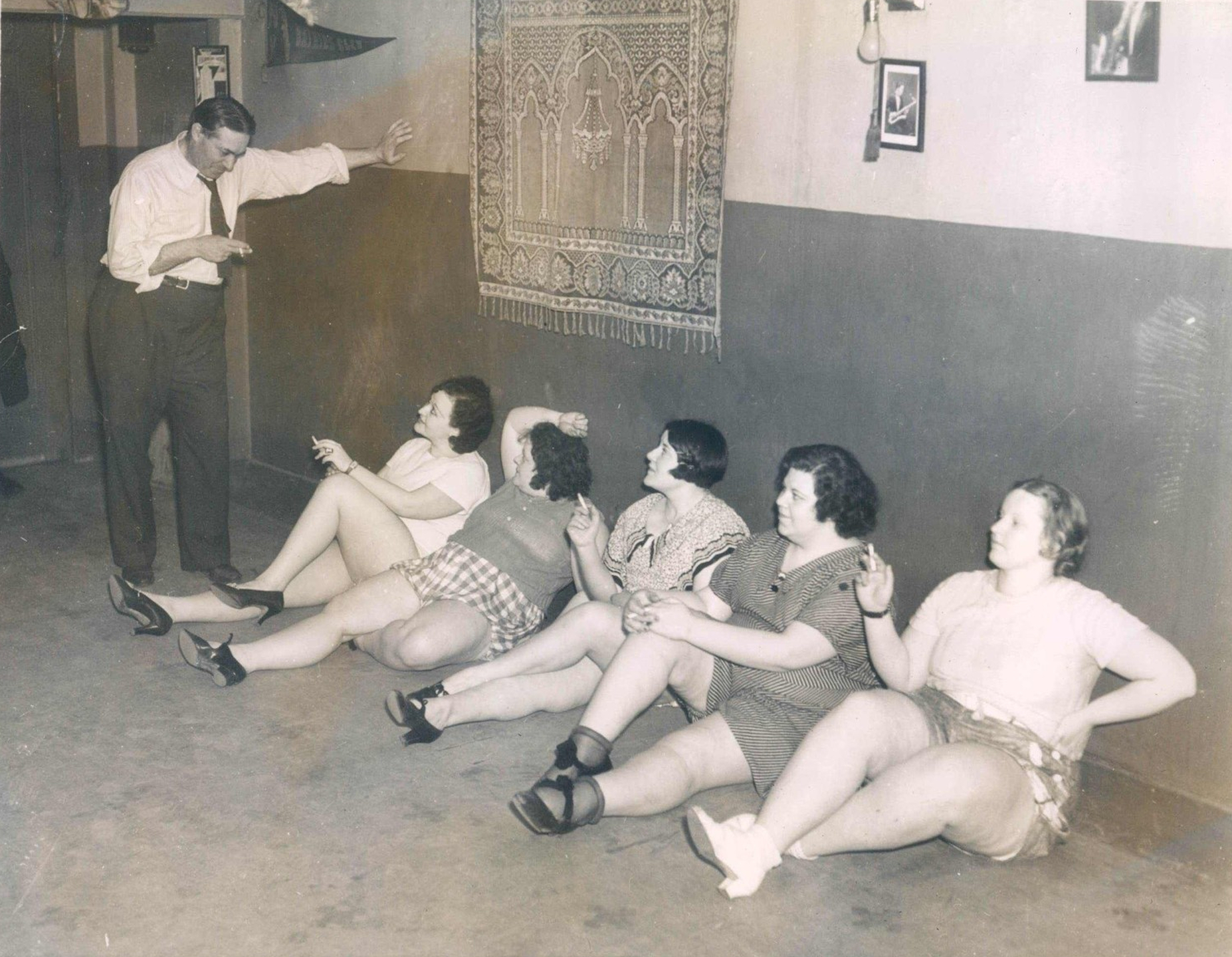
1935 – Heavy Women Smoking Cigarettes – Vaudeville Act Takes A Break

The “Tiny Rosebuds” Take A Break From Rehearsing

Heavy Girls Smoking May 11 1935

We’ll let the slug from this unusual news photograph describe the scene:

A Half-Ton of Terpsichore

An act which is liable to bring down the house, (with a crash), is the Tiny Rosebuds, at present rehearsing in New York for a Buffalo appearance. Membership in the troupe is restricted to young ladies weighing at least 200 pounds. Here is the troupe relaxing after a light (heavy) workout. Left to right, are: Nick Elliott, instructor: Hieni Joyce, wgt. 215: Bobbie Diamond, Captain, wgt. 210: Fannie De Belis, wgt. 201: Tiny Sinclair, wgt. 240: and Dorothy Baer, wgt. 230.

Credit Line (Acme) 5-11-1935

The headline uses the word Terpsichore, who in Greek mythology was the muse of dancing and choral singing.

So what sort of an act were the Tiny Rosebuds?

Miss Bobbie Diamond the leader of the Rosebuds, lamented in a May 1935 interview with Raphael Avellar of the New York World-Telegram, how hard it was to pick the right women for the group.

“My Tiny Rosebuds don’t have to be too good looking, just passable. But they have to have the weight and you’d be surprised at the number of girls of 170 or so who try and pass for 200. It’s hard, I tell you, to get a first-class girl, because lots of them who have the weight haven’t got it in the right places. I mean it isn’t on the legs and thighs, where it counts. As I say, as long as they are passable and know a little rhythm, they’ll make good Rosebuds, providing they’ve got the heft. Right now I’m kind of looking for one to sing, too.” Continue reading

Gerry Cheevers, Boston Bruins Goaltender And First To Decorate A Goalie Mask

Who Was That Masked Man?

Gerry Cheevers photo © Pete Mocca

Gerry Cheevers photo © Pete Mocca

He had the most recognizable mask in the history of the NHL.

And, from what I have been able to research, Gerry Cheevers was the first goalie to decorate his goalie mask.

Gerry Cheevers was with the Boston Bruins from 1965-66 through 1971-72, jumped to the World Hockey Association (WHA) to play for the Cleveland Crusaders for four seasons, and then returned to the Bruins in 1975-76 and retired after the 1979-80 season.

Supposedly Cheevers was not enamored of the all white fiberglass mask, and one day a seemingly unremarkable incident triggered an alteration to the mask.

The distinctive stitch pattern that was to become Cheevers trademark began in the late 1960’s when Cheevers was hit in the mask with a puck during a practice. Even though he was not hurt Cheevers wanted to get off the ice to take a breather. In the locker room, Bruins trainer John “Frosty” Forristall drew a big stitch mark on the mask to show where Cheevers would have received stitches had he not been wearing a mask to demonstrate to the coach the “seriousness” of the blow Cheevers had taken.

The rest of the Bruins thought it was hilarious and Cheevers kept the stitch mark. Cheevers liked the decoration so much he began adding more stitches to the mask season after season every time he took a puck to the face. Cheevers made one other innovation to the mask that was adapted by most goalies in the 1960’s and 70’s, and that was to widen the eye slots so he could see the puck better.

Amazingly, Cheevers says he primarily used that one marked up mask for his entire career. The mask now is on display at the home of his grandson.

After his playing career was over, Cheevers coached the Bruins for four and a half seasons before he was fired in 1985.

Cheevers didn’t just have a great mask, he had a great career posting 230 wins with just 102 losses and a 2.89 goals against average. Cheevers was elected to the Hockey Hall of Fame in 1985. In what might be Cheevers greatest achievement, he went undefeated in 33 consecutive games in 1972, setting a record that still stands today.

1956 – Joe DiMaggio And Hollywood Stars Attend A Charity Ball

Fundraiser For Boys Towns Of Italy Draws Top Celebrities 1956

Elsa Maxwell Cleo Moore Joe DiMaggio Linda Darnell Shirley Jones 1956 3 22

The woman seated is Elsa Maxwell, a gossip columnist who was famous for hosting parties featuring royalty, the wealthy and movie personalities. Standing from left to right are stars Cleo Moore, Joe DiMaggio, Linda Darnell and Shirley Jones.  At the event, DiMaggio, crowned Shirley Jones queen of the Boys Towns of Italy.

Called the “Ball Of The Year,” the benefit was held on March 22, 1956 at the Waldorf-Astoria Hotel. The support for Boys Towns of Italy came primarily from American contributions. The organization was founded in 1945 at the end of World War II to help war refugee children.

At the time DiMaggio was rumored to be dating Cleo Moore, a look-alike to his ex-wife, Marilyn Monroe. Moore was groomed by Columbia Pictures to be their answer to   Monroe, but her career never took off and she retired from films in 1957 at the age of 33. Moore died in 1973, three days before her 49th birthday of a heart attack.

Mickey Lolich – Hero Of The 1968 World Series

Mickey Lolich Wins Game 7 Of The 1968 World Series – October 10, 1968

Mickey Lolich Oct 10 1968

ST. LOUIS – Oct. 10 – WORKING ON THE CARDINALS – Detroit Tigers pitcher Mickey Lolich as he pitches to the St. Louis Cardinals in the final game of the 1968 World Series at Busch Stadium in St. Louis Thursday. (AP WIRE PHOTO)

It had been 23 years since the Tigers had last won the World Series. A Detroit pitcher would play a huge role in the 1968 World Series, but it wasn’t who everyone thought it would be.

The Tigers ace pitcher was Denny McLain who posted an incredible 31-6 record in the regular season. He remains the last pitcher to win 30 or more games in a season. But in the World Series McLain went 1-2, unfortunately going head to head twice with the Cardinals star hurler Bob Gibson and losing both times in games one and four.

Mickey Lolich on the other hand, was a very good pitcher and put up a solid 17-9 regular season record. In the World Series he proved to be unbeatable, pitching three complete game victories, including the exciting finale against Bob Gibson. Continue reading

Classic Hollywood #26 – Jimmy Stewart & Ginger Rogers

Jimmy Stewart & Ginger Rogers Win Oscars – 1941

James Stewart Ginger Rogers Oscars 1941

February 27, 1941 – the Oscars are awarded at the Biltmore Hotel in Los Angeles, CA. This was the first time sealed envelopes were used to keep the winners names secret. Continue reading

A Close Play At The Plate In Game 3 Of The 1951 World Series

Alvin Dark Slides In Safely As Yogi Berra Drops The Ball And The Yankees Fall Apart

Giants shortstop Alvin Dark is safe at home plate as Yankees catcher Yogi Berra can't handle the ball

Giants shortstop Alvin Dark is safe at home plate as Yankees catcher Yogi Berra can’t handle the ball

NEW YORK: ERROR FOR BERRA – Giant Alvin Dark is safe at the plate as Yogi Berra drops the ball trying to tag him. Bobby Brown threw to Berra from third on Monte Irvin’s grounder in the Giants big five-run sixth inning. The National League champs made it their second victory over the Yankees in the third game of the 1951 World Series at the Polo Grounds, Oct 6, with a 6-2 score.  Credit (ACME) 10-6-51

The New York Giants had every reason to believe that this was the year they would win the World Series. They had defeated the Brooklyn Dodgers just days before in a best of three tie-breaker playoff series. On October 3, Giants fans witnessed the “Miracle of Coogan’s Bluff” – Bobby Thomson’s dramatic 9th inning home run off of Ralph Branca that propelled them into the Series against the Yankees.

The World Series would be a match-up between cross-river rivals and their respective rookie stars Willie Mays and Mickey Mantle and it would end up being the finale for Joe DiMaggio’s career.

On October 6, 1951 with 52,305 fans packed into the Polo Grounds, the largest crowd ever to see a World Series game in a National League ballpark, the Giants fans were cautiously optimistic.

The series was tied at one game apiece and the Giants were holding a slim 1-0 lead in the fifth inning, when depending on how you look at it, the Giants erupted or the Yankees fell apart. Continue reading