Tag Archives: 1960s

Willie Mays, Roberto Clemente Before The 1961 All-Star Games

Before The Mid-Summer Classics Of 1961

NL All Stars 1961 Mays Cepeda Murtaugh Burgess Clemente

Pittsburgh (July 1) – All Stars – Danny Murtaugh, manager of the world champion Pittsburgh Pirates (center), looks over some mighty potent bats in the hands of four National League stars named for the All-Star baseball games July 11 at San Francisco and July 31 at Boston. They are (l to r) Willie Mays and Orlando Cepeda of San Francisco and Smoky Burgess and Roberto Clemente of Pittsburgh (AP wire photo) 1961

For 1959 – 1962 two baseball All-Star games were played during the summer.

The National League won the first game on July 11, 1961 by a score of 5-4. Both Mays and Clemente played the whole game. Mays went 2 for 5 scoring twice and driving in a run when Mays doubled home Hank Aaron and scored on a single by Clemente in the tenth inning. Clemente went 2 for 4, scored one run and drove in two including the game winner.

This was also the legendary game where pitcher Stu Miller was allegedly blown off the mound in San Francisco’s windy Candlestick Park. To this day Miller denies it even though he was quoted after the game saying, “The wind blew me off the mound.”

In the second All-Star game at Boston’s Fenway Park July 31, 1961, the game was called after the ninth inning, a 1-1 tie. Again Mays and Clemente played the entire game with Mays going 1 for 3 and Clemente going 1 for 2.

The Pirates starting catcher Smoky Burgess always looked old in every photo I’ve ever seen of him. In 1961 he was only 34. If you met Smoky on the street you would probably think he was anything but a ballplayer – possibly a postal clerk or a truck driver. But Burgess, was indeed a six time all-star with a .295 career batting average, even if he didn’t look the part.

Outtake Photos Of The Doors 1967 Debut Album Cover

What The First Doors Album Cover Could Have Looked Like

Doors debut album photo session © Joel Brodsky

Doors debut album photo session © Joel Brodsky

Almost every rock fan is familiar with The Doors 1967 eponymous debut album containing the hit songs Light My Fire, Break On Through, Soul Kitchen and The End. The album’s  iconic front and back covers were photographed by Joel Brodsky. The back cover photo was also used for a billboard advertisement; the first album to ever get that treatment on the Sunset Strip in Hollywood.

As we pointed out in our article about Carole King and her photo session for Tapestry, there are always other photographs from a photo session that the public rarely sees.

In these sessions, photographer Joel Brodsky took many pictures of The Doors that could have ended up on the cover. Some of the photos were later used on album sleeve inserts and on greatest hits collections.

Below are some of the other photographs from these famous sessions. Do you think any of them would have worked better than what was chosen?

Dodgers In Spring Training – 1963

Podres, Koufax And Perranoski Get Ready For A Great Season – March 1963

Podres Koufax Perranoski 1963 March

Three of the anchors of the Dodger pitching staff, Johnny Podres, Sandy Koufax, and Ron Perranoski reach for the same ball at spring training in March 1963.

This trio of Los Angeles Dodgers hurlers would play a big part in helping propel the Dodgers to a World Championship in 1963. The 99-63 Dodgers would humble the 104-57 Yankees in a four game World Series sweep holding the Yankees to a measly four runs.

Johnny Podres hero of the Brooklyn Dodgers 1955 World Series Championship would go 14-12 in 1963 and win game two of the World Series against the Yankees pitching eight and a third innings and allowing just one run in a 4-1 Dodger victory at Yankee Stadium.

Sandy Koufax had his breakout year in 1963 going a magnificent 25-5 with a 1.88 ERA and chalked up 301 strikeouts in 311 innings pitched. He won the Cy Young Award and National League Most Valuable Player Award. In the World Series he won game one and game four allowing just three runs while striking out 23 batters!

Dodgers relief ace Ron Perranoski had his best season ever in the majors with a 16-3 record and 21 saves to go along with a miniscule 1.67 ERA. He received the save in Podres’ victory.

Don Drysdale pitched the third game in the World Series and shut out the Yankees 1-0.

Historic List Of Every Hotel In Manhattan In 1964

All The Hotels In Manhattan With Addresses and Telephone Numbers From 50 Years Ago

New York Guidebook John KouwenhovenFrom one of the best (and for some reason uncommon) guidebooks to New York City ever published, The New York Guidebook edited by John A. Kouwenhoven (Dell) 1964, comes this useful list of every hotel in Manhattan. We should clarify “every” with the word “approved” hotel and motel. In other words, the flop houses on The Bowery or other squalid hotels did not make the final cut.

The New York Guidebook was published with the 1964 New York World’s Fair visitor in mind as there is a special section devoted to it.

All together there are 183 hotels listed in the book. If you are wondering about the prices, they are not listed. But by checking another pamphlet from the time I discovered The Plaza Hotel was charging from $20 – $34 per night for a double room, while The Madison Square Hotel was charging $7 – $8 per night for a double.

You will note that all the telephone numbers begin with the letter prefix’s such as GR for Gramercy, BU for Butterfield, CI for Circle and RH for Rhinelander. This was because the telephone exchange corresponded with the neighborhood a person or business was located in.  It is a much more picturesque way of assigning a phone number and made remembering the number much easier. PEnnsylvania 6-5000 anybody?

What is also interesting to notice is how many of these hotels are still in existence today and how many which had been in business for such a long time have now vanished.

This is presented as a research tool, but for many the list will bring up a wisp of nostalgia when you see the names Hotel Astor, The Drake, Biltmore and Savoy. I wish there was a list like this available online for every decade in New York City from the 1800’s and on.

So here is our online contribution to researchers or those who are just curious.

Hotels of Manhattan –  1964:

Abbey Hotel, 151 W. 51st St., N. Y. 19, N. Y., (CI 6-9400)

Aberdeen Hotel, 17 W. 32nd St., N. Y. 1, N. Y., (PE 6-1600)

Adams Hotel, 2 E. 86th St., N. Y. 28, N. Y., (RH 4-1800)

Alamac Hotel, 71st St. & Broadway, N. Y. 23, N. Y., (EN 2-5000)

Albert Hotel, 23 E. 10th St., N. Y. 3, N. Y., (OR 7-0100)

Alden Hotel, 225 Central Park W., N. Y. 24, N. Y., (TR 3-7300)

Algonquin Hotel, 59 W. 44th St., N. Y. 36, N. Y., (MU 7-4400) Continue reading →

Gas Price Wars – 1967 Style

Remember Paying 27 Cents A Gallon For Gas?

Gas Price Wars 1967 photo by Fred Victorin

War Over? No, Not Quite.

Too late, sir, the gasoline price war is over. Or is it? This sign leaves consumer Don Lambert wondering. Yesterday the price had risen three cents a gallon. But that’s still four cents a gallon cheaper than the pre-gas war price. But you better fill up soon, the price may jump any time now. The latest gasoline war started in early April. Presently regular sells at anywhere from 22.9 cents a gallon (at Webb’s City) to 29.9 cents for the major brands. The major oil companies blame the independents; the independents charge the major distributors are trying to drive them out of business. – St. Petersburg Times; May 5, 1967 photo: Fred Victorin

For almost three quarters of the twentieth century gasoline prices hovered around 30 cents per gallon.

I filled up the car the other day at a Hess Station in New Jersey. I paid $3.27 per gallon.

The average national price of gasoline in 1919 was 25 cents per gallon. Of course if you adjust for inflation, it was just as expensive to fill up your vehicle in 1919 as it is today.

Until 1973 the price of gasoline never rose above 50 cents per gallon. Then the Arab oil embargo occurred causing gasoline shortages and steep price increases. We will never again see gas at 27 cents per gallon. You can debate if that is a good thing or a bad thing.

The Ed Sullivan Show Was Not First With The Beatles

Jack Paar Featured The Beatles One Month Before Sullivan

The Beatles with Ed Sullivan 1964

Ed Sullivan, Paul McCartney, George Harrison and John Lennon

With Beatlemania nostalgia peaking this month, it is interesting to take note of something that seems to be a common misperception, that the Beatles made their prime time American TV debut on the Ed Sullivan Show on February 9, 1964.

In fact the Beatles were noticed by Jack Paar when he was visiting England in the fall of 1963. A film crew captured them performing and the footage was shown on the Jack Paar Program on January 3, 1964, more than one month before the Ed Sullivan Show.

The big difference was for the Ed Sullivan Show the Beatles came to the United States for the first time and performed live on the program. Beatlemania had hit the United States and the impact reverberates to this day.

Many underestimated the staying power of the Beatles. After their first Sullivan appearance, McCandlish Phillips of the New York Times wrote, “At their present peak, the Beatles face an awful prospect of demise. They are a craze. Anyone at the center of a craze finds that everything he touches turns to money. But since a craze is a source of inflation, it may precede a crash.” He could not have been more wrong. Even Jack Paar thought the the Beatles would be a passing fad when he showed them on his program.

Here is Jack Paar reminiscing about the Beatles with a clip from the original 1964 program.

https://youtu.be/aqll7MBaCOY?t=47

Mickey Lolich – Hero Of The 1968 World Series

Mickey Lolich Wins Game 7 Of The 1968 World Series – October 10, 1968

Mickey Lolich Oct 10 1968

ST. LOUIS – Oct. 10 – WORKING ON THE CARDINALS – Detroit Tigers pitcher Mickey Lolich as he pitches to the St. Louis Cardinals in the final game of the 1968 World Series at Busch Stadium in St. Louis Thursday. (AP WIRE PHOTO)

It had been 23 years since the Tigers had last won the World Series. A Detroit pitcher would play a huge role in the 1968 World Series, but it wasn’t who everyone thought it would be.

The Tigers ace pitcher was Denny McLain who posted an incredible 31-6 record in the regular season. He remains the last pitcher to win 30 or more games in a season. But in the World Series McLain went 1-2, unfortunately going head to head twice with the Cardinals star hurler Bob Gibson and losing both times in games one and four.

Mickey Lolich on the other hand, was a very good pitcher and put up a solid 17-9 regular season record. In the World Series he proved to be unbeatable, pitching three complete game victories, including the exciting finale against Bob Gibson. Continue reading →

Maury Wills And A New Stolen Base Record October 3, 1962

The Dodgers All-Star Shortstop Maury Wills Gets His 104th Stolen Base

Baseball Maury Wills Steals 104th base 1962 10 3

LOS ANGELES, Oct. 3 – WILLS STEALS AGAIN – Maury Wills of the Dodgers slides safely into third for his 104th stolen base of the season, as the throw from catcher Ed Bailey of the Giants bounces past third baseman Jim Davenport and into left field. Wills kept going and scored on the action to put the Dodgers ahead 4-2. (AP Wirephoto)

Maury Wills lead the National League six straight times in stolen bases from 1960 -1965. When he shattered Ty Cobb’s 47-year-old single season record of 96 stolen bases in 1962, with 104 steals, Wills revolutionized the game. Teams looked at Wills style of play and realized they could change the outcome of the game by having their own speedsters.

Eventually Lou Brock and Rickey Henderson would each succeed in establishing new stolen base records of 118 and 130 bases respectively. But it was Maury Wills who brought back the art of the steal from the deadball era of baseball. In addition to an all-star selection and gold glove award Wills was named the National League’s Most Valuable Player in 1962.
One interesting side note: Wills got caught stealing only 13 times in 1962. In his 96 steals, Ty Cobb was caught 38 times in 1915.

Roger Maris Hits His 61st Home Run

October 1, 1961, A Home Run Record Is Set & Baseball Blows Its Big Moment

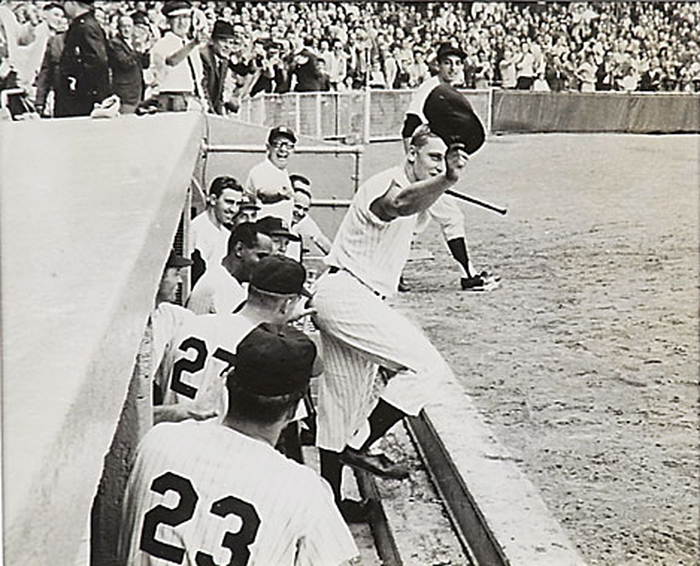
Roger Maris emerges from the dugout to tip his cap after hitting his 61st home run of the season. October 1, 1961

Roger Maris emerges from the dugout to tip his cap after hitting his 61st home run of the season. October 1, 1961

52 years ago today, on the last day of the regular season October 1, 1961, Roger Maris hit his 61st home run of the season off of the Red Sox hurler Tracy Stallard in the fourth inning. For those who were fortunate enough to be there, it was a great moment in baseball history.

Unlike many of today’s players who will take a curtain call without any prodding for driving in the go-ahead run, Maris had to literally be pushed out of the dugout to acknowledge the 23,154 cheering fans at Yankee Stadium.

So why were there only 23,154 fans to see Babe Ruth’s record eclipsed?

That has to do with former sportswriter and then baseball Commissioner, Ford Frick who was a great friend of Babe Ruth and his ghost-writer.

Frick had declared that an asterisk be placed next to any home run record set, if it was not accomplished in 154 games, which was the number of games Ruth played in 1927 when he set his home run mark at 60.

Legendary baseball owner Bill Veeck tells this scathing and hilarious story in his wonderful memoir, Veeck as in Wreck written with Ed Linn (G.P. Putnam’s Sons) 1962.

Let us be fair. Ford Frick does not try to do the wrong thing. Given the choice between doing something right or something wrong, Frick will usually begin by doing as little as possible. It is only when he is pushed to the wall for a decision that he will always, with sure instinct, and unerring aim, make an unholy mess of things.

Suppose that, purely as an exercise, I had put the following baseball question to you at any time during the past twenty-five years.

Suppose, starts the question, that someone comes along to challenge Babe Ruth’s record- which is THE record the same way Mt. Everest is THE mountain. Continue reading →

Mickey Mantle’s Last Game At Yankee Stadium

Unlike Mariano Rivera’s Farewell, No Fanfare And Only 5,723 Fans At Yankee Stadium – September 25, 1968

June 8, 1969 - Mickey Mantle Day- Mantle gazes, as former Yankees announcer Mel Allen in the background

Mickey Mantle looks on as his longtime teammate Whitey Ford announces his retirement May 30, 1967.

With all the celebrations surrounding Mariano Rivera’s retirement and last game at Yankee Stadium, it got me thinking about Mickey Mantle’s last game at Yankee Stadium.

It was a sunny day on Wednesday, September 25, 1968 and not being able to attend school yet because I was too young, my father who worked a night shift took me to Yankee Stadium to see a meaningless 2:00 pm game between the Cleveland Indians and the New York Yankees. It was the last home game of the season for the 5th place Yankees. I vividly remember the game, but it originally wouldn’t be because it was Mickey Mantle’s last game at Yankee Stadium. Continue reading →