Tag Archives: 1890s

All New York City Streets Are Not Created Equal

The Distances Between Streets & Avenues – Things You Probably Didn’t Know

If you are traveling at the same pace, regardless of the avenue, it is faster to walk between 6th and 7th Streets than walking from 13th to 14th Streets. Why? Because the block between 6th and 7th is only 181 feet, 9 inches while the block between 13th and 14th is 206 feet, 6 inches.

Anyone walking around Manhattan is sure to notice that street distances between blocks and avenues vary widely. But few know that the block lengths can vary by several feet.

When the grid plan for Manhattan’s streets were laid out, you’d think that the streets would be equidistant. They are not.

Maybe this is the sort of thing that almost no one would care about, but living up to this web site’s name, I found this chart very interesting. It is from the New York Bureau of Buildings in the 1892 edition of The World Almanac.
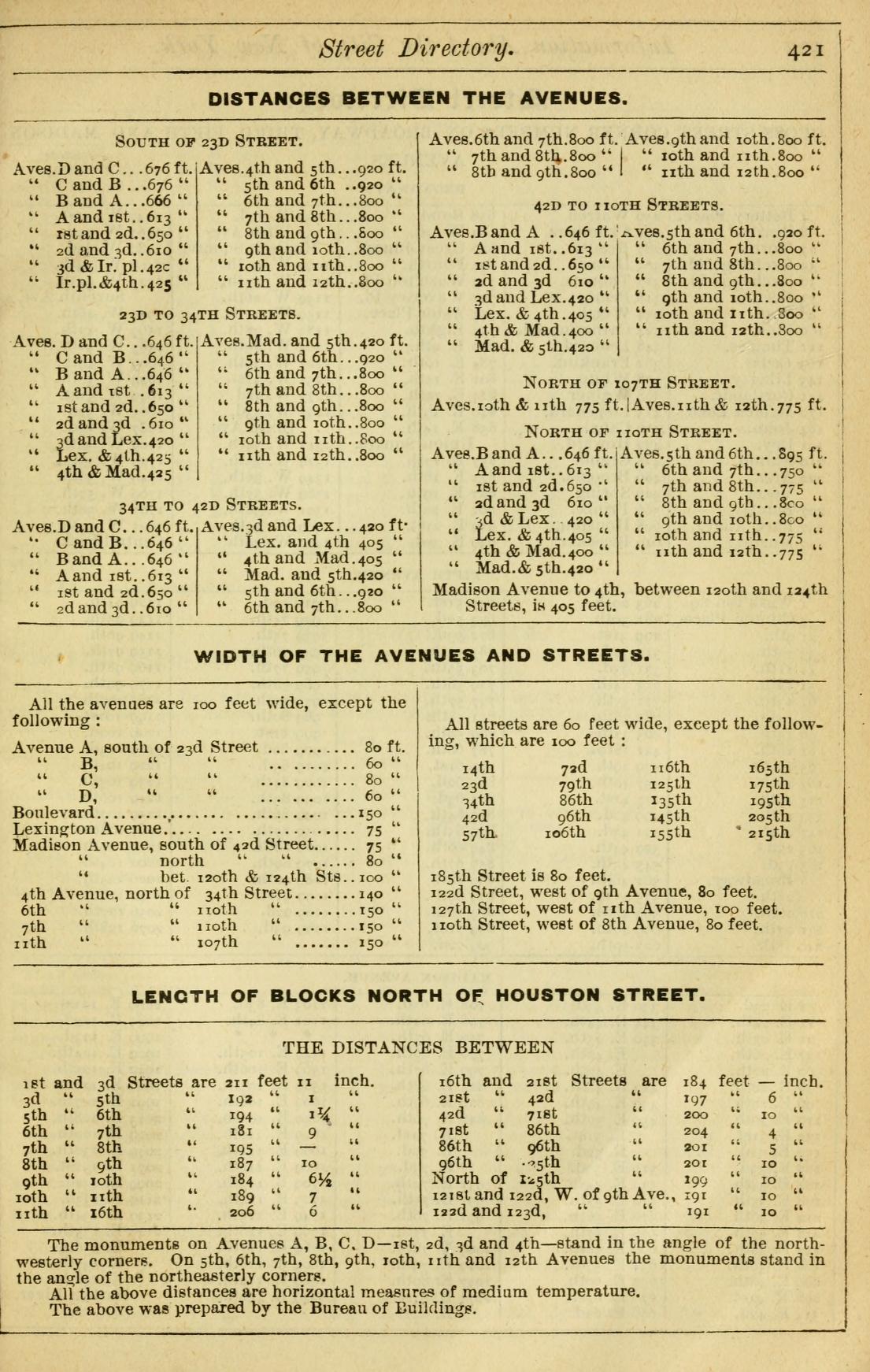
1892 World Almanac (click to enlarge)

As you see, the chart lists the distances between the avenues, the width of the avenues and streets and the length of blocks north of Houston Street.

There are a few interesting things to note. One is how far Avenues A, B, C and D extended northward in 1892. Avenue A was later renamed Sutton Place north from 53rd Street and York Avenue north from 59th Street. Avenue B was renamed East End Avenue from 79th to 90th Street. Many portions of Avenue A, B, C and D were never completed (the landfill required to extend them was never done), or wiped out with map changes and construction in the 20th century (e.g. The Franklin D. Roosevelt Drive). Regardless, the almanac still lists the proposed dimensions for the phantom avenues via the Bureau of Buildings.

The other thing to note is that the main cross streets of 14th, 23rd, 34th etc. are all the same: 100 feet wide as compared to the other streets which are all 60 feet wide.

I have used the modern names of avenues in parentheses. Below are some highlights of the chart.

Avenues in Manhattan are 100 feet wide with some notable exceptions:

Lexington Avenue – 75 feet

Boulevard (Broadway) above 59th Street – 150 feet

Madison Avenue South of 42nd Street – 75 feet

Madison Avenue North of 42nd Street – 80 feet

Madison Avenue From 120th to 124th Streets – 100 feet Continue reading →

Crime, Murder, Prisons, Hangings and Lynchings in 1891

Some Interesting Facts The 1892 World Almanac

The 1892 World Almanac contains fascinating crime statistics.

Putting the crime numbers in perspective to the population, in 1890 the United States total population was 62,830,361.  The “colored” population  was 7,488,676. So, African-Americans made up about 12% of the population.

There were 45,233 people in penitentiaries, 14,687 were black. That means African-Americans comprised nearly one third of the inmates in the U.S. penitentiary system.

The number of murders and homicides reported by newspapers for 1891 was 5,906.

The murders and homicides are broken down as follows:

  1. Quarrels 2,820
  2. Liquor 877
  3. Unknown 859
  4. Jealousy 449
  5. By Highwaymen 241
  6. Infanticide 208
  7. Resisting Arrest 182
  8. Insanity 102
  9. Highway Men Killed 74
  10. Self Defense 74
  11. Strikes 10
  12. Outrages (?) 2

The number of legal executions reported in the U.S. was 123. The two leading states were Georgia and Texas with 19 and 12 executions respectively. The electric chair as a means of execution was first put into use in New York in 1890.  Almost all the executions in 1891, were by hanging.

The number of lynchings reported was 195. The leading three states were Louisiana 29, Alabama 26 and Mississippi with 23. Six of the people lynched were women.

Below is the full chart on all these statistics. (double-click to enlarge to full size)


Death By Root Beer

A Soda Tax Would Not Have Prevented Henry Koerner’s Death

New York City Mayor Michael Bloomberg doesn’t like soda and would like to tax people to discourage them from drinking it. But it wasn’t obesity or the root beer itself that caused Henry Koerner’s demise, it was a bizarre accident.

In the August 20, 1892 New York Times, a brief story appears about Henry Koerner, who worked for Lighte Brothers (a mineral water manufacturer) at 509 East 17th Street and how he was killed when the root beer he was loading on to a wagon exploded.

When Koerner slipped on a fruit peeling on the sidewalk, the ten pound pressurized tank of root beer he was carrying dropped on the stone pavement and exploded like a charge of dynamite.  The tank shattered in all directions with one piece going right through Koerner’s head, killing him instantly. The explosion was so powerful, the top of the tank went 150 feet into the air and fell to the ground with a deafening crash.  The poor man left behind a wife and three children.

I’m sure there was little if any compensation for his loss of life, as accidents like this were dismissed as being part of the hazards of working.  Below is the original newspaper story.

Death By A Fly Bite

115 Years Ago, A Boy Mysteriously Dies and a Fly is to Blame

In 1896 you could die at a moment’s notice. There were no antibiotics.  Doctors and scientists were slowly discovering how diseases were spread. Then, as now, the medical and scientific community gets stymied.

For instance, imagine  hundreds of people sharing a glass or cup to drink from a public place where healthy and sick people alike could spread their germs. Yes, people actually did that. And in the U.S. thousands every year got sick or died from that practice. The impetus to invent a disposable cup – to stop spreading disease via communal drinking apparatus led to the Dixie Cup which came on the market in 1907.

But in 1896, before West Nile Virus or Ebola Virus was discovered, something strange and horrible occurred Continue reading →