Category Archives: New York

Old New York In Photos #190 – Broadway North From Bowling Green 1889

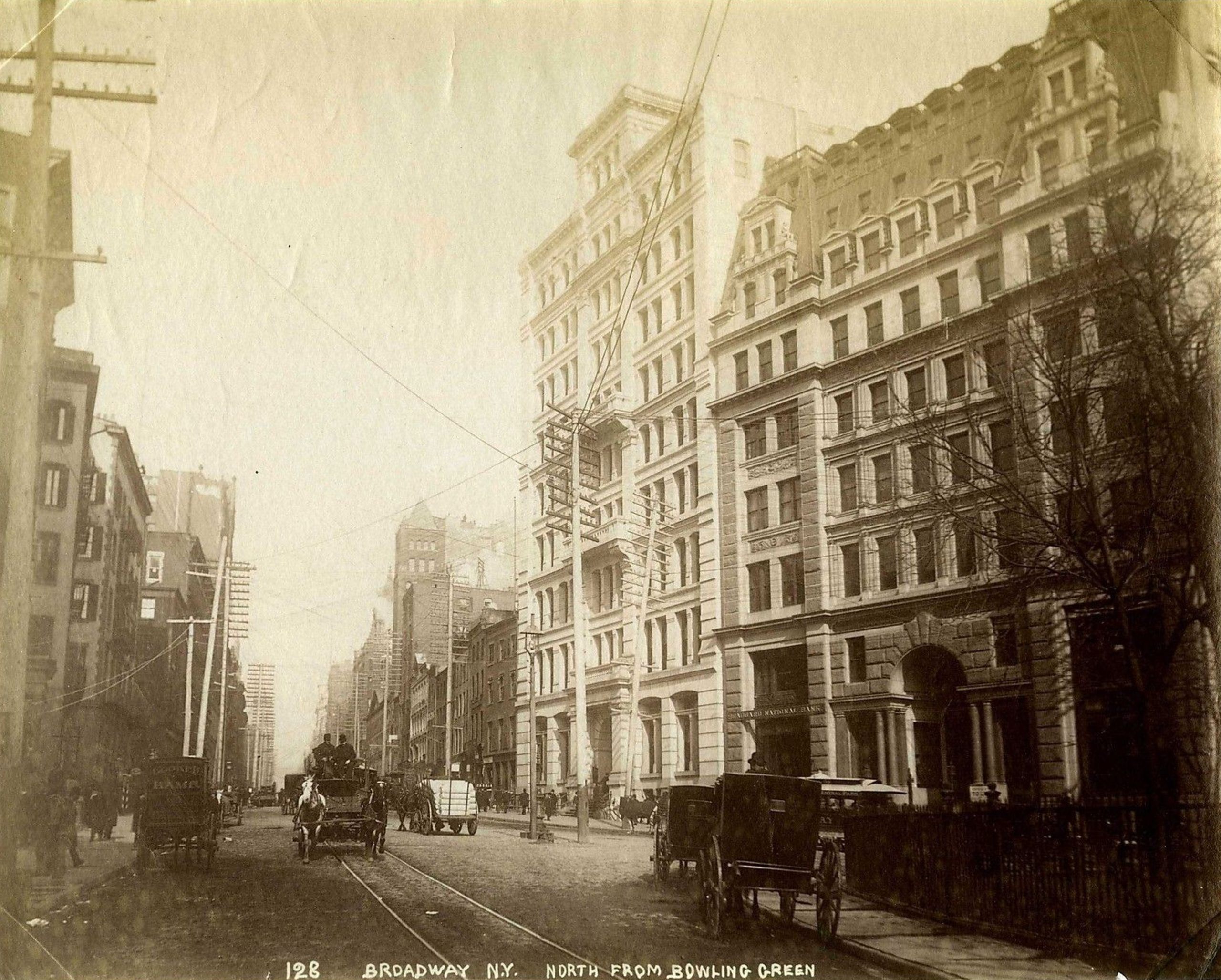
A View Up Broadway From Bowling Green
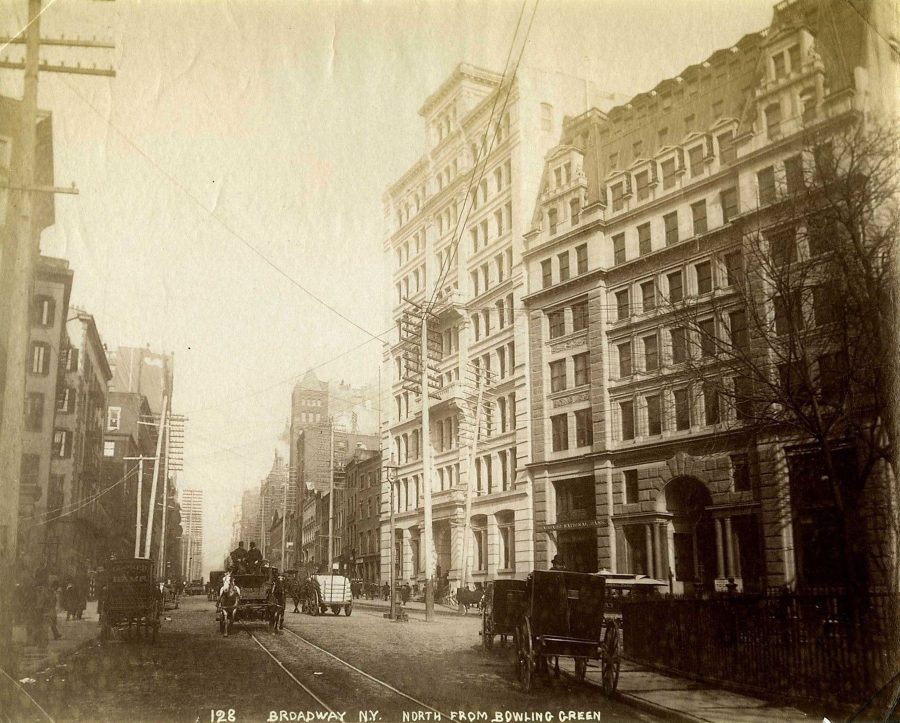
This 1889 view of Broadway north from Bowling Green shows the street before skyscraper construction would permanently alter the famous corridor.

We are dating the photograph by the buildings visible and most importantly the presence of overhead telegraph wires.

After the blizzard of 1888 caused wires around the city to come down, a movement to place wires underground began in earnest. Upon taking office in 1889 Mayor Hugh J. Grant immediately set upon removing overhead wires, sending crews with axes to chop down poles if the companies responsible for the wires did not promptly relocate them.

We see pedestrians going about their business as horse drawn vehicles make their way up and down Broadway. Parking does not seem to pose a problem and a wagon advertising  “hams” is making a delivery on the west side of Broadway. Bowling Green’s original 1771 fence is visible in the foreground.

The Buildings

On the right with arched entryway is the nine-story Welles Building at 14-16-18-20 Broadway. Beginning in 1882 the Welles Building became the home of the Petroleum Exchange.

It make sense that adjacent to the Welles Building, in 1885-1886 the Standard Oil Company would build its ten-story 157 foot tall headquarters at 26 Broadway. Continue reading

A List Of New York City Hotels In 1877

Visitors Could Stay At These New York City Hotels In 1877

We’ve provided lists like this twice before for New York’s hotels in 1882 and 1964.

This is useful to someone researching or wondering about where the New York City hotels of 1877 were located.

This compilation  comes from The Practical Guide To New York City and Brooklyn by Henry Morford; Union News Company and Lee, Shephard and Dillingham( 1877).

The advertisement for Stevens House from the book shows a rate of $1.00 per day for a single room. Double occupancy at most hotels ran between $1.00 to $2.00.

One thing to take note of is that 38 Continue reading

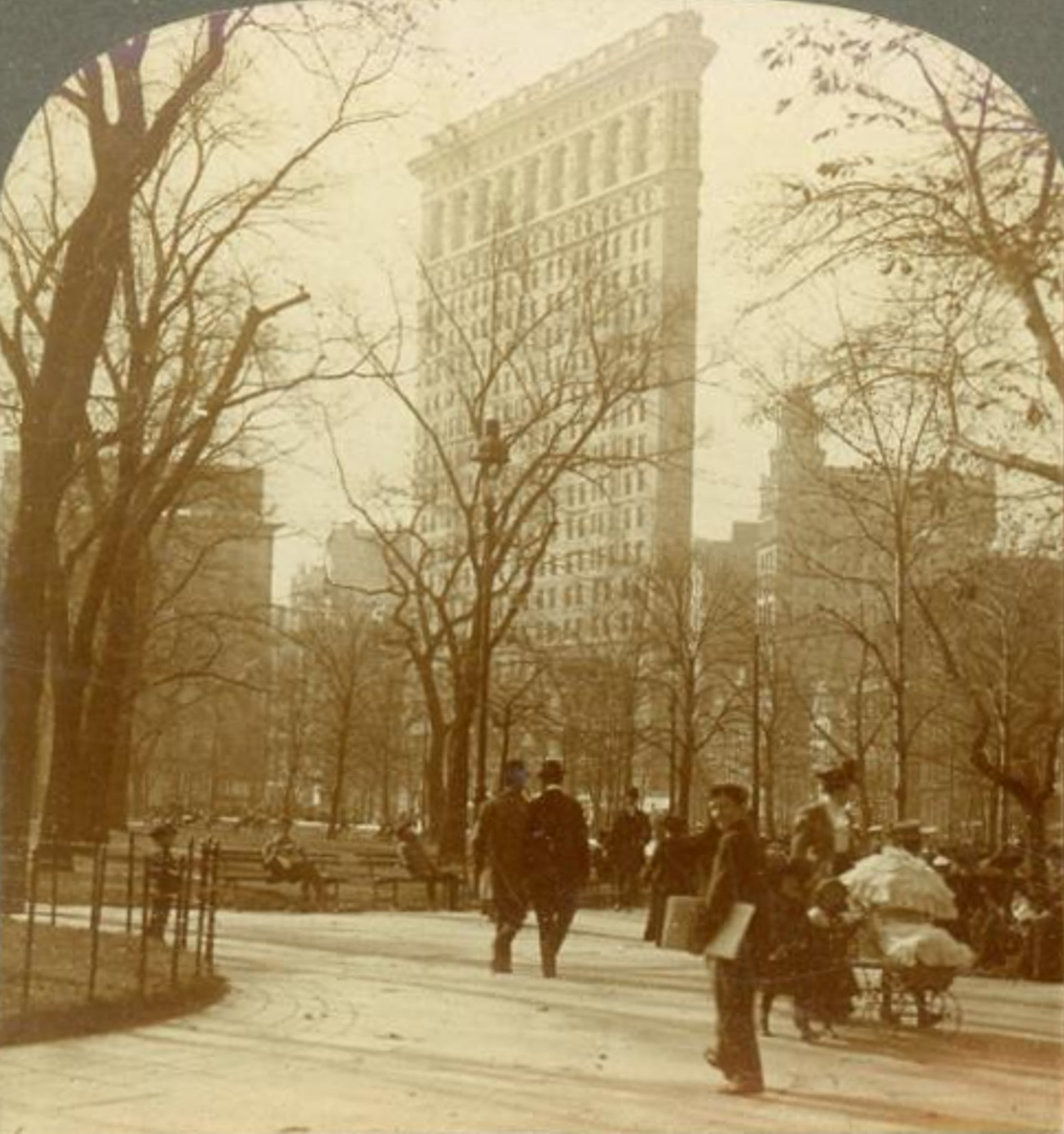
Old New York In Photos #189 – The Recently Completed Flatiron Building 1902

The Innovative Flatiron Skyscraper – Available To Rent 1902

Our photograph is from American Art Views, a view book published September 15, 1903 showing contemporary New York City.

To the right, with a flag on its roof is the six-story Fifth Avenue Hotel (1859-1908). The clock in front of the hotel remains standing today, though the hotel is long gone. On the corner of 24th Street we can glimpse the sign for for “Maillard’s.”

Maillard’s restaurant and confectionery shop was on the ground floor of The Fifth Avenue Hotel.  Continue reading

What Did The Rear Entrance To Ebbets Field Look Like?

The Less Than Iconic Rear Facade Of Ebbets Field

The Dodgers left Brooklyn after the 1957 season, breaking many Dodgers fans hearts. The Dodgers home park Ebbets Field was razed in 1960. A housing project is now on its site.

But the memories of what the ballpark looked like is etched in anyone’s mind who ever visited Ebbets Field. If you do remember visiting you are at least 70 years-old. The reality is, few people are still around who actually saw the place.

It’s really photographs of the ballpark, especially the front entrance, that baseball fans are familiar with.

The main entrance was at the corner of Sullivan Place and McKeever Place. McKeever Place was originally Cedar Street, but renamed in 1932 after one of the contractors who built Ebbets Field.

This is what the front  looked like.

Ebbets Field 1940s

The exterior of the front of the New York Mets home Continue reading

A Patriotic Macy’s Thanksgiving Day Balloon – 1940

Macy’s Thanksgiving Day Parade – 1940

Annual Macy Parade For Thanksgiving
New York: Photo shows “Uncle Sam” as it passed through 34th Street, in front of Macy’s. photo: Acme 11/21/1940

As isolationists wanted the United States to stay out of World War II, the Macy’s Thanksgiving Day Parade in 1940 had a patriotic balloon of Uncle Sam. The balloon was not a statement of being pro-war, Continue reading

Old New York In Photos #188 – Broadway & 28th Street Hotel Victoria

Looking Down Broadway & The Hotel Victoria c. 1908

This view from the southwest corner of 28th Street looking south along Broadway was taken by the Detroit Publishing Company circa 1908.

Let’s take a closer look at this photograph.

On the left is the eight story Hotel Victoria stretching from Broadway to Fifth Avenue along 27th Street. President Grover Cleveland would use the Victoria as his headquarters whenever he was visiting the city. The hotel began operations in 1872 and was razed in 1914.

You are not contemplating suicide when on the third floor, but there is a man standing on the hotel’s window ledge. He does not appear to be cleaning the windows.

In the background Continue reading

Ladies Testing An Inventor’s New Life Preserver – 1932

Escalator Inventor, Jesse W. Reno’s New Life Preserver Gets A Test In New York

Buoys And Girls – In New War On Drowning
New York – These lucky buoys are embracing the quartet of pretty maidens who assisted at the tests of a new life preserver at the Park Central Hotel pool today (Tuesday.) The device is said to be of one third the weight and three times the buoyancy of the present cork life vests. The belts are the invention of Jesse W. Reno, well known engineer who also invented the modern escalator or moving stairway. The girls are, left to right: Dorothy Day, Pat Hughes, Prudence Edgar and Sherry Pelham. photo: International News Photos 5-3-1932

As this old news photo confirms, getting publicity for a product usually works when you have pretty women pose with it.

Jesse W. Reno

Engineer Jesse Wilford Reno has an extremely short biography on Wikipedia. Reno’s entry says he invented the escalator and claims it was first installed at the Iron Pier at Coney Island in 1891.

But when Reno died at the age of 85, his obituary Continue reading

Book Review – The Day The Bubble Burst October 29, 1929

A Classic Wall Street Tale – Soon To Be Repeated

October 29 is an important anniversary date that many do not remember because they did not live through it. On that date in 1929 the stock market crashed to an astonishing level.

Major media outlets are praising Aaron Ross Sorkin’s forthcoming book 1929: Inside the Greatest Crash in Wall Street History–and How It Shattered a Nation, (Random House, November 4 2025). 

Coincidentally I was just finishing an older book about the same subject. It is  among the best books ever written about Wall Street.

The Day the Bubble Burst: A Social History of the Wall Street Crash of 1929 by Gordon Thomas and Max Morgan-Witts (Doubleday, 1979) is a masterful work of  storytelling.

While John Kenneth Galbraith’s 1955 book The Great Crash 1929, remains the seminal work on the economic causes of the crash, Thomas and Morgan-Witts examine the human aspects of the financial calamity which ushered in the Great Depression.

Threading together the lives of movers and shakers of Wall Street and the ordinary citizen, the authors lay out stories that resonate today. Events unfolding before us now, have similarities to the great crash of 1929. Continue reading