Author Archives: B.P.

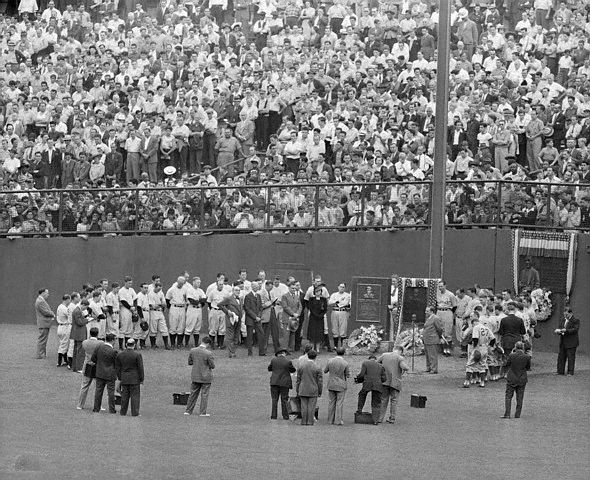
Honoring Lou Gehrig, His Monument Unveiled – 1941

The Day The Yankees Paid Their Final Tribute To The “Iron Horse”

This monument ceremony seen below was supposed to take place July 4 1941, on the two year anniversary of Lou Gehrig Day in 1939.

Many baseball fans know that the New York Yankees began the tradition of Old-Timers Day with a ceremony on July 4, 1939 to honor Lou Gehrig, the “Iron Horse.” On that day, the Yankees brought together Lou’s old teammates to show their deep admiration for a man who exemplified everything the Yankees were about. At the last minute Gehrig was asked to say something to the packed house at Yankee Stadium.

The words he said, now known as, “The Luckiest Man on the Face of the Earth” speech, live on in immortality because it was completely spontaneous and from the heart.

What you may not know, is that you really have never heard or seen that speech.

You have only seen or heard small portions of Gehrig’s speech, because believe it or not, there is not one extant movie or audio recording of Gehrig’s complete speech. Only snippets.

As incredible as it sounds with all those newsreel cameras present to record the activities at Yankee Stadium, no complete version of the speech has surfaced in all these years. Continue reading

Babe Ruth, Dewayne Wise And Mistakes Umpires Make

Umpires Make Mistakes: See Baseball History 101

Photo Mike Stobe / Getty Images

Everyone is in an unnecessary uproar over the  Dewayne Wise phantom catch of a baseball that disappeared into the crowd at Yankee Stadium on June 26, 2012 during a 6-4 Yankee victory over the Cleveland Indians.

The umpire, Mike DiMuro is human. He made a mistake and admitted it after the game. That was the right thing to do.

Do you want the game to stop every time there is a controversial play? Aren’t the games slow enough?

Mistakes similar to this have been happening since baseball began and have been forgotten unless they affect the pennant race or a World Series game.

One forgotten incident that occurred on August 1, 1920 was whether Joe Jackson of the Chicago White Sox actually caught a baseball Babe Ruth hit into an overflow crowd at Comiskey Park.  The aftermath of that play is shown below.

Babe Ruth & Miller Huggins argue with umpire Tom Connolly, Bob Meusel (with bat) listens © blackbetsy.com

Going into the game against the White Sox, Ruth was on a tear, having hit 37 home runs already, shattering his own record of 29 home runs set the previous year. Continue reading

Old New York in Photos #19 – First Traffic Light Signals

First Traffic Light Signals –  Fifth Avenue and 34th Street, 1922

The Beginning of New York City’s Traffic Lights

This ornate traffic light at 34th Street, was one of seven put up in New York City on the heavily traveled Fifth Avenue in 1922.

The city had experimented with traffic signals in 1917 when a device invented by an engineer, Foster Milliken, was installed at the intersection of Fifth Avenue and 57th Street. The device was a revolving flashlight that would flash signals as red to stop and green for go.  This may sound ridiculous now, but in the early days of traffic signals there was no standard for color relating to traffic. Continue reading

The Forgotten Brooklyn Elevated Train Crash Of 1923

June 25, 1923 Intersection of Atlantic and Flatbush Avenues

Photo © Osmund Leviness

“Those who died were fortunate it seemed to me when I looked inside the cars. As long as I live I can never forget it. All the people were in a mass there, struggling and screaming, with blood running over them. They all seemed to be bleeding or stained with blood. One woman’s head was terribly cut on top, and one jaw seemed to be crushed in. The hand of another woman was almost cut off. One woman I took out through a window died a few minutes after I carried her into the post office. I can’t forget the inside of those cars. They looked like my idea of purgatory.” –  Traffic Officer Joseph J. Ryan who was on the scene immediately after the crash.

This incredible accident happened 89 years ago, Monday, June 25, 1923  as two cars of the BMT derailed and plunged 35 feet into the street at the intersection of Atlantic and Flatbush Avenues in Brooklyn. Continue reading

Joe DiMaggio’s Comeback 1949

The Yankee Clipper Gets Ready To Return To Play – June 21, 1949

Many who saw Joe DiMaggio play say he was the greatest all-around ballplayer who ever lived. Everything he did seemed effortless. Of course this is a huge exaggeration. Everything DiMaggio did so well required practice, patience and hard work.

When DiMaggio missed the first three months of the 1949 baseball season with a painful heel injury, many fans, players and sportswriters thought he might never play again.

So it was hush-hush when DiMaggio went to an empty Yankee Stadium to test out his heel in a full workout on June 21, 1949.

Things went well and DiMaggio returned to the Yankee line-up on June 28, 1949 at Fenway Park against the Red Sox to start a three game series. He hit a homerun in the first game which the Yankees won by a score of 5-4. The Yankees swept the series and when DiMaggio left Boston, he had hit four homeruns and driven in nine runs.

The impact of his return cannot be understated. In the 76 games DiMaggio played for the remainder of the year, he batted .346, hit 14 homeruns and drove in 67 runs. His on base percentage was the highest of his career, .459. In 329 plate appearances he struck out only 18 times.

The Yankees ended up edging the Red Sox by one game in the final season standings, propelling the Yankees into the World Series against the Brooklyn Dodgers.

DiMaggio would go on to have the worst World Series performance in his storied career, batting just .111. But the Yankees still defeated the Dodgers four games to one, starting their stretch of winning five World Championships in a row.

The No-hitter, Break-up King

Cesar Tovar

Pitchers who come close to baseball immortality by throwing a one-hitter will always remember the batter who broke up their no-hitter.

Of all the players who have played big league baseball, you’d think some great or pesky contact hitter like Pete Rose, Ty Cobb, Joe Sewell or Lloyd Waner would hold the record for getting the only hit in a game that otherwise would have been a no-hitter.

But the man who set the record for having the only hit in a game, that ended up being a one-hitter is Cesar Tovar.

Tovar, a .278 career hitter, who played from 1965-1976 spoiled five no-hitters, a record now shared with Eddie Milner.

Tovar got the only hit of the game off of:

  1. Barry Moore of the Washington Senators (April 30, 1967)
  2. Dave McNally of the Baltimore Orioles (May 15, 1969)
  3. Mike Cuellar  of the Baltimore Orioles (August 10, 1969)
  4. Dick Bosman of the Washington Senators (August 13, 1970)
  5. Jim “Catfish” Hunter of the Oakland Athletics (May 31, 1975)

The first four times, Tovar was playing for the Minnesota Twins.  The last time versus Hunter, he was with the Texas Rangers. Tovar’s hits against McNally and Cuellar came in the ninth inning.

Tovar is also one of four players to play all nine positions in one major league game.

Cesar Tovar died at the age of 54 on July 14, 1994.

Motörhead Live In Their Prime – 1980

Concert At Nottingham Theatre Royal Is Well Worth Viewing

motorhead tour booklet photo Brian GoodmanFor those of you who are fans of Motörhead this is definitely worth watching.  If you are not a fan, then this video should help make you one. This show captures the band in full control playing a scorching set with good audio and video. The classic line-up of Lemmy, Fast Eddie Clarke and Phil Taylor perform the following set:


Overkill
Too Late Too Late
Shoot You In The Back
Step Down
Jailbait
Leavin’ Here
Metropolis
Train Kept a Rollin’
Bomber
Motörhead


Crime, Murder, Prisons, Hangings and Lynchings in 1891

Some Interesting Facts The 1892 World Almanac

The 1892 World Almanac contains fascinating crime statistics.

Putting the crime numbers in perspective to the population, in 1890 the United States total population was 62,830,361.  The “colored” population  was 7,488,676. So, African-Americans made up about 12% of the population.

There were 45,233 people in penitentiaries, 14,687 were black. That means African-Americans comprised nearly one third of the inmates in the U.S. penitentiary system.

The number of murders and homicides reported by newspapers for 1891 was 5,906.

The murders and homicides are broken down as follows:

  1. Quarrels 2,820
  2. Liquor 877
  3. Unknown 859
  4. Jealousy 449
  5. By Highwaymen 241
  6. Infanticide 208
  7. Resisting Arrest 182
  8. Insanity 102
  9. Highway Men Killed 74
  10. Self Defense 74
  11. Strikes 10
  12. Outrages (?) 2

The number of legal executions reported in the U.S. was 123. The two leading states were Georgia and Texas with 19 and 12 executions respectively. The electric chair as a means of execution was first put into use in New York in 1890.  Almost all the executions in 1891, were by hanging.

The number of lynchings reported was 195. The leading three states were Louisiana 29, Alabama 26 and Mississippi with 23. Six of the people lynched were women.

Below is the full chart on all these statistics. (double-click to enlarge to full size)


Where Did The Saying “Up The River” Come From?

A Movie Cliche’s New York Origins

If you ever watch any gangster films from the 1930’s or 40’s, one of the lines of dialogue that always pops up is: “up the river.”

Somebody would utter it: a criminal; prosecutor; police officer; or a fellow gangster. Listen and it will be said in most of these early crime movies.

Lines like:

“Didn’t you hear, Rocky’s going up the river.”

“If you don’t talk Ike, I can guarantee you’re going to spend a long stretch up the river.”

“I’m not takin’ the fall to go up the river for a heist you did, Spats.”

The term “up the river” as most people know refers to going to prison.

So where did the saying come from?

In the 1800’s, when you were charged with a crime and sent to prison in New York City, the accused would first be taken to the prison on Centre Street in lower Manhattan which was known as “the Tombs” built in 1838.

The Tombs were so named because the original structure had large granite columns on the outside of the building which  resembled Egyptian burial architecture, a.k.a. tombs. The Tombs though, were merely a holding prison for the accused criminals awaiting trial.

After sentencing, convicts were sent to a prison on Blackwell’s Island (today known as Roosevelt Island) in the middle of the East River.

However if you were a habitual offender or committed a very serious offense, you would be sent thirty miles north, up the Hudson River to Sing Sing prison. This is the origin of the phrase being sent, “up the river.” Sing Sing separated the hardened criminals from the run of the mill pickpockets, burglars and ordinary thieves.

Even though, the term “up the river” originally referred to Sing Sing, it was eventually applied to anyone being sent to any prison.

Babe Ruth’s 1920 Uniform Sells For $4.4 Million At Auction

Babe Ruth, King Of The Sports Memorabilia World

Nearly sixty-four years after his death, Babe Ruth set another record on Sunday May 20, 2012 . His circa 1920 Yankees road jersey sold at SCP auctions for a staggering $4.4 million.

Photo © SCP auctions

This eclipses the previous highest amount paid for a piece of sports memorabilia, a Honus Wagner baseball card, which sold in 2008 for $2.8 million.

To put the amount of the sale price in some perspective, Babe Ruth earned approximately $910,000 during his entire major league baseball playing career from 1914 -1935. This of course does not account for inflation. In modern dollars with inflation Ruth would have earned $15.3 million.

Also Ruth made vast amounts of money during the off-season, barnstorming and doing various product endorsements and personal appearances.

How would Ruth have felt about his uniform selling for more than he made his entire career? I’d like to think Ruth would have had a good laugh at that fact.

Babe Ruth, second from left, with his Yankee teammates, early 1920’s

Here is a photograph of Babe Ruth early in his New York Yankee career during spring training, possibly wearing the multi-million dollar uniform.

On a side note

The Kansas City Royals defeated the New York Yankees last night, May 21 at Yankee Stadium by a score of 6-0.  What made me notice this otherwise unremarkable game was what the New York Times said today in the sports section:

But the clutch-hitting woes of the Yankees — not just their wheezing All-Star first baseman — remained for another game, a 6-0 loss to the Kansas City Royals in front of 39,229 fans.

Anyone attending or watching the game on television knows the announced attendance of 39,229 was a joke. Looking at the mostly empty stadium, there were probably no more than 8,000 people attending the dreary game, which was played under a constant, steady rain.

The idea that baseball attendance is counted not by clicks of the turnstile, but by tickets sold is ridiculous. It’s another slight problem in a laundry list of things that MLB should address before baseball becomes completely irrelevant.