As Seen In Housing Works Bookstore Cafe on Crosby Street

Whoever sets up the sections at Housing Works Bookstore Cafe on Crosby Street deserves a pat on the back for coming up with the shelving combination of Politics with True Crime.

As Seen In Housing Works Bookstore Cafe on Crosby Street
Whoever sets up the sections at Housing Works Bookstore Cafe on Crosby Street deserves a pat on the back for coming up with the shelving combination of Politics with True Crime.
June 1 Would Have Been Marilyn Monroe’s 88th Birthday
I can’t imagine Marilyn Monroe at 88, can you? Would she be like Doris Day who stays close to her home and discourages having any photos taken of her? Or would she still be active and in the public eye? We’ll never know. Marilyn died at the age of 36 under mysterious circumstances the evening of August 5, 1962, or for those who buy into the “official suicide story,” in the early morning hours of August 6.
Photographer Milton Greene, Marilyn’s one time business partner, took these photos of Marilyn in the early to mid-fifties. Here is the always young and beautiful Marilyn Monroe.

Marilyn Monroe signing autographs for fans 1953 photo © Milton Greene


What The First Doors Album Cover Could Have Looked Like

Doors debut album photo session © Joel Brodsky
Almost every rock fan is familiar with The Doors 1967 eponymous debut album containing the hit songs Light My Fire, Break On Through, Soul Kitchen and The End. The album’s iconic front and back covers were photographed by Joel Brodsky. The back cover photo was also used for a billboard advertisement; the first album to ever get that treatment on the Sunset Strip in Hollywood.


As we pointed out in our article about Carole King and her photo session for Tapestry, there are always other photographs from a photo session that the public rarely sees.
In these sessions, photographer Joel Brodsky took many pictures of The Doors that could have ended up on the cover. Some of the photos were later used on album sleeve inserts and on greatest hits collections.
Below are some of the other photographs from these famous sessions. Do you think any of them would have worked better than what was chosen?


Westchester Home For Sale in 2014. In the 1930’s the home was known as Wisteria House. photo: HGMLS
You may or may not believe that houses have vibes, memories or energies surrounding them. But regardless of your beliefs, would you want to live on a property where a serial killer committed a murder so horrific that the police did not initially believe the details of the confession?

In a bucolic town in Westchester, NY, you can buy the three acre property where serial killer Albert Fish took and brutally killed ten-year-old Grace Budd on June 3, 1928.

Asking price – $799,900.
The home shown in the contemporary photograph above and in the vintage news photograph on the left was once known as Wisteria House, an 1860 villa in what was once Greenburgh, NY, and is now part of the town of Irvington.
Obviously the real estate agent listing the home will not advertise the fact, that on this property right behind the old home was where Wisteria Cottage stood (shown in photo to the right). This is where Albert Fish strangled, dismembered and later, at his own home, ate Grace Budd.
To say Albert Fish was one of the most heinous people who ever walked the earth would be an understatement.
Reading Fish’s life story is to uncover the debaucheries of a real life Hannibal Lecter as described in Silence of the Lambs. Continue reading
In 1911 The Proposed McCarren Bridge Was To Replace The “Old” Brooklyn Bridge So It Could Be Reconstructed

Existing & proposed bridges New York City 1911 – note the four lower Manhattan bridges instead of three (click to enlarge)
From the New York Tribune of January 1, 1911 comes this illustration showing New York City with its existing bridges and some proposed new ones.
Sandwiched very tightly between the Brooklyn Bridge and the Manhattan Bridge connecting lower Manhattan with Brooklyn, is a proposed new bridge which was to be called the McCarren Bridge named after “Long Pat” McCarren (1847-1909) a state senator who was Brooklyn’s Democratic political boss during the late 1800’s.
Once the proposed McCarren Bridge became a reality, city engineers planned to close and rebuild the Brooklyn Bridge. The engineers feared that the increase in heavy traffic on the Brooklyn Bridge would necessitate additional strength being added, otherwise a support or cable might give way causing a horrible catastrophe. Borings were even made at the site, but the McCarren Bridge was never built.
Other proposed bridges in the illustration show the Hell Gate Bridge which was begun in 1912 and completed in 1916.
Further north on the Harlem River connecting upper Manhattan with the Bronx is another proposed bridge that was never built nestled between the University Heights/West 207th Street Bridge and Washington Bridge. This bridge would have been located at 177th Street in the Bronx and was to be called The Morris Heights Bridge. Continue reading
The Death Of The Scorecard At The Ballgame

Scorecard vendor at the Polo Grounds 1949 – photo William C. Greene
Recently I went to a baseball game at that imitation ballpark in the Bronx they call Yankee Stadium. After being gently frisked at the admission gates and going through the turnstiles, the thing that did not greet me was what you see above: a vendor selling scorecards.
You could buy a scorecard, but not for 10 cents as it was at the Polo Grounds in 1949. The archaic idea of a scorecard costs $10 at Yankee Stadium and is available at the souvenir shops spread throughout Yankee Mall Stadium. The scorecard is buried in some glossy souvenir publication which I did not purchase, nor did anyone else.
When I used to attend a lot of games in the 1970’s and 80’s buying a scorecard was a no-brainer. From anywhere from a reasonable 25 cents in the early 1970’s to two dollars in the late 80’s, filling out that scorecard and having a program was a nice memento of a game I went to. There is a certain enjoyment derived from scorekeeping and having a permanent record of a game you are attending.


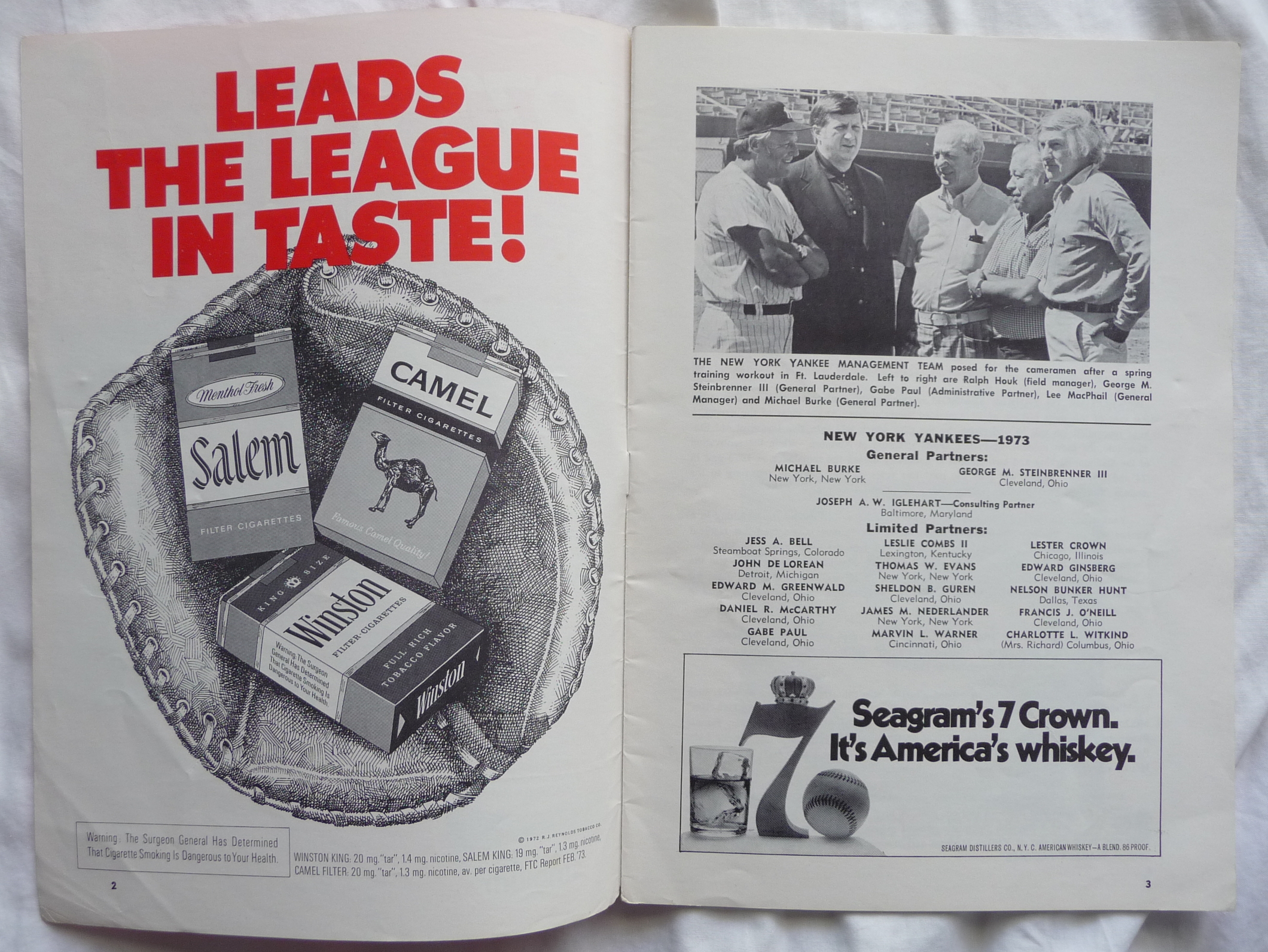
I just dug this program of my closet from a game I went to on Thursday evening September 6, 1973. The Yankees came back in the bottom of the eighth inning after trailing 6-5 on a three run home run from Mike Hegan to beat the Milwaukee Brewers 8-6. Bobby Murcer and Roy White also homered for the Yanks. The time of the game was 2:22.
In my childish way I merely recorded outs as fly outs, ground outs or line outs without denoting the fielders who made the play. As you can see my scorekeeping leaves a lot to be desired, but for a little kid I think I did a pretty good job. Eventually I learned to score correctly.
For 30 cents they packed a lot into 28 pages. Continue reading
Julie Newmar, Barbara Eden and Tina Louise (Catwoman, Jeannie and Ginger) Before TV Super-Stardom


In the mid 1960’s three television shows debuted that have achieved pop culture immortality status: Gilligan’s Island; I Dream of Jeannie and Batman. The beautiful women associated with these shows are forever young in TV re-runs.
Before they went on to become pop-culture legends, Julie Newmar, Barbara Eden and Tina Louise each posed for cheesecake photos in the 1950’s that displayed their natural assets.
Julie Newmar had appeared in films, television and on Broadway winning a Tony Award for Best Supporting Actress for The Marriage-Go-Round. Everlasting fame came to Julie Newmar playing Catwoman on Batman.
Barbara Eden starred in a number of television shows and some movies throughout the 1950’s and 1960’s before landing the title role in I Dream of Jeannie in 1965. The show ran for five seasons on NBC and is still seen today in syndication.
After modeling and appearing on Broadway in the 1950’s Tina Louise became a movie star in her film debut God’s Little Acre (1958) . When she took the role of Ginger Grant in Gilligan’s Island, Louise mistakenly thought via her agent that she would be the lead in the ensemble cast show according to series creator Sherwood Schwartz. Tina Louise believed Gilligan’s Island ruined her acting career and forever typecast her as a sex symbol rather than a serious actress. The show has been broadcast all over the world constantly ever since its CBS network run ended in 1967.
It’s hard to believe all three glamorous women are now in their early 80’s. Ironically, Tina Louise who believed her career was ruined by her participation in Gilligan’s Island, is the only one still actively seeking and getting acting roles.
Fastway – Eat Dog Eat (SPV/Steamhammer)
For those who wondered if Fast Eddie Clark and Fastway would ever put out another new album, the answer is, finally yes. It took more than twenty years, but Fastway, Clark’s post-Motörhead band, in April 2012 finally and quietly released in the U.S. Eat Dog Eat and it is a decidedly radio friendly rock album. That is if there were radio stations that still played new rock albums.
 On internet streaming sites and satellite radio where hard rock seems to have retreated, I’m afraid this excellent effort was completely overlooked. In the past two years I never heard one new cut from Fastway.
In this seemingly temporary incarnation, Fastway is now a three-piece ensemble with former Little Angels front man Toby Jepson, producing the album and providing lead vocals, bass guitar and acoustic guitar. Fast Eddie plays lead guitar and Matt E.(?) is on drums. Continue reading

New York City– Harold B. Funston, accounting machine mechanic of Columbus, Ohio brought to New York for an appearance on a radio program, eats glass from a light bulb in a demonstration of his unique hobby — that of emulating the mysteries of the East Indian Fakirs. Credit line (Acme) 2/21/39
The radio program mentioned above was a CBS show, “Dave Elman’s Hobby Lobby.” In rehearsals, Funston amazed Elman, Radio Guide reporter Martin Lewis and the studio audience by chewing up and swallowing six razor blades, which he downed with a glass of water. He then proceeded to eat some light bulbs.
 Film footage exists of Funston eating razor blades; putting fire in his mouth; and laying on a bed of spiked nails as another man sits on him. He also extinguishes a lit cigarette with his tongue.
Here is another Continue reading
The Story Of The End Of Lou Gehrig’s Consecutive Game Streak – May 2, 1939

Yankee captain Lou Gehrig stuns Tigers manager Del Baker, home plate umpire Steve Basil and umpires Red Ornsby and Bill Summers as Gehrig informs them he has benched himself. (photo AP)
Almost everyone knows something about Lou Gehrig, the Iron Horse, and his consecutive game playing streak. But you’ve probably never seen the dreaded moment when Gehrig took himself out of the lineup ending his streak, except by seeing actor Gary Cooper do it in the famous 1942 movie The Pride of the Yankees.
This photograph above shows that actual moment that occurred 75 years ago today.
Since June 1, 1925 Lou Gehrig had appeared in 2,130 straight games over the past fourteen seasons with the Yankees. Gehrig played with sprains, concussions, back spasms, broken bones and illnesses that would have had a lesser man take at least a day off, go on the disabled list or convalesce in a hospital. But Gehrig didn’t just play. He played exceptionally, putting up outstanding numbers offensively and defensively while always conducting himself with grace and humility on and off the field.
So on Tuesday, May 2, 1939 at Briggs Stadium in Detroit, nothing seemed out of the ordinary when Yankee captain Lou Gehrig came to home plate to deliver the starting lineup card.
But earlier in the locker room in a private talk, Gehrig informed Yankees manager Joe McCarthy that he was removing himself from the lineup because he “wasn’t doing the team any good.” McCarthy asked him if he was serious and Gehrig replied that he was. McCarthy then told Gehrig it would be as he wished.
Gehrig approached the plate and handed the lineup card without his name on it to home plate umpire Steve Basil and Tigers manager Del Baker. On the photo, you can see the shock and disbelief on the faces of the men gathered around Gehrig whose expression is one of complete dismay.
The thunderbolt news raced through both teams, then around the stadium and finally throughout the baseball world through the newswires that Lou Gehrig had taken himself out of the lineup and was ending his famous streak.
When the announcement was made over the public address system to the 11,379 fans in attendance of Gehrig’s voluntary withdrawal, it was suggested that he get a “a big hand.”
The New York Times reported a deafening cheer resounded as Lou walked to the dugout, doffed his cap and disappeared in a corner of the bench.

Lou Gehrig consoles Babe Dahlgren about replacing Gehrig in the Yankees line-up, May 2 1939
Ellsworth “Babe” Dahlgren who had waited since 1937 to start at first base for the Yankees, finally, but reluctantly got his chance. “I hated to break his streak,” said Dahlgren.
”I remember Lou taking the lineup card up to the plate that day. When he came back to the dugout he went over to the water fountain and took a drink. He started to cry. Lou stood there with a towel on his head, taking the longest drink I’ve ever seen anybody take.” Continue reading