This is not part of some government secret test program to see how many cigarettes you need to smoke before you develop cancer. Testing cigarettes was part of Sol C. Korn’s job as the director of various cigarette and cigar company’s from the 1920’s until the 1960’s. In 1945 when this picture was taken he was president of the Fleming-Hall Tobacco Company.
Before The Internet, The Quickest Way To Get Photos Back To The Newspaper- Via Pigeon
Walker Cooper, Phil Rizzuto and Private Harry Myers and carrier pigeons, October 4, 1942 photo: New York Journal-American
You would have thought by 1942 there was a quicker way for a newspaper to get photos from one place to another than using a carrier pigeon. Apparently not.
Before game four of the World Series at Yankee Stadium, Private Harry Myers, the Journal-American’s pigeon specialist, shows the Cardinal’s Walker Cooper and the Yankee’s Phil Rizzuto how photographic negatives of the World Series game are sent by pigeon from the ballpark to the newspaper’s offices for same-day publication of the photos.
Amazing.
Maybe it was just the New York Journal-American’s method, as I cannot imagine all the newspapers releasing pigeons during a baseball game.
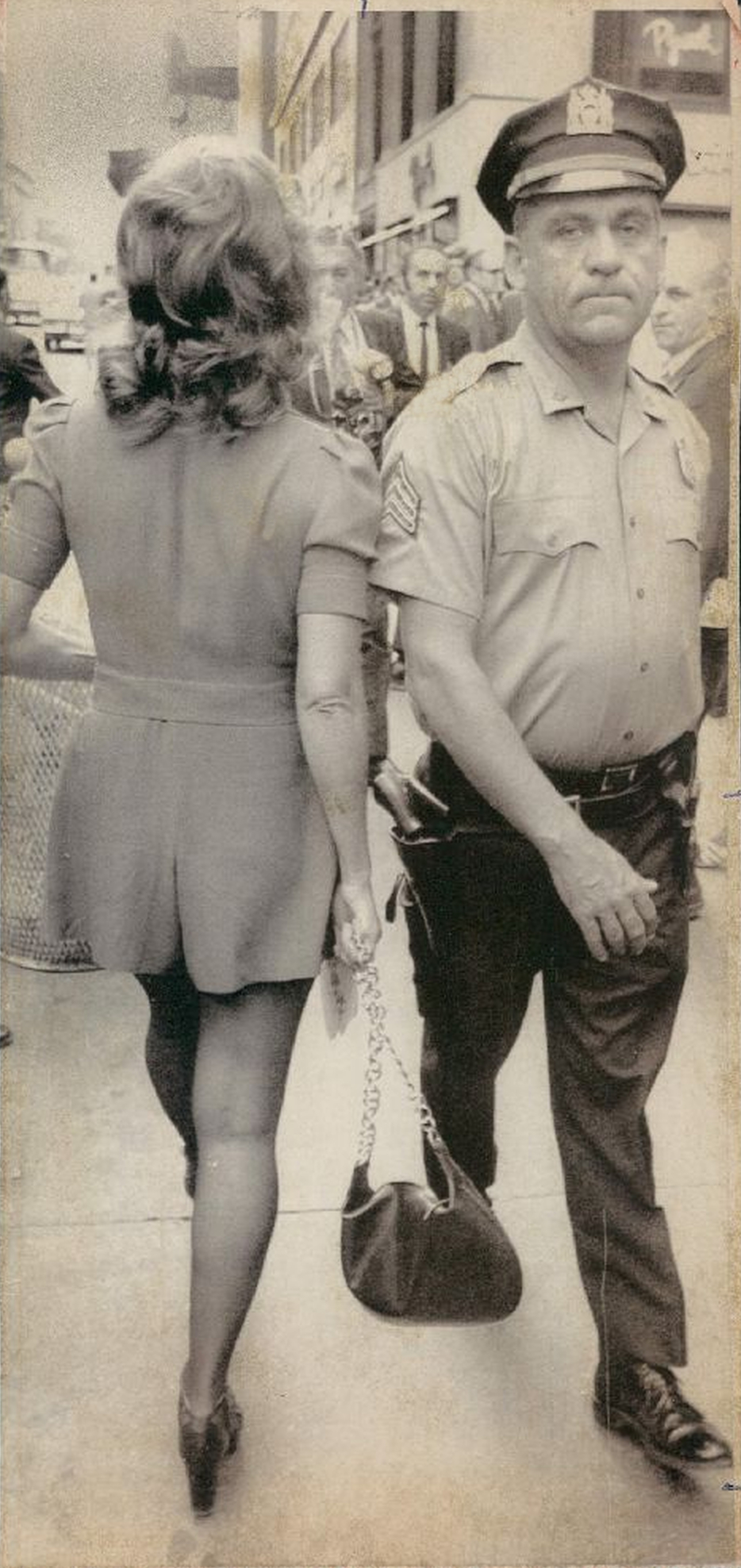
A New York City Cop Takes Exception To Claudia Cardinale’s Dress – 1971
Disturbing the Peace
New York, NY – A New York policeman is not deterred in his duty as Italian actress Claudia Cardinale turns on her charm in front of Grand Central Station. After telling Cardinale to “move along,” the policeman rubs shoulders with her as he goes his way and she goes hers. Front view of the departing actress shows why he asked her to move. The dress she wore to plug a new movie caused a mid-town traffic jam. (UPI) 8-3-71
Here is how Claudia was causing the traffic jam —
I love the men’s faces in the background, while the cop scowls and bumps into Cardinale. For 1971 this mode of dress on the city streets was considered very risque. Today it would barely attract attention, let alone have the police intervening.
A member of the Turner Classic Movie Fan Forum, FrankT65, posted a behind the scenes account of what occurred here.
Frank was responsible for running a publicity junket for Paramount’s The Red Tent starring Claudia Cardinale, Sean Connery and Peter Finch. Here is how Frank describes the event:
We had lots out of town press coming in for a junket and if anything we would have plenty of publicity coverage for the film.
Our VP in charge of marketing was Charles Glenn….a man who believed in the publicity stunt, which had been considered by many to be outdated. I myself loved publicity stunts…it got you out of the office and in with the public where a public relations person belonged. Problem was there were too few stunts you could connect with THE RED TENT. Finally someone came up Continue reading →
Houdini, Debunker Of All Psychic Phenomena STILL Has Not Communicated From The Other Side
When Harry Houdini claimed he could do something, he would prove it. For instance, he said he could escape from any jail cell, sometimes with multiple gates and holding areas. Here he is seen emerging from a penitentiary holding only shackles and locks next to his near naked body. The demonstration would usually blow the superintendent or warden of the prison away. Before entering the cell Houdini was searched and stripped. How did he escape from all those jail cells?
Usually Houdini opened the lock with a carefully hidden key or pick – use your imagination to figure out where he hid it. All over the United States and Europe, Houdini performed this trick as a jail breaker hundreds of times and it rocketed him to fame. The one thing Houdini couldn’t escape was death.
On Halloween in 1926 Houdini died. He promised his wife Bess Continue reading →
Wes Parker goes after a ball in game 4 of the World Series Oct 10 1965 photo: UPI
The Los Angeles Dodgers played the Minnesota Twins in the 1965 World Series with the Dodgers prevailing in seven games.
At Dodger Stadium on October 10, 1965, in game four with two outs in the top of the ninth, Twins slugger Don Mincher hit a pop fly that was drifting into the stands in foul territory. With the Dodgers leading 7-2, Dodgers first baseman Wes Parker made a desperate leap into the stands to try and catch Mincher’s foul ball and end the game.
Parker’s jump fell short and he missed the ball.
Mincher ended up striking out and Don Drysdale got the complete game win for the Dodgers. Time of the game two hours and fifteen minutes.
The Moment Bobby Thomson Hit His “Shot Heard Round The World”
Bobby Thomson connects, Oct. 3, 1951, catcher is Rube Walker, umpire is Lou Jorda photo: Wide World
This article is titled “A Day Brooklyn Dodgers Fans Would Love To Forget” but in actuality Brooklyn Dodgers fans are dwindling in number.
You’d have to be at least 60 years old to have any memory of “dem bums” playing at that great ballpark known as Ebbets Field. The team moved to Los Angeles in 1958, breaking everyone in Brooklyn’s hearts.
The day the Dodgers left Brooklyn for smoggy L.A. was a horrible moment, but no moment was as painful for Dodgers fans as the Giants bottom of the ninth inning comeback of a best two out of three playoff series with the Dodgers.
On Wednesday October 3, 1951 one of the most memorable events in all of baseball history occurred. As seen in the photo above, Dodgers fans were devastated when the New York Giants third baseman Bobby Thomson hit a one out, three run home run to left field off of Dodgers pitcher Ralph Branca, to give the Giants a 5-4 miracle win at the Polo Grounds and propel them into the World Series against the Yankees. Continue reading →
Later That Year, Jayne Is Photographed With Her Role Model, Marilyn Monroe
This photograph of Jayne Mansfield in a sheer negligee top is not your standard cheesecake photo. And it’s not because Jayne is a little overexposed, which tended to be her modus operandi in front of the camera.
It is because the photograph was taken by Milton Greene, known for his business partnership with Marilyn Monroe. In 1955, Greene did a whole session of photographs with Mansfield and made some stunning images of her.
Considering Greene’s business dealings and personal closeness to Marilyn Monroe,(Marilyn was living for a time with Greene and his wife Amy) it is a bit of a surprise that Marilyn Continue reading →
49 Years Ago, Satchel Paige Shut Out The Red Sox For Three Innings.
No Big Deal, Except That He Was 59
Satchel Paige, age 59 warming up on September 13, 1965 two weeks before facing the Red Sox photo: AP
To hold “a day” for a ballplayer years after he last played in the major leagues is a special treat for the player. What makes it even more special is when the player participates in the game.
Forty nine years ago on September 25, 1965, Satchel Paige stepped on to the field at Kansas City’s Municipal Stadium on Satchel Paige Night as the starting pitcher for the Kansas City Athletics. It was supposed to be a publicity stunt conceived by Athletics owner Charlie Finley to boost attendance, but Paige took his pitching seriously and would not be embarrassed.
Paige considered by many to be the Negro League’s best pitcher for over two decades, came to the Major Leagues when he was 42-years-old in 1948 when he was signed by Indians owner Bill Veeck.
Paige went 6-1 with a 2.48 ERA that year and helped Cleveland win the pennant. Paige stayed in the majors until he was 46 and continued playing in the minors and barnstorming into the early 1960’s.
At Satchel Paige Night, Charlie Finley had provided a rocking chair for Paige to sit in before the ball game began and a nurse was stationed next to Paige to massage him and keep his arm loose.
The visiting Boston Red Sox did not lay down for Paige. They tried, but the crafty 59-year-old was not going to let a bunch of kids show him up on his own night.
In the first three innings the Red Sox managed to get a runner on with an error and a double by Sox star Carl Yastrzemski.
At the beginning of the fourth inning with the A’s winning one to nothing, Paige went to the mound Continue reading →
Thurman Munson Is Out And Billy Martin Does Not Agree
There was no instant replay back when this scene occurred on July 21, 1978 as Billy Martin pleads his case in vain to umpire Durwood Merrill. Believe it or not, they are arguing that Munson should have been called safe when he attempted to steal home.
The Yankees were playing the Minnesota Twins at Metropolitan Stadium, a place very familiar to Yankees manager Billy Martin and the theft of home. When Martin managed the Twins in 1969 he taught Rod Carew how to swipe home and Carew ended up with a record seven steals of home.
It was not a big deal that Munson was called out in this instance, as the Yankees won the game 4-0.
Bet you didn’t know there was once a pancake flipping champ in New York? Well there was in 1947.
Note the concentration in young Henry McChesney’s face. The rules and how many other entrants there were in this contest is anyone’s guess. The caption for this Acme news photo reads as follows:
Fancy Flapjack Flipper
New York: When Henry McChesney end-over-ended a flapjack five times, he became champion flapjack flipper of the Madison Square Garden Club. Judging the contest, held August 28th, is Legionnaire John M. Lewis, who awarded the wise old owl emblem to the club, one of the Boys’ Clubs in which the National Americanism Commission of the American Legion is interested. credit: (Acme) 8-28-47

 This is not part of some government secret test program to see how many cigarettes you need to smoke before you develop cancer. Testing cigarettes was part of Sol C. Korn’s job as the director of various cigarette and cigar company’s from the 1920’s until the 1960’s. In 1945 when this picture was taken he was president of the Fleming-Hall Tobacco Company.