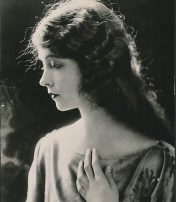
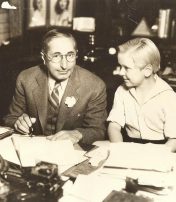
Lillian Gish, King Vidor & Irving Thalberg On The Set of La Bohème 1925
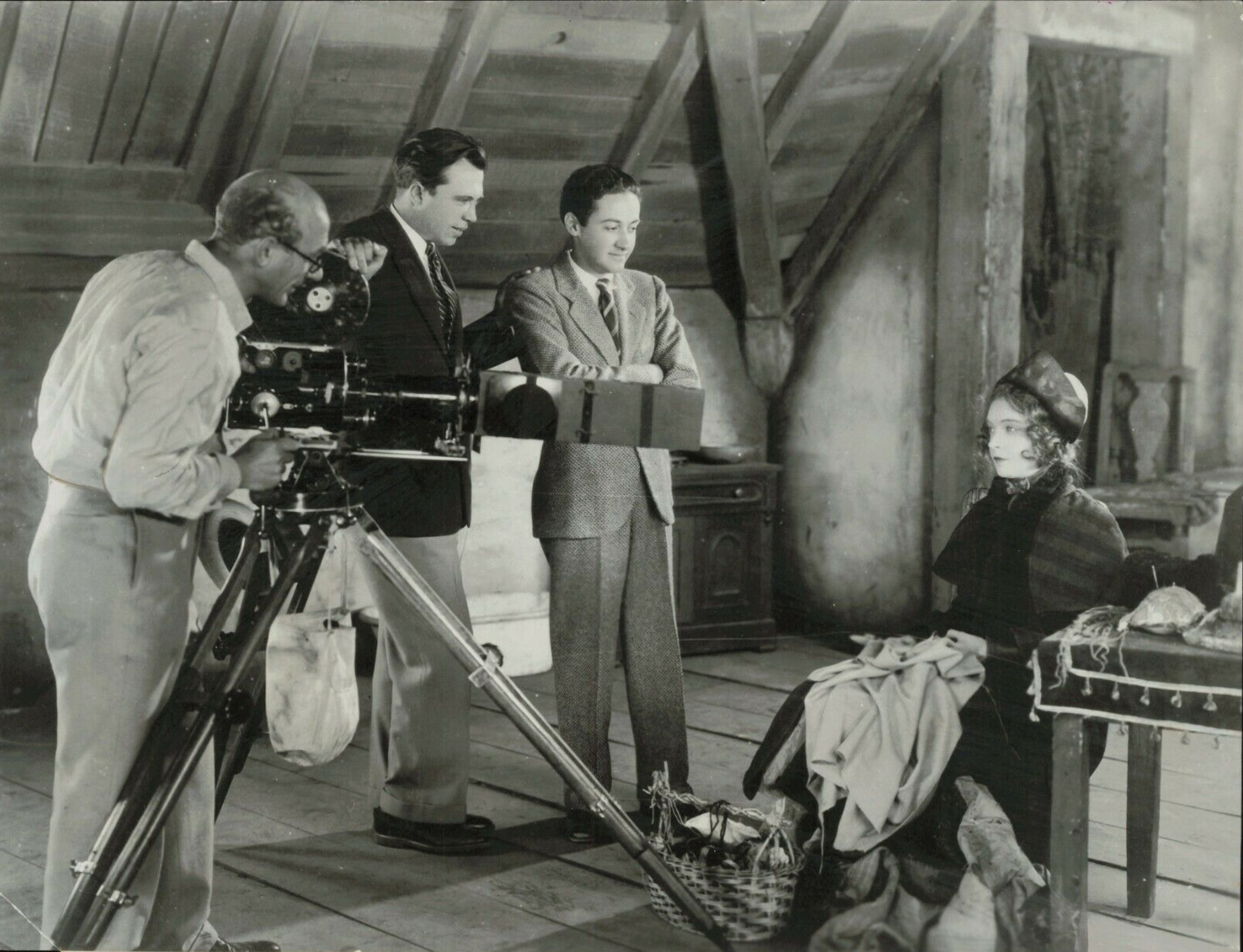
Exclusive Layout – 25 Years Of Movie Making – M-G-M – An interior shot in 1925: The antiquated “silent” camera shoots the first scene for “La Bohème” starring Lillian Gish, while director King Vidor (c) and the late Irving Thalberg, famous young M-G-M production chief, stand by. photo: M-G-M Photos, July 8, 1948 ( uncredited in photo behind the camera is cinematographer Hendrick Sartov)
In 1925, Lillian Gish was beginning a one million dollar contract to make six films in two years for Metro Goldwyn Mayer.
But, when Gish arrived at MGM no preparations were in place for her. No stories or even ideas, no directors, nothing.
Left to choose a vehicle her on own, Gish picked La Bohème. It is the story of a group of striving artists struggling to make good in 1830s Paris. Gish plays Mimi, a fragile waif who lives in an attic and barely ekes out a living as a seamstress. John Gilbert plays Rodolphe a young playwright who falls in love with Mimi.
Production head Irving Thalberg asked who Gish would like for her director? As Gish relates in her 1969 autobiography with Ann Pinchot, The Movies, Mr. Griffith and Me (Prentice-Hall):
“As I had been in Italy for two years I had seen few recent films, and he ran some of M.G.M.’s latest ones for me. Among them were two reels of an unfinished picture that I found so good that I asked Irving for its director and the entire cast. It was The Big Parade. Irving agreed. I wanted Hendrick Sartov as photographer, and Irving said that I could have him too. By then Sartov had invented the soft focus lens, which he named the ‘Lillian Gish lens.’ He never let it out of his sight; he used to carry it around in his pocket.”
Gish’s Influence On Cinematography
Gish also made a suggestion to Thalberg for a change that would alter MGM’s method of shooting. She continues in her autobiography:
“When I suggested to Irving that we use panchromatic film, the new, highly sensitive stock that we had tried on the exteriors of The White Sister and had used exclusively on Romola, he hesitated.
“We can’t handle it in our laboratories,” Irving objected, “‘because we know nothing about it.”
‘It’s the film of the future,” I said. “You’ll have to use it eventually. Why not let the man whom we took to Italy handle it?”
He reluctantly agreed. When the company saw the results, they tore out all the old equipment and rebuilt their laboratory to handle only panchromatic film in the future. I also persuaded them to build better miniature sets, so that the cameraman and director could plan scenes and lighting before filming and thus save time and money.
The film debuted at the Embassy Theater in New York on February 24, 1926. Even though a silent film, as with many important silent films, there was accompanying original music orchestration for La Bohème. The musical compositions were by William Axt and were synchronized by David Mendoza and William Axt.
La Bohème is considered by many to be Gish’s best performance in a film. La Bohème was a modest box office success and earned profits of nearly $400,000.