
19th Century Summer Vacation?
For Most People There Was No Such Thing.

Congress Hall Hotel, Saratoga Springs, NY ad 1886
Summer is underway. For many people summer vacation plans are in place.
Yet, vacations are something we take for granted and are a relatively modern notion.
What was leisure like in the late 1870s?
Your family lives in the city. Your job as a shipping clerk; pressman; dressmaker; bookkeeper; engineer; blacksmith; engraver or iron worker pays the bills, and you may be able to put a little money aside each month.

New York Sun Help Wanted ads 1872
Your work schedule: 10 hours a day, six days a week.
Days off?
One. Sunday. The Lord’s day of rest.
This was the typical work schedule for most Americans up until the late 19th century.
Any other time off?
 With few exceptions, the idea of “taking a vacation” was unheard of. For the professional man with better pay, they might be able to send their family out of the hot city for part or all of the summer. But it was not a vacation as we now think of it.
In Henry Collins Brown’s anecdotal book Brownstone Fronts And Saratoga Trunks, (E.P. Dutton) 1935, a few paragraphs are devoted to how summer vacations came to be.
The question of where to spend the summer had none of the importance that attaches to it today. You generally went to your relations in the country and protested loudly when they returned the compliment in the winter. Vacations were not yet considered an absolute necessity. Offices and manufacturing plants still worked the full ten hours on Saturdays
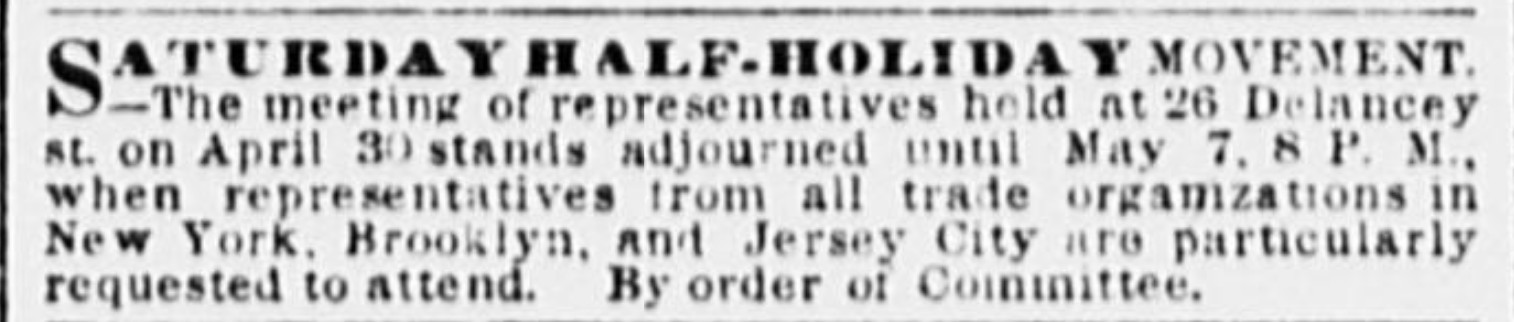
and other days, many retail stores celebrating the week-end, keeping open till ten o’clock.Advertisement in New York Sun Help Wanted section for half day Saturday movement, May 6, 1881
Gradually, a few merchants closed a little earlier on Saturday and by slow and easy stages
the half day quietly took a permanent place in our scheme of things. But that half day at first was portioned off among the clerks, each taking turns at keeping the store or office open
while the majority went off.The idea of a whole week off at a time, was one of gradual growth. We had no such ideas as prevail today regarding hygiene in offices, the virtue of rest and the value of vitamins.
It was largely a matter of grind, grind, grind all the time. Still, the idea was born and as business men prospered, the cost of vacations appeared less formidable and began to grow in favor as its wholesome effect on employees was noticed. A firm giving vacations was held in higher regard than one that didn’t. And so the idea spread. But it was many years before
the streets took on the deserted appearance that is now characteristic of them today at week-ends in summer. As if to quiet consciences for these lapses from grace, camp meetings sprang up all over the country. That seemed to provide an adequate excuse for loafing in the country.So long as you were engaged in nurturing your spiritual life, that seemed a justifiable reason for neglecting business. So the combination was successful till the people tired of harmless deception and decided to take a holiday without any subterfuge. And the time devoted to recreation steadily advanced from one week to ten days and then two weeks. While it has remained stationary at that period for some years, there is an increasing tendency to lengthen that period and three weeks to a month is not now an isolated instance.


For a lot of people, summer vacations are still no such thing.