Monthly Archives: June 2013

Classic Hollywood #24 – W.C. Fields In Color

W.C. Fields In A Rare Color Photograph Circa 1940

WC Fields color

W.C. Fields or Bill Fields to his friends, was one of the most talented comedians of the first half of the 20th century. He began his show business career in vaudeville as a juggler and worked his way up to top billing in the Ziegfeld Follies for a ten year stretch. From there he went on to become a major film star during the 1930’s and early 1940’s. Today, upon viewing his films, many people do not understand why he was considered funny. But I assure you there is a subtle brilliance in Fields’ portrayals of the henpecked husband, disreputable man and misunderstood misanthrope.

One of the more popular, yet apocryphal stories about Fields, was that he had hundreds of bank accounts spread across the country, many under ridiculous pseudonyms such as Otis Criblecoblis; Mahatma Kane Jeeves; Aristotle Hoop; Ludovic Fishpond; Figley E. Whitesides and so on. After Fields died in 1946, his mistress Carlotta Monti claimed that there was over $1.3 million in unclaimed funds in banks under the fake names. An assistant hired to solve the dilemma of Fields estate found only 24 accounts all under Fields real name. Continue reading

Chart of The World’s Religions In 1890 – Over 100 Million Barbarians

In 1890, Almost 10% Of The World Contained “Nondescript Heathens”

Click to enlarge

Click to enlarge

This plucky statistic is from a chart entitled “Estimated Number of all Creeds” in S.T.W. Sandford and Sons Book Of Information published in 1890.

The 32 page booklet was given away by the company to promote their patent medicines. Dr. Samuel T.W. Sandford was made wealthy during the mid to late 19th century by selling his cure-all Dr. Sandford’s Liver Invigorator. The information is presented in almanac-like fashion, yet interspersed with advertising for Dr. Sandford’s products on practically every page. Most of the information presented is basic “did you know” material. But the chart caught my eye. 

The world’s estimated 1.3 billion people are broken down as follows:

Number of all people Proportion to total Number percent
Buddhists 405,000,000 31.2
Christians 399,200,000 30.7
Mahomedans 204,200,000 15.8
Brahamanists 174,200,000 13.4
Nondescript Heathens 111,000,000 8.3
Jews      5,000,000 0.6

A 19th century Anglo-American viewpoint that over 100 million people could be described as “Nondescript Heathens” would not be considered anything out of the ordinary.

Vintage 1978 Yankees Schedule Including Ticket Prices And Other Surprises

A Nostalgic Look At The 1978 Yankees Schedule Handout

Yankee Schedule 78 Seating

click to enlarge

I attended about 25 games in 1978 at Yankee Stadium. I was a young lad with a minimal allowance. So how could I afford it? Mostly I would buy general admission tickets. The cost, $2.50.

When I would splurge, about six times a year, I could buy a box seat for $6.50. Anywhere in the stadium. Field box, mezzanine, upper box, it didn’t matter, they were all available.

The Yankees drew over 50,000 fans 13 times during the year. Seven of the large crowd games were against the Red Sox. The average home attendance for the season was only 28,838.

I pulled this tri-fold schedule from my collection. The ticket prices are displayed below: Box Seats $6.50; Reserved Seats $5.00; General Admission $2.50 and Bleacher Seats $1.50.

click to enlarge

click to enlarge

There are several other things to notice here. First the schedule itself. Continue reading

Before They Were Famous…

The 4 Nightingales – “Big Hit Everywhere”

4 Nightingales

This rare trade card from 1908 – 1909 advertises a vaudeville group known as “The Four Nightingales.” Two of them went on to worldwide fame. Can you guess who they are?

Scroll down for the answer.

A huge clue is “Minnie Marx Manager”

It is The Marx Brothers. From left to right: Milton “Gummo” Marx, Adolph “Harpo” Marx, Julius “Groucho” Marx and Lou Levy.

Gummo Marx Continue reading

Frank Chance, Chicago Cubs Player-Manager circa 1912

Frank Chance, Subject of Baseball’s Most Famous Poem

Frank Chance 1912These are the saddest of possible words:

“Tinker to Evers to Chance.”

Trio of bear cubs, and fleeter than birds,

Tinker and Evers and Chance.

Ruthlessly pricking our gonfalon bubble

Making a Giant hit into a double –

Words that are heavy with nothing but trouble:

“Tinker to Evers to Chance.”

Just what is a “gonfalon” anyway? It is a pennant or a flag.

When columnist Franklin P. Adams wrote the poem “That Double Play Again” (later retitled “Baseball’s Sad Lexicon”) in 1910, Frank Chance was the manager and first baseman of the Chicago Cubs. With double play partners Johnny Evers and Joe Tinker, the three would be immortalized first in the popular poem and later in the Baseball Hall of Fame.

Chance played for the Cubs from 1898 -1912 and was claimed off waivers by the Reds after the 1912 season. A month later he was claimed off waivers again from the Reds by the Yankees. In 1913, Chance became the manager of the New York Yankees and played a few games at first base.

He managed the Yankees for two seasons, leading the team to 7th place in 1913 and 6th place in 1914.

Frank Chance died at the age of 48 on  September 15, 1924. He was elected to the Hall of Fame in 1946, 22 years after his death by the Old Timers Committee.

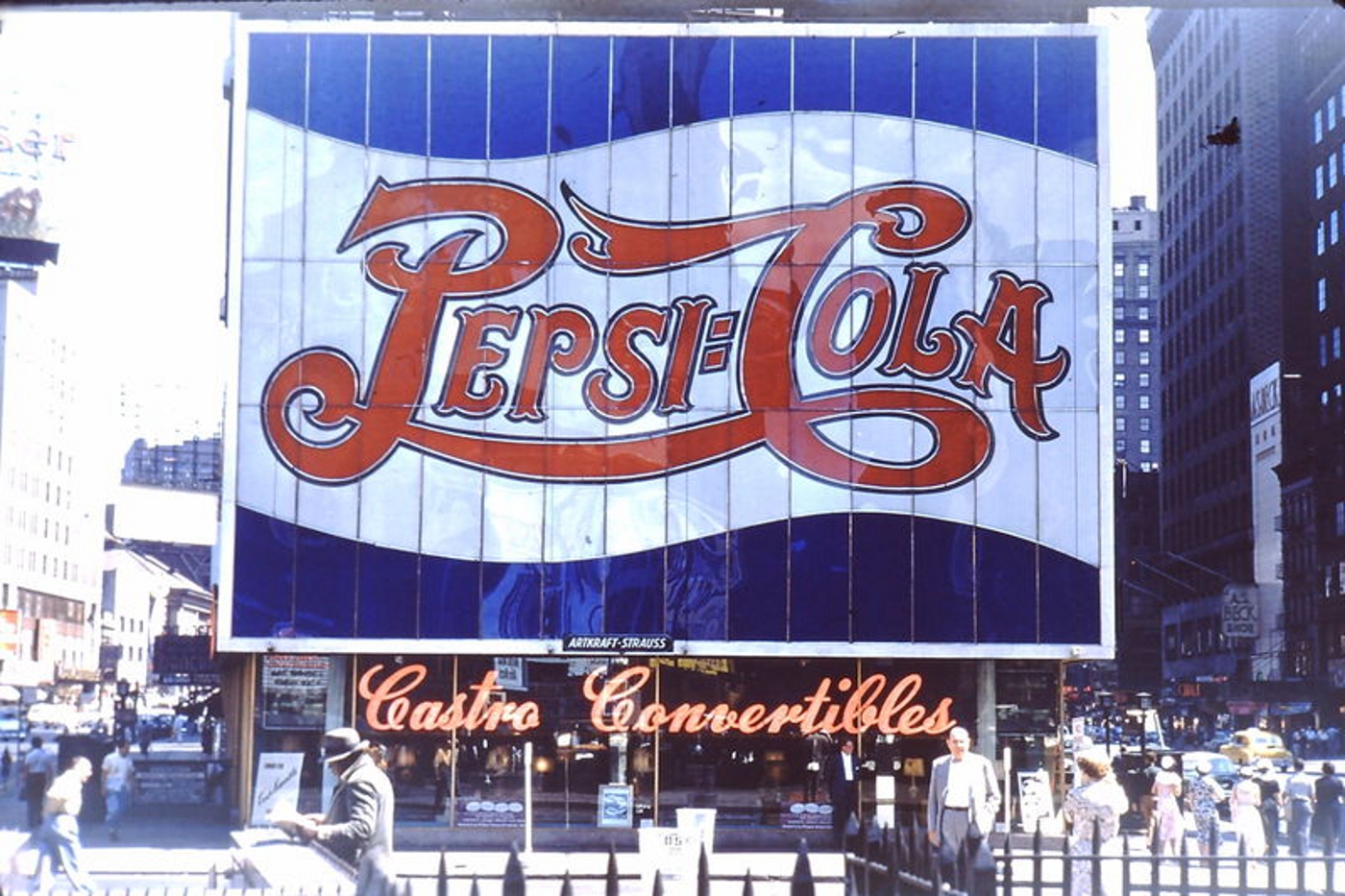
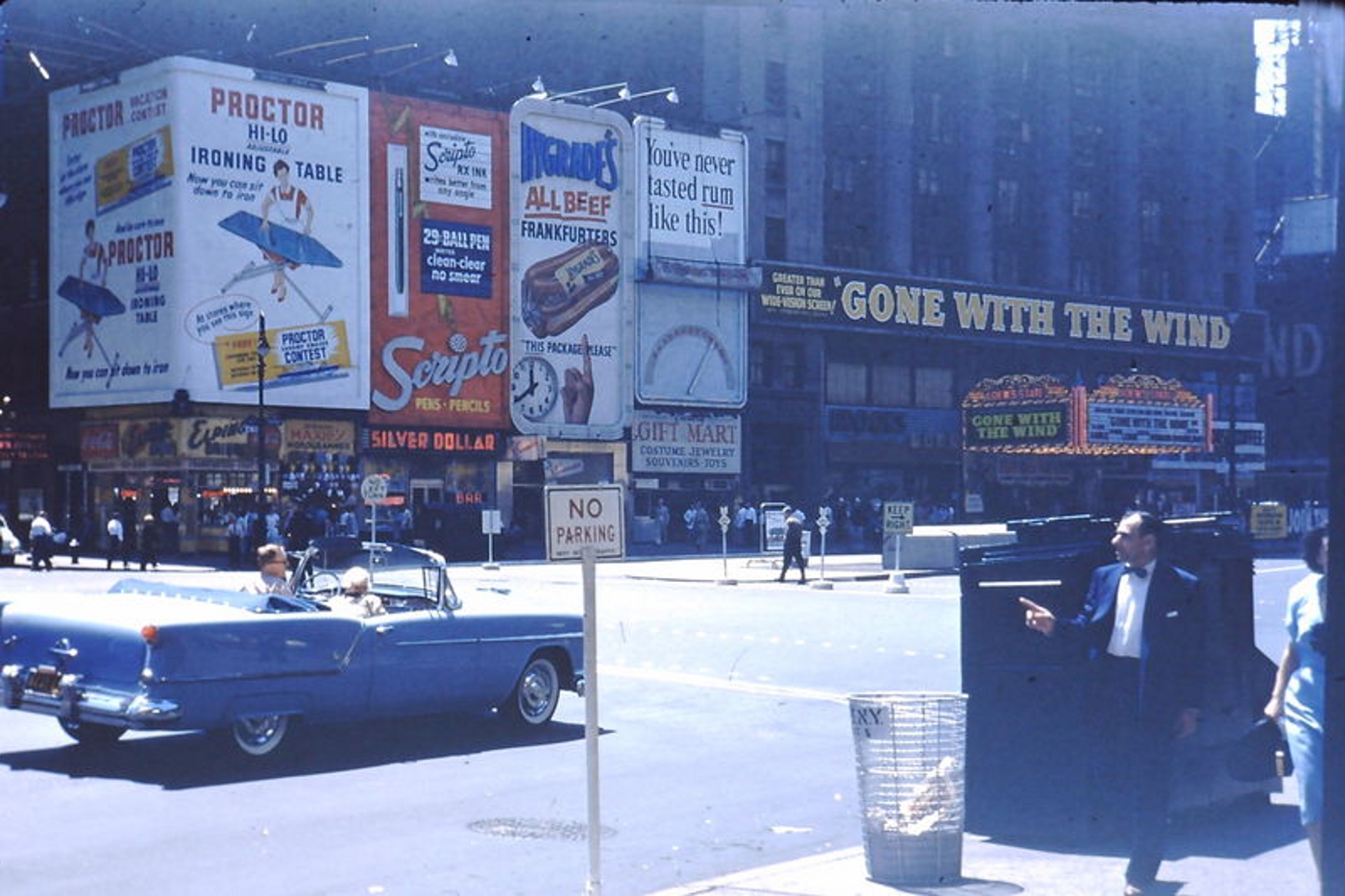
Old New York In Photos #29 – Times Square In Vintage Color Photographs

Advertisements & Scenes of Times Square In Vintage Color Photographs 1954

Times Sq 7 1954

It’s been almost 60 years since these photographs were taken by an anonymous amateur photographer who was interested in the signage, ads and the streets surrounding a vibrant, now vanished Times Square.

The city began sterilizing all the flavor from the crossroads of the world in the late 1980’s. It was a few years later that most New Yorker’s began noticing the mall-ification of Times Square. True, Times Square had denigrated into a rather sleazy place from the mid-1960’s until the “revitalization” took place. But what has it become?

For anyone who lived through Times Square’s final heyday in the 1950’s, today the place must seem extremely distasteful with its countless tourist barkers, ill-planned pedestrian plazas and glass monolith buildings sheathed in gaudy LED light ads. It’s overcrowded with people moving slowly, chain stores, costumed kitsch characters and modern day hucksters hawking their products to tourists for a “real New York experience.” Give me the days of three card monte games and prostitutes over eight people wandering around in Mickey Mouse costumes any day.

As Nik Cohn said in 1997, ‘Times Square has always changed every 20 years. But this time it’s changed to a corporate, generic American city that doesn’t particularly express the uniqueness of New York.”

Times Sq  looking southeast 1954But let’s go back in time to 1954 when it was a better time for Times Square. Legitimate theatre was still great, movies offered up Cinemascope entertainment and real Broadway characters (not criminals and freaks) roamed the streets.

Enjoy these Kodachrome views of what you would have seen looking around Times Square on a sunny, warm July day in 1954.

Minimal commentary has been added for identification purposes. Click any photo to enlarge.

Times Sq 6 1954Times Square looking south from 46th Street. Shown are: Times Tower Building, Bishop’s Crook Light, Hotel Astor with The Astor Roof Garden, Victoria Theater showing About Mrs. Leslie starring Shirley Booth and Robert Ryan, on the extreme left a portion of the statue for the giant block long Bond Clothes advertisement.

Times Sq 1954 1Looking west from Broadway and Seventh Avenue along 45th Street. Shown are: the Astor Theater with a large billboard for Indiscretion of an American Wife starring Jennifer Jones and Montgomery Clift, and Rodgers and Hammerstein’s musicals Me and Juliet  and The King and I, and the 26 story Hotel Piccadilly at 227 West 45th Street. Continue reading

As President, Theodore Roosevelt Carried A Handgun

The 26th President Didn’t Take Chances In Public

Theodore Roosevelt Campaigning in CarTheodore Roosevelt said, “Speak softly and  carry a big stick.”

Roosevelt however didn’t carry a stick, but a .45 caliber Colt revolver.

After William McKinley’s assassination in 1901, Roosevelt didn’t want to be at the mercy of some random shooter without the opportunity for self defense.

In Theodore Rex by Edmund Morris, Random House, 2001, Morris describes how Roosevelt shocked the president of Harvard, Dr. Charles William Eliot when Roosevelt was being awarded an honorary degree.

“Dr. Eliot escorted him (Roosevelt) to a guest suite to change, and watched with fascination as he tore off his coat and vest and slammed a large pistol on the dresser. Eliot asked if it was his habit to carry firearms. ‘Yes, when I am going into public places.'”

Morris also tells about Roosevelt vacationing at his home in Oyster Bay, NY during the summer of 1902:

“The sight of a gun butt protruding from the presidential trouser-seat caused some consternation in Christ Episcopal Church.”

Can you imagine President Obama carrying a handgun?